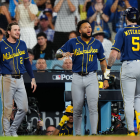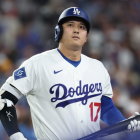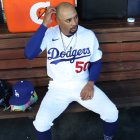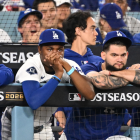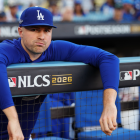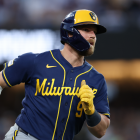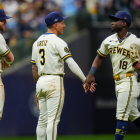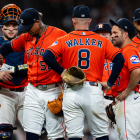


It was the end of a season and maybe the end of a dynasty. The Los Angeles Dodgers were unceremoniously swept in four games in the NLCS by the Milwaukee Brewers. The Brewers erased an early 4-0 deficit to win Game 4 on Thursday (MIL 6, LAD 4). It is Milwaukee's second-ever pennant and first since 1982. The Dodgers, for the first time since 2023, are going home ringless.
"Extremely proud," Dodgers manager Dave Roberts said when asked how he felt about his team's recent run. "It never feels good to lose and not accomplish a goal to win the World Series. It started back in the early part of February. I love this team and what we had to go through. It's one of those things that every night we take the field, people are bringing their best to beat us."
Even with the NLCS loss, the Dodgers are undoubtedly the team of the 2020s thanks to their three World Series titles (2020, 2024-25), and they are the closest thing baseball has had to a "superteam" since the late 1990s/early 2000s New York Yankees. There was an air of invincibility surrounding the Dodgers right up until the Brewers sent them home for the winter.
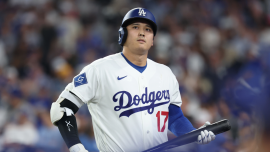
Baseball is hard. It's a grueling sport with a long regular season, and an increasingly long postseason subject to more randomness than any other sport. Building a superteam is almost impossible, which makes L.A.'s recent run all the more impressive. Yes, they spent A LOT of money, but so did many other teams, and none came close to this level of success.
Which teams have the best chance to emerge as baseball's next superteam? We can debate exactly what we mean by "superteam" (multiple World Series titles? perennial contention?), but it is one of those things you know it when you see it.
Here are our potential superteam tiers.
Tier 1: Powerhouses
The best of the best. The teams that, if they win the World Series next year, no one would bat an eye and consider themselves surprised. These are the teams with the best chance to be baseball's next superteam.
Los Angeles Dodgers: As poorly as they played in the NLCS, and as old as they looked in the NLCS, there's no reason to think the Dodgers won't enter 2027 as the NL West favorites and on the short list of World Series contenders. They're talented, they're smart, and they have unmatched resources (money and tradeable prospects). A salary cap or stiffer competitive balance tax penalties may rein the Dodgers in a bit, but their player development is so good that I suspect they would continue to dominate the sport anyway.
Milwaukee Brewers: They have been baseball's best team the last two seasons and almost their entire core is either signed long-term or under team control with little service time. Milwaukee's farm system is also regarded as one of the game's best, if not the best. Infielder Jesús Made is arguably the top prospect in baseball and he should make his MLB debut in 2027. Small market teams are always at a disadvantage when it comes to putting together dynastic runs because money equals margin of error. The Brewers can't plug a roster hole or paper over a mistake with money the way big spending teams can. Salary cap or no salary cap, the next collective bargaining agreement figures to include increased revenue sharing, which would level the financial playing field somewhat.
New York Yankees: The Yankees are a metronome. They haven't had a losing season since Wayne's World was in theatres, their "bad" seasons are usually pretty good, and they're in the postseason just about every year. Free agency can be a minefield, but the Yankees tend to nail their biggest signings (Gerrit Cole, Max Fried, etc.), and their player development has improved. The Yankees are here because they give themselves a bite at the apple every season. They're in the postseason every year, and any year could be the year things fall into place for a parade down the Canyon of Heroes.
Tier 2: Perennial contenders
These teams are in the postseason more often and not, and they usually find themselves near the top of the standings. They're all just a few breaks and fortunate bounces away from superteam status.
Atlanta Braves: Other than an injury-plagued 2025 season, the Braves have been to the postseason every year since 2018. They have a prime-aged core on the position player side (Ronald Acuña Jr., Drake Baldwin, Matt Olson, etc.) and the ageless Chris Sale fronting the rotation. The Braves have been held back by depth issues the last few years, however, which prevents them from moving up into Tier 1. They looked like a potential dynasty following their 2021 World Series win. That's a pretty good reminder of how hard it is to win a championship and stay championship-caliber in this game.
Boston Red Sox: The Red Sox must figure out how to break through the ceiling they've hit the last two years (losing the Wild Card Series at Yankee Stadium), but gosh, what a core. Roman Anthony, Garrett Crochet, Ceddanne Rafaela, and Payton Tolle are an enviable quartet to build around, and there's a strong supporting cast in place. The Red Sox are one or two big bats away from being a serious problem for the rest of the American League. Even without that big bat(s), they're good enough to reach the postseason and capable of going on a run.
Chicago Cubs: They have some heavy lifting ahead of them this offseason, given the state of the rotation and the fact that both corner outfielders (Ian Happ and Seiya Suzuki) are free agents. When you start your roster with Pete Crow-Armstrong, though, and have a supporting cast that includes Alex Bregman, Michael Busch and Nico Hoerner, you're about 80% of the way to World Series contention. The Cubs are stuck playing in the same division as the Brewers and that makes life challenging, but in no way does it doom them.
Cleveland Guardians: Yes, they play in a crummy division, but the Guardians win that crummy division every year and work their way into the postseason. That's more than half the battle when it comes to establishing yourself as a superteam. Cleveland will never run high payrolls, which lessens their margin of error, though the upcoming collective bargaining agreement could improve things for tiny payroll teams. Bottom line, the Guardians keep pumping out quality pitching, and when you do that, you have a chance to win a lot of ballgames.
Philadelphia Phillies: The Phillies are getting long in the tooth and they're closer to the end of their World Series window than the beginning, but that window is still open. It will remain open as long as they have Jesús Luzardo and Cristopher Sánchez leading the rotation, and Bryce Harper and Kyle Schwarber anchoring the middle of the lineup. You have to squint to see a potential superteam here, yes, though the foundation of a World Series-contending roster is in place. Improve the supporting cast and the Phillies are right there with any team.
San Diego Padres: I am curious to see how the Padres approach their first offseason under their new ownership. José Feliciano and Kwanza Jones, the new owners, insist they will spend to keep the team in contention. OK, so why shouldn't the Padres be in on Tarik Skubal on Day 1 of the offseason then? The Padres have to figure things out on the pitching side, for sure. They badly need more depth. They do have a strong blend of 20-somethings (Jackson Merrill, Ethan Salas, Fernando Tatis Jr.) and veterans (Manny Machado) to build around, though.
Tampa Bay Rays: Tampa's status as a perennial contender is a wee bit overstated (this is their first postseason appearance since 2023), but they are inarguably one of the smartest teams in baseball, and they have a capital-S Superstar in Junior Caminero. Also, they have a new ballpark coming in the next few years, one that will be located in Tampa rather than St. Petersburg. That should boost revenues and thus payroll, and improve their World Series chances.
Tier 3: You gotta show me something
This tier is reserved for teams that should have been better than they were in 2026. These teams could be on the cusp of superteam status a year from now, but right now, they're all well short for one reason or another.
New York Mets: The Brewers having the success they've had while the Mets have authored back-to-back disaster seasons begs the question: Is POBO David Stearns really all he's cracked up to be? The silver lining of their lost 2026 season is that several young players emerged as long-term building blocks, most notably Carson Benge and Nolan McLean. Those two, plus Juan Soto, who will turn only 28 later this month, are the makings of a championship-caliber core, plus owner Steve Cohen is very willing to spend. Are the Mets a potential superteam? Yes. Have they earned the benefit of the doubt? Absolutely not.
Seattle Mariners: Expectations were sky high coming into the season and then the Mariners fell flat and finished five games back in what was arguably the worst division in baseball history. More distressingly, franchise players Cal Raleigh and Julio Rodríguez took big steps back. It feels like the range of potential outcomes for the 2027 Mariners is massive. You could tell me they'll win 102 games and storm to the World Series, and I'd believe it. You could also tell me they'll stumble to 75 wins and Rodriguez's name will pop up in trade rumors, and I'd believe that too.
Toronto Blue Jays: Last year, the Blue Jays came as close to winning the World Series as you can without actually winning the World Series. If Vladimir Guerrero Jr. continues to be this moving forward, that's an enormous problem and puts a serious dent in Toronto's World Series hopes. I'm willing to give Guerrero and the Blue Jays some benefit of the doubt and assume 2026 is not their new normal, but not so much that I'll move them into Tier 2. They have won a postseason series in just one of the last 10 seasons, after all.
Tier 4: Up-and-comers
At best, these teams are a year away from being a year away from possible superteam status, but they are arrow-up organizations rapidly approaching contention. If they were a stock, I'd say buy buy buy.
Chicago White Sox: I thought the White Sox were a year away entering 2026. Instead, so many of their young players took a step forward at once, and they were able to contend for the AL Central title. Making the jump from rebuilder to contender is the easy part. The hard part is staying in contention. To do that, the White Sox must come up with more pitching, and we need to see some more commitment (i.e. raise payroll) from owner Jerry Reinsdorf, who treats the ChiSox as the smallest big market team in baseball.
St. Louis Cardinals: The transition from John Mozeliak to new POBO Chaim Bloom is complete, and now the farm system and player development apparatus is on the rise. The Cardinals have several building-block position players in place (Masyn Winn, Jordan Walker, JJ Wetherholt) with more on the way (Jesús Báez, Rainiel Rodriguez, etc.). Now the pitching must catch up to the position player side of things, and pitchers are wizards these days. Anyone could break out at any moment. The Cardinals are on the cusp of a return to sustained contention.
Washington Nationals: The new front office, led by POBO Paul Toboni, is getting rave reviews. The results are already showing up on the field, too. CJ Abrams, Cade Cavalli, and Jacob Young all made leaps this season. They turned low-cost pickups Foster Griffin and Curtis Mead into a bounty of young players at the trade deadline. The farm system is robust. The Nationals are in a brutal division, but the third wild card spot is very forgiving. All indications are that they will compete for one of them soon, and the NL East title not long after that.