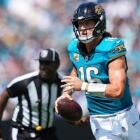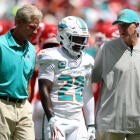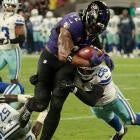

Three players (New York Jets running back Breece Hall, Dallas Cowboys wide receiver George Pickens and Atlanta Falcons tight end Kyle Pitts) were designated as franchise players this year. Indianapolis Colts quarterback Daniel Jones received a transition tag.
Pickens is the only one who didn't get a long-term deal before the July 15 4 p.m. ET deadline for franchise players to sign multi-year contracts. Since the deadline has passed, Pickens is prohibited from signing a long-term contract until the end of the regular season on Jan. 10, 2027.
Each year, NFL teams are allowed to retain the rights to one of their impending free agents with the use of a franchise or transition designation during a 15-day period beginning on the 22nd day before the start of the upcoming league year and ending at 4 p.m. ET on the eighth day prior to the start of the upcoming league year. The designation window in 2027 will be from Feb. 17 to March 3.
How franchise tenders are calculated is misunderstood. Prior to the 2011 NFL collective bargaining agreement, non-exclusive franchise tags were based on the average of the five highest salaries at a player's position in the prior year, or 120% of the player's prior-year salary, whichever was greater. For franchise tag purposes, salary means a player's salary cap number, excluding workout bonuses and most other performance bonuses.
The 120% and the five-largest-salaries provisions have remained intact, but the formula component is now calculated over a five-year period tied to a percentage of the overall salary cap. More specifically, the number for each position is derived by taking the sum of the non-exclusive franchise tags determined by the original methodology for the previous five seasons and dividing by the sum of the actual NFL salary cap amounts for those seasons. The resulting percentage, which is known as the cap percentage average in the CBA, is then multiplied by the actual salary cap for the upcoming league year.
This non-exclusive tag allows a player to negotiate with other NFL teams, but if he signs an offer sheet with another club, his team has five days to match the offer. If the offer is not matched, his team will receive two first-round picks as compensation from the signing team.
Under the exclusive franchise tag, a player will receive a one-year offer from his team that is the greater of the average of the top five salaries at his position once the restricted free agent signing period of the current league year has ended (April 23 for 2027) or 120% of his prior year's salary. The non-exclusive number is initially used as a placeholder and adjusted upwards if the exclusive calculation dictates once restricted free agency ends. A player cannot negotiate with other teams with the exclusive franchise tag.
The transition tag has been used far less frequently than the franchise tag. It is based on the average of the top ten salaries at a player's position using the same methodology as non-exclusive franchise tag calculations. The 120% provision also applies. Teams have the same right of first refusal as with franchise tags, but do not receive any draft choice compensation for declining to match an offer sheet.
Use of the franchise tag has significantly decreased over the last two years. Only five players were given the designation. Jones received the lone transition tag. From 2022 through 2024, the franchise tag was used 22 times, or about 7 per year.
Potential 2027 franchise-tag candidates are listed below. Some of the potential recipients will sign contract extensions prior to the start of the 2026 regular season, making the franchise tag a moot point.
Seattle Seahawks defensive tackle Leonard Williams wasn't included. Using the designation on Williams will be too cost-prohibitive due to the 120% of the prior year's salary provisions. Williams' tag number will be $35,563,500. Detroit Lions safety Brian Branch was excluded from consideration because of the torn right Achilles tendon he suffered late in the 2025 season.
The Minnesota Vikings are precluded from designating quarterback Kyler Murray as a franchise or transition player should he have a career resurrection. Murray's contract has a provision prohibiting a franchise or transition tag when his contract expires following the 2026 season.


Mayfield intends to end contract talks if a new deal isn't in place when Buccaneers veterans report to training camp on July 28. He recently suggested that both sides want to reach an agreement, but the key would be finding a middle ground to make both sides happy.
Mayfield is likely looking to become the 13th quarterback making at least $50 million per year. If the Buccaneers aren't comfortable getting into or close to this salary stratosphere, it will cost $46.77 million at a minimum to put a franchise tag on Mayfield in 2027, given the way the 120% of prior year's salary provisions operate for these purposes, should he play out his contract.
Mayfield's 2026 salary cap number is $39.975 million, which includes $1 million of his $5 million in 2026 incentives being classified as likely to be earned. Likely earned incentives aren't part of this calculation. The 2026 incentives from Mayfield's existing contract would carry over, where any earned in 2026 would be an additional cap charge.


Nacua can make a good case based strictly on production; he should be the NFL's highest-paid wide receiver ahead of Jaxon Smith-Njigba, who received a four-year, $168.6 million contract extension averaging $42.15 million per year with a wide receiver record $120,067,996 in overall guarantees from the Seahawks in March. The 2023 fifth-round pick led the NFL with 129 receptions for 1,715 yards and 10 touchdowns, all career highs, last season. Nacua's 107.2 receiving yards per game topped the NFL. He also carried the ball 10 times for 105 yards with a touchdown.
Nacua is off to one of the most productive starts to an NFL career for a wide receiver. He has 313 receptions for 4,191 yards and 19 receiving touchdowns in the 44 games he has played during his first three NFL seasons. Nacua's 313 receptions are the fourth most ever in this span behind Justin Jefferson (324), Michael Thomas (321) and Amon Ra-St.Brown (315). Only Jefferson (4,825) has more receiving yards through three seasons than Nacua. His 95.3 receiving yards per game are the most in NFL history.
Off-the-field issues are jeopardizing Nacua's early payday. Nacua tried to sneak live streamers into the Rams' practice facility against head coach Sean McVay's wishes late last season. During the livestream, Nacua performed a suggested touchdown dance with a gesture considered antisemitic, for which he apologized. A lawsuit was filed against Nacua in March, alleging he bit a woman while intoxicated and made antisemitic statements on New Year's Eve. Nacua spent time earlier this offseason in a holistic care facility to focus on personal growth and overall behavioral improvement.
It's conceivable that Nacua could get a new deal before the Rams open the 2026 regular season against the San Francisco 49ers on Sept. 10. The Rams will need to be comfortable Nacua has turned over a new leaf for that to happen.


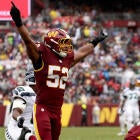
Pickens took his game to a new level in 2025. This was after his attitude and immaturity prompted the Pittsburgh Steelers to trade him and a 2027 sixth-round pick to the Cowboys for a 2026 third-round pick and a 2027 fifth-round pick. He had 93 receptions, 1,429 receiving yards and nine receiving touchdowns, all career highs, while averaging 15.4 yards per catch last season. He ranked in the NFL's top 10 in each of these categories. Pickens was named to the Pro Bowl and earned second-team All-NFL honors for the first time in his career. His efforts led to Dallas designating him a franchise player for $27.298 million.
The Cowboys were crystal clear early in the offseason that there wouldn't be negotiations with Pickens about a long-term deal. Pickens seems to have taken the decision in stride. As long as Pickens continues to have a good attitude about Dallas' decision, he should be in line for a massive payday with the Cowboys or some other team in 2027, provided he doesn't sustain a serious injury during the upcoming season. Pickens would likely be looking to join Jaxon Smith-Njigba and Ja'Marr Chase in the exclusive $40 million per year wide receiver club. Dallas putting a franchise tag on Pickens for a second straight year, with the required 20% raise at $32,757,600 wouldn't be a surprise even if it's done just to trade him.


Winning the 2025 rushing title seemed like a certainty for Taylor until his production nosedived during the latter part of the season after Jones tore his right Achilles in a Week 14 game against the Jacksonville Jaguars. Opposing teams stacked the box against Taylor without Jones in the lineup. Taylor finished third in the NFL with 1,585 rushing yards last season. He led the league with 20 total touchdowns (18 rushing and two receiving) and 323 carries.
Taylor is entering the final year of a three-year, $42 million extension he signed during the early part of the 2023 regular season after acrimonious negotiations in which he requested a trade. He is likely looking for a new deal near the top of the running back market.
Saquon Barkley is the league's highest-paid running back. He signed a two-year, $41.2 million extension averaging $20.6 million per year with the Philadelphia Eagles in 2025. Christian McCaffrey is second with the two-year, $38 million extension, averaging $19 million per year, which he received from the 49ers in 2024. Taylor's current $14 million per year deal, adjusted for the 33.99% increase in the salary cap since signing in 2023, averages just over $18.75 million per year.
It will be $18,674,400 to put a franchise tag on Taylor in 2027. That's 120% of his $15.562 million cap number for 2026.

The Colts really need to sign either Nelson or Taylor to a new deal since only one can be kept off the open market with an expiring contract. It wouldn't be surprising for Nelson, who is 30, to insist on becoming the league's highest-paid interior offensive lineman, like he was when he signed his current four-year, $80 million extension in 2022. Nelson isn't showing any signs of slowing down, and offensive guards can continue to play at an extremely high level into their mid-thirties.
This type of contract demand could be problematic for the Colts, given the developments on the offensive line in free agency. Tyler Linderbaum not only became the NFL's highest-paid center but also an interior offensive lineman when he signed a three-year, $81 million contract averaging $27 million per year with the Las Vegas Raiders in March.
Typically, an offensive guard sets the pay scale for the interior offensive linemen. Prior to Linderbaum signing, the last time a center was the NFL's highest-paid interior offensive lineman was in 2015. Mike Pouncey's five-year extension with the Miami Dolphins averaged $8.95 million per year. Logan Mankins led offensive guards at $8.5 million per year. He signed a six-year, $51 million contract with the New England Patriots in 2011. It should be noted that the Buccaneers released offensive guard Carl Nicks from the five-year, $47.5 million deal, averaging $9.5 million per year, he signed during 2012 free agency in August 2014.
The 120% of prior-year salary provisions will apply to Nelson for the 2027 franchise tag. Since Nelson's 2026 cap number is $24.02 million, it will be $29.04 million to put a franchise tag on him.


The Lions are among the NFL's most proactive teams at locking up core players before the expiration of rookie contracts. This philosophy could work to LaPorta's advantage. LaPorta had a fast start to his career. He set a single-season rookie record for a tight end with 86 receptions in 2023, which was broken by Brock Bowers the following year, and earned second-team All-Pro honors in the process. LaPorta missed the final eight games last season with a herniated disc in his back, which required surgery. The most recent relevant data point in the tight end market is the three-year, $53 million contract, averaging $17,666,667 per year, with $36 million fully guaranteed. Pitts signed with the Falcons in June as a franchise player.


Olave has stated that he would like to have a new deal done before he reports to training camp on July 28. The Saints historically haven't operated on that timeframe. Extensions with the Saints sometimes come closer to the start of the regular season.
Olave, who is scheduled to make $15.493 million in 2026 on his fifth-year option, had a career year in 2025. He caught 100 passes for 1,163 yards with nine touchdowns, which were all season bests, and was named a second-team All-Pro. Olave compared favorably statistically with fellow 2022 first-round picks Drake London and Garrett Wilson over his first four NFL seasons.
The Jets signed Wilson to a four-year, $130 million extension averaging $32.5 million per year with $90 million in overall guarantees last July. London signed a four-year, $141 million extension (worth a maximum of $150 million) with the Falcons in July. At $35.25 million per year, London is the NFL's third-highest-paid wide receiver. The deal has $99.871 million in guarantees, where $52.871 million was fully guaranteed at signing.

Vea, who is scheduled to make $18 million in 2026, attended but didn't participate in the Buccaneers' mandatory June minicamp because he is unhappy with his contract. He surely took note of Dexter Lawrence getting a one-year, $28 million extension when he was traded to the Cincinnati Bengals from the New York Giants in April, and the three-year, $78 million extension averaging $26 million per year Jordan Davis signed with the Eagles in March. Lawrence and Davis are the league's two highest-paid nose tackles.
These deals were before Jeffery Simmons dramatically raised the salary bar for interior defensive linemen during the latter part of June. Simmons received a three-year, $105.828 million extension averaging $35.276 million per year with $100 million in guarantees, of which $60.2 million was fully guaranteed at signing from the Tennessee Titans.


Kraft was on pace for nearly 70 catches and close to 1,100 receiving yards when he tore the ACL in his right knee in the eighth game of the 2025 season. His 15.3 yards per reception was eighth in the NFL last season. Kraft excels in picking up yards after catching the football. His 10.8 yards after catch were easily the most for a tight end in 2025. Pitts' $17,666,667 million per year should be Kraft's salary floor.


Tuipulotu had a breakout 2025 season with 13 sacks, which were the sixth most in the NFL. Given that pass rushers who can consistently get to the quarterback are paid a premium, the Chargers shouldn't expect Tuipulotu to sign for less than $35 million per year. With Tuipulotu having another double-digit sack season while playing out his rookie contract, a long-term deal in 2027 could cost the Chargers in excess of $40 million per year.


There could be some frustration on Porter's part because his fellow members of the Steelers 2023 draft class, edge rusher Nick Herbig and tight end Darnell Washington, have already gotten new deals this offseason. Porter probably believes he should be among the league's highest-paid cornerbacks, while the Steelers may not feel that type of money is warranted right now.
Dating back to Week 8 of the 2023 season, Porter hasn't given up a touchdown in 1,467 snaps, according to the NFL's Next Gen Stats. Opposing quarterbacks only completed 48.3% of passes (29 of 60 attempts) for a 56.2 passer rating when targeting Porter in 2025, per Pro Football Focus. Porter doesn't have any accolades in his three NFL seasons, as he hasn't been named an All-Pro
or to the Pro Bowl.
There are three cornerbacks (Sauce Gardner, Trent McDuffie and Derek Stingley Jr.) with contracts averaging $30 million per year or more. McDuffie leads the way with the four-year, $124 million extension averaging $31 million per year, which he signed in connection with his March trade from the Kansas City Chiefs to the Rams. He could drop to third in the cornerback salary hierarchy if Christian Gonzalez and Devon Witherspoon receive respective new deals from the Patriots and Seahawks in the coming weeks.