The 2026 league year, which began on March 11, has been great financially for most major offensive positions. Patrick Mahomes became the first quarterback to break the $60 million-per-year barrier. Jaxon Smith-Njigba topped Ja'Marr Chase as the NFL's highest-paid wide receiver. Saquon Barkley dropped to fourth on the running back pay scale, with Jahmyr Gibbs, who now leads the way, Bijan Robinson and Jonathan Taylor joining him in the $20 million-per-year club last week.
Offensive tackle Laremy Tunsil's contract extension made him the first and only $30 million-per-year offensive lineman. Peter Skoronski just established a new benchmark for offensive guards at $25 million per year. It may be short-lived if the Indianapolis Colts sign Quenton Nelson, who is in a contract year, to a new deal.
The most shocking development has been Tyler Linderbaum resetting the center market by a whopping 50% when he signed a three-year, $81 million contract averaging $27 million per year with the Las Vegas Raiders in free agency.
Tight ends are the exception to this offensive salary boom. A career-high 88 receptions, nearly 1,000 receiving yards and a second-team All-Pro selection in 2025, leading to a franchise tag, weren't enough for Kyle Pitts to move the needle for tight ends. His three-year, $53 million deal with the Atlanta Falcons in June made him the NFL's third-highest-paid tight end at $17,666,667 per year. Pitts did establish a new tight end record with $36 million fully guaranteed at signing.
Why the tight end market has fallen behind
A stagnant tight end market isn't anything new. Jimmy Graham became the league's first $10 million-per-year tight end in 2014 when he signed a four-year, $40 million contract with the New Orleans Saints as a franchise player. The mark wasn't eclipsed until 2020, when Austin Hooper got a four-year, $42 million deal averaging $10.5 million per year from the Cleveland Browns as an unrestricted free agent.
The massive reset came later in 2020 during training camp. George Kittle signed a five-year, $75 million contract extension averaging $15 million per year with the San Francisco 49ers. Travis Kelce quickly followed suit with a team-friendly four-year, $57.25 million extension averaging $14,312,500 per year from the Kansas City Chiefs.
Six years later, the tight end market has yet to hit the $20 million-per-year mark. Kittle is currently the highest-paid tight end with the backloaded four-year, $76.4 million extension averaging $19.1 million per year that he signed with the 49ers in April 2025. There's $22.4 million in Kittle's 2029 contract year, when he will be 36. The first three new years of Kittle's extension average $18 million per year.
Kittle's deal came about a month after Trey McBride signed a four-year, $76 million extension averaging $19 million per year with the Arizona Cardinals. The first three new years of McBride's extension average $19,333,333 per year. McBride's $43 million in overall guarantees are the most ever for a tight end.
There's a big drop-off in tight end salaries after Kittle, McBride and Pitts. Isaiah Likely is next at $13,333,333 per year. The three-year, $40 million deal Likely signed with the New York Giants is worth a maximum of $47.2 million through incentives.
It wasn't too long ago that nearly three times as many tight ends as today were making $13.5 million per year or more. Eight tight ends on multiyear contracts were above that mark in 2023.
A subset of the overall tight end market has reached new heights in 2026. Charlie Kolar became the first blocking tight end to eclipse the $8 million-per-year mark when he signed a three-year, $24.3 million deal with the Los Angeles Chargers during free agency in March.
Darnell Washington took blocking tight end salaries to an unprecedented level in June. He received a four-year, $42 million extension from the Pittsburgh Steelers, making him the first blocking tight end to reach the $10 million-per-year mark.
The gap between the highest-paid tight end and the top-paid blocking tight end has narrowed to 81.9%. It was 150% when Kittle signed his $15 million-per-year extension. Nick Boyle was at the top of the blocking tight end pay scale at $6 million per year.
The blocking tight end market has jumped 35.48% in 2026 alone, going from Josh Oliver's $7.75 million per year to Washington's $10.5 million average yearly salary. That's more than the tight end market has moved over the last six years. Kittle's two market-setting deals represent a 27.33% increase. Since 2020, the salary bar for blocking tight ends has been raised by 75%.
This 27.33% increase is well below the growth in the salary cap. The 2020 salary cap was $198.2 million. The current $301.2 million salary cap is 51.97% higher than the 2020 figure.
Who could finally reset the tight end market


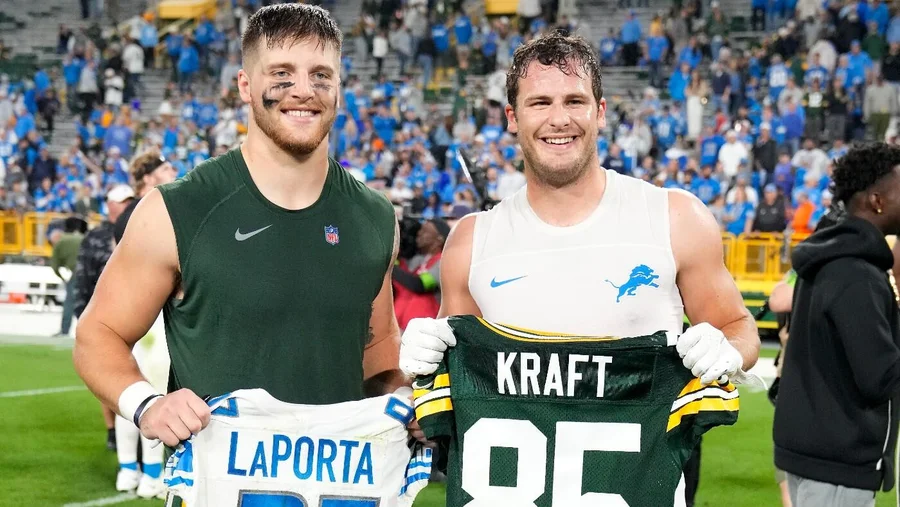
There's still a chance the tight end market won't be left out of 2026's offensive salary boom. Green Bay Packers general manager Brian Gutekunst revealed there have been discussions with Jack Bechta, Tucker Kraft's agent, since training camp opened at the end of July.
Kraft was on pace for more than 70 catches and 1,100 receiving yards before he tore the ACL in his right knee eight games into the 2025 season. Through seven team games, Kraft led NFL tight ends in receiving yards (469) and was tied for the most touchdown receptions (six). He finished 2025 with 32 catches for 489 yards and six touchdowns. Kraft's 15.3 yards per reception ranked eighth in the NFL last season. Kraft excels at picking up yards after the catch. His 10.8 yards after catch per reception were easily the most for a tight end in 2025.
Unlike most pass-catching tight ends, Kraft is a good blocker. Green Bay's run game averaged 0.18 more yards per carry with Kraft on the field last season.
Kraft appears to be on track to play in the regular-season opener. The Packers activated him from the physically unable to perform list a few days into training camp.
The Packers are likely viewing a deal in the same vicinity as Pitts' $17,666,667 per year as appropriate for Kraft, who is in a contract year. Bechta probably has his sights set much higher. It wouldn't be surprising for Bechta to use Kittle's 2020 deal adjusted for salary cap inflation, which is a little more than $22.75 million per year, as a guide since he also represents Kittle.
The Packers will likely have to give Kraft a player-friendly cash flow regardless of his average per year. That's because the only guaranteed money in Green Bay veteran contracts is a signing bonus and/or a roster bonus payable within a few days of signing.
The bigger deals contain an unsecured roster bonus due on the third or fifth day of the league year in the second and third years. The roster bonuses are supposed to be substitutes for additional contract guarantees. The overall guarantees in Green Bay contracts are less than those in comparable deals with other teams. The only exceptions have been made with quarterbacks Jordan Love and Aaron Rodgers, as well as edge rusher Micah Parsons.


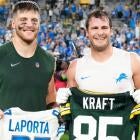
Gibbs' record-setting running back contract at $22.5 million per year has prompted speculation that the Detroit Lions will turn their negotiating attention to Sam LaPorta, who is in a contract year just like Kraft. He is also represented by Bechta.
LaPorta had a fast start to his career. He set a single-season rookie record for a tight end with 86 receptions in 2023, which Brock Bowers broke the following year, and earned second-team All-Pro honors in the process. LaPorta missed the final eight games last season with a herniated disc in his back, which required surgery. He was averaging a career-best 54.3 receiving yards per game when he suffered the injury.
The Lions aren't opposed to doing deals during the regular season. For example, edge rusher Aidan Hutchinson's $45 million-per-year extension, which made him the NFL's second-highest-paid non-quarterback, wasn't done until the end of October after he demonstrated that the season-ending broken fibula and tibia in his left leg suffered in 2024 hadn't affected him. LaPorta reportedly has been terrific in training camp.
A similar wait-and-see approach with LaPorta's back injury would surely prompt Bechta to insist on Kraft's average per year being LaPorta's salary floor. Gibbs came in $250,000 per year ahead of Robinson, who signed a couple of days before him.
Detroit balking at Bechta's demands could open the door to LaPorta becoming an unrestricted free agent in March. The last time the Lions used a franchise tag was in 2018 on edge rusher Ziggy Ansah.
It should also be noted that the Lions opted against making a substantial tight end investment in T.J. Hockenson. They dealt him within the NFC North to the Minnesota Vikings at the 2022 trade deadline instead. Bechta would be licking his chops for a tight end of LaPorta's caliber to hit the open market in his prime as a 26-year-old.


The next major reset of the tight end market is likely to come in 2027. Brock Bowers will be eligible to sign a contract extension as soon as the 2026 regular season ends on Jan. 10. He is the Raiders' primary receiving threat. The 112 passes Bowers caught in 2024 are a single-season rookie record.
It wouldn't be surprising for Bowers' camp to use Linderbaum's 50% center market increase to try to justify a deal averaging more than $30 million per year. How high Bowers can eventually take the tight end market remains to be seen.