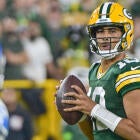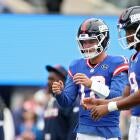


Sam Darnold was five snaps into the 2026 NFL season — and the Seahawks were five snaps into their Super Bowl title defense — before everything took an unexpected turn. A sack ended Seattle's opening possession. Darnold walked gingerly to the sidelines before later limping to the locker room with a hip injury, and suddenly Drew Lock found himself as QB1.
Seattle won anyway (with some help); Lock finished 16 of 22 for 187 yards and a touchdown, the defense picked off Drake Maye three times in the fourth quarter and the defending champs rallied from a 10-point deficit. The early news on Darnold has been encouraging – tests ruled out a fracture and the injury is believed to be muscular — but he is expected to miss at least the Week 2 matchup against Arizona.
Which brings us to a question that comes up almost every NFL season: What actually happens when a championship-caliber team loses its starting quarterback?
The easy answer: The team gets worse. The more interesting question is whether the rest of the roster can absorb that drop-off without letting one injury change the entire season. History says good teams can survive losing QB1 — especially when the absence is short and the backup fits the offense.
Good teams get worse without QB1, BUT … the season usually isn't over
So, yes, no surprise here: Good teams get worse when they lose their starting quarterback. The surprise is how often they still survive it.
Looking at data from 2015-2025, 41 teams were above .500 at the time they had to turn to a backup quarterback. Those backups went just 55-82, a .401 winning percentage, which tells you exactly what you'd expect: Losing your starter usually makes even a good football team significantly worse.
Here's the caveat: 24 of those 41 teams — nearly 60% — still made the playoffs. Twelve won at least one postseason game, and four eventually won the Super Bowl.
And the better the team, the better its chances of surviving. Among more established contenders — teams that had played at least four games and were winning at a .600 clip or better —nearly two-thirds still made the playoffs despite their replacement quarterbacks going just 36-47.
That's the important part. The backup usually isn't making the team better. Everyone else on the roster makes it possible for the backup to keep the season from falling apart.
You can see it in the scoring numbers. Those contender-level teams averaged roughly 25 points per game before losing their starter while allowing a little more than 20. With the backup, scoring fell to about 19 points while the defense allowed about 22 — an eight-point swing from plus-5 to minus-3. For context, the median NFL game over the last two seasons was decided by seven points.
So the roster doesn't suddenly become bad because QB1 got hurt. But the offense loses roughly a touchdown's worth of margin for error, which means games that once might have been comfortable suddenly have to be survived.
That's essentially what happened Wednesday night. Seattle scored just 13 points with Lock under center, but its defense held New England to 10. Yes, thanks in no small part to the Drake Maye 4th Quarter Turnover Extravaganza – but that's the point. Lock didn't need to replace Darnold's productivity. He just needed to do his part, take care of the football, avoid the backbreaking mistakes and allow the rest of the roster to conduct business as usual.
How long is Darnold out? That's the bigger question
If there is one number that matters most for the Seahawks, it's how many games they'll actually need Lock to start. Among teams that were above .500 when the backup quarterback took over, the difference between a short absence and a long one was stark.
How good teams fared without QB1, 2015-2025
Length of QB1 absence | Backup's record | Made playoffs |
1-3 starts | 24-25 | 67.9% |
4+ starts | 31-57 | 38.5% |
7+ starts | 19-37 | 16.7% |
That first row in the table above is where Seattle should find comfort. The backups were barely .500, yet nearly 68% of those teams still made the playoffs. And that's really the whole idea. The guys who started the season on the sidelines holding the clipboard and wearing the baseball cap didn't need to become stars. They needed to keep a good team from turning one bad Sunday into a month-long problem.
Once the absence stretched beyond three starts, though, the math changed … quickly. Fewer than 40% of the teams requiring four or more replacement starts made the postseason, and 17% of teams that needed a backup for seven or more starts got there.
So if Darnold misses the Arizona matchup in Week 2, and maybe even the Commanders a week later, history offers hope. If we're still talking about Lock starting a month from now, that's a very different story. In part because that's what history tells us; in part because here is Seattle's schedule starting in Week 4: Chargers, 49ers, at Broncos, Chiefs and Bears.
Getting to January is one thing; winning there with QB2 is another
There's another distinction that matters when we talk about teams "surviving" a quarterback injury. Making the playoffs with a backup holding things together isn't the same thing as asking that backup to win playoff games.
In our previous data, of the 24 teams that were above .500, lost their starter and still reached the postseason, 14 had their QB1 back to start every playoff game. Nine had to continue with a backup quarterback throughout the postseason. (The 2020 Rams split the difference: John Wolford started their wild-card win before Jared Goff returned for the divisional round.)
Backup quarterbacks in those situations went 5-8 in playoff starts. Three of those five wins belonged to Nick Foles.
That tells you just about everything. History says a good roster can often survive the injury. History is much less encouraging when the backup has to become "That Guy" for the duration.
Foles remains the obvious exception. The 2017 Eagles were 11-2 when Carson Wentz tore his ACL. Foles went 2-1 to finish the regular season and then went 3-0 in the playoffs, including one of the greatest Super Bowl performances by a backup.
The 2016 Raiders, meanwhile, are the other extreme. Oakland was 12-3 when Derek Carr broke his leg; Matt McGloin lost the regular-season finale and then got hurt himself. That left rookie Connor Cook making his first career NFL start in the wild-card round where he went 18 of 45 with a touchdown and three picks. The Raiders lost to the Texans, 27-14.
Oakland still had a 12-win roster, but Carr went down in Week 16 — about the worst possible time to lose your starter. And if you don't have a legitimate backup plan, this is what can happen: The margin for error evaporates, no matter how good the rest of the team is.
What can happen when a contender loses QB1, 2015-2025
Team | QB1 | Backup situation | Backup result | Season result |
2019 Saints | Drew Brees | 5-0 | 13-3, playoffs | |
2022 Cowboys | 4-1 | 12-5, won playoff game | ||
2025 49ers | 5-3 (2 stints) | 12-5, won playoff game | ||
2023 Jets | Wilson/Siemian/Boyle | 6-10 | 7-10, missed playoffs | |
2023 Vikings | Hall/Dobbs/Mullens | 3-6 | 7-10, missed playoffs | |
2016 Raiders | Derek Carr | McGloin/Cook | 0-1 regular season; Cook lost WC game | 12-4, first-round exit |
Sometimes the backup just has to keep the car on the road
The best examples aren't always the backups who played like stars. They're the guys who understood the assignment and landed in a situation that didn't ask them to be something they weren't.
New Orleans was only 1-1 when Drew Brees injured his thumb in 2019, which is why a team's early-season record can be misleading. The Saints were obviously very good. Teddy Bridgewater stepped into a Sean Payton offense loaded with answers, completed nearly 70% of his passes in his five starts, threw nine touchdowns and just two interceptions. He went 5-0.
Payton wasn't asking him to be Brees, either. He talked at the time about highlighting what Bridgewater did particularly well and building a plan around it. That's pretty much the definition of making the backup fit the offense — and the offense fit the backup.
Brees returned. New Orleans finished 13-3. Mission accomplished.
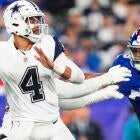
Cooper Rush did something similar in Dallas three years later. Dak Prescott was injured in the opener, and Rush stepped into a Cowboys team that was much better than the 0-1 record suggested. He went 4-1 in Prescott's absence. Dallas eventually finished 12-5, and Dak was back when the games mattered most.
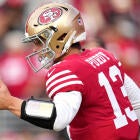
Then there's Mac Jones last season. Brock Purdy went down after San Francisco's 2025 season opener; Jones won both games during the first absence and eventually went 5-3 across Purdy's two injury stretches. The 49ers finished 12-5 and won a playoff game after Purdy returned.
The interesting part wasn't that Jones suddenly became a different quarterback. It was that San Francisco put him in an environment that fit the player he already was.
I wrote after his first 49ers start last season that Jones looked much more like the Alabama quarterback who became a first-round pick than the frenetic version we saw late in his New England tenure. Kyle Shanahan gave him answers and leaned into his ability to process and distribute the football.
I say it all the time when evaluating quarterbacks for the NFL Draft, and it applies here too: Fit matters.
It mattered for Bridgewater in New Orleans. It famously mattered for Foles in Philadelphia. And it has already mattered for Darnold, whose career was headed in the exact wrong direction after his time in New York and Carolina, and before a year in San Francisco led him to Kevin O'Connell in Minnesota. He went 14-3 in 2024 and turned that season into his opportunity – and a Lombardi Trophy – with Seattle.
Of course, sometimes it doesn't work
The 2023 Jets are the giant blinking warning sign.
New York entered that season believing Aaron Rodgers was the final piece for a roster with one of the league's best defenses. The Jets preseason win total was 9.5, and their playoff odds were -150. We're not talking about last year's Jets outfit — the expectations were high.
Rodgers lasted four snaps before tearing his Achilles, and although New York somehow won that opener, former first-rounder Zach Wilson and the subsequent replacements (Trevor Siemian! Tim Boyle!) went 6-10 the rest of the way. A team built with legitimate postseason expectations finished 7-10.
That's what happens when temporary becomes permanent.
Minnesota learned the same lesson later that season. The Vikings were 4-4 when Kirk Cousins tore his Achilles, then cycled through Jaren Hall, Josh Dobbs and Nick Mullens while going 3-6 the rest of the way. And while Kevin O'Connell basically managed to hold the QB room together with chicken wire and duct tape, it was a two-game fix, not a two-month solution. Minnesota didn't become a bad roster overnight, but the instability at the most important position eventually overwhelmed everything else.
The flip side is what happens to bad teams. Since 2015, 43 teams were .400 or worse when they lost QB1. Their backups went 51-116-1, and only two of those teams still made the playoffs.
A good team usually asks a backup to preserve something. A struggling team often needs the backup to actually change its trajectory, and that's a much harder job.
Which brings us back to Drew Lock — and fit
Lock has already had his chance to prove he could be a long-term NFL starter. The results weren't good enough.
He is 10-18 in 28 career starts, going 4-1 as a rookie in Denver, then 4-9 in 2020. Since then, he's mostly been a backup, with two starts for Seattle in 2023 and five for a bad Giants team in 2024.
But Seattle isn't asking Drew Lock to be the new face of the franchise for the next five years. They aren't even asking him to prove he can carry the team for the next five months. They're asking him to keep the car on the road for a team that just won the Super Bowl — and we all witnessed Wednesday night that the rest of the roster can do the heavy lifting.
Seattle has that lights-out defense. It has a solid offensive line. And it has Jaxon Smith-Njigba and rookie running back Jadarian Price.
Lock has already shown he can win in this town, even if some of the faces have changed. In 2023, playing for Pete Carroll and with Shane Waldron as his offensive coordinator, he went 1-1 in two starts in place of an injured Geno Smith, and he led a 92-yard game-winning drive against the Eagles.
Then Wednesday night happened. Darnold went down, Lock came in cold, Seattle fell behind 10-0, yet he still finished 16 of 22 for 187 yards, no turnovers and a 113.3 passer rating. He highlighted his outing with a 45-yard touchdown toss to JSN that changed the game.
None of that suddenly makes Lock a franchise quarterback. And it doesn't need to.
History – and common sense – says great teams will get worse when QB1 goes down. But a roster like Seattle's can survive a short absence if the backup avoids mistakes and keeps the offense on schedule. Lock doesn't need to play like Darnold. He needs to be Seattle's version of Teddy Bridgewater, or even Mac Jones – do your job, lean on your playmakers and let the defense do the rest.
If Lock is still starting six or eight weeks from now, history gets a lot bleaker. But for a few Sundays, with this roster around him? Fit matters.