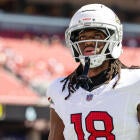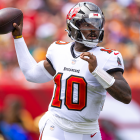


When the Cardinals drafted Marvin Harrison Jr. fourth overall in 2024, he was all but anointed a future Hall of Famer. And after what he did at Ohio State, it didn't take much imagination to envision what his NFL career might look like. Thirty-three games later, we're having a very different conversation: Would Harrison be better off playing somewhere other than Arizona?
Maybe.
But trading for Harrison requires believing two things: that the Cardinals haven't gotten the most out of him, and that another team can do better. The first argument is getting easier to make. The second is where things get complicated, especially when you look at what's happened to other highly drafted receivers who fell short of expectations early in their careers.
With the NFL trade deadline approaching, that's worth examining.
The No. 4 pick comes with expectations
In my recent story on Carnell Tate, the fourth pick in the 2026 NFL Draft, we looked at what teams should expect from receivers drafted in the top 10. The average rookie season over the last decade was 901 receiving yards. Harrison finished with 885 in 2024, a respectable start, even if it fell short of expectations.
But things haven't gotten better. Harrison managed 608 yards in 12 games last season, and through four games in 2026, he has five catches for 85 yards. For perspective, Seahawks rookie running back Jadarian Price, who played three games before landing on IR, has four receptions. This is the same Price who was targeted just 14 times over his final two seasons at Notre Dame. Harrison was targeted at least 13 times in four different games during his final season at Ohio State.
So yeah.
Through 33 NFL games, Harrison has 1,578 receiving yards. Amari Cooper, also drafted fourth overall, had 2,285 yards at the same point. Corey Davis, the fifth pick in 2017, had 1,503. Harrison's production looks much closer to Davis's than Cooper's.
Harrison vs. first-round receivers early in their careers
Statistic | Harrison | 1st-round WR avg. | Rank (53 WRs) |
Receiving yards/game | 47.8 | 53.0 | 33rd |
Receptions/game | 3.27 | 3.73 | 35th |
Receiving TD/game | 0.39 | 0.30 | 17th |
Catch rate | 53.5% | 59.3% | 46th |
Yards/target | 7.81 | 8.22 | 31st |
Yards after catch/reception | 2.5 | 4.5 | T-51st |
Explosive catches/target | 20.8% | 18.4% | 9th |
There are encouraging numbers here. Harrison's 13 touchdowns are more than Cooper (12) or CeeDee Lamb (11) had through their first 33 games. He's also ninth in explosive receptions per target. But he's near the bottom in catch rate and yards after the catch. The big plays are there; the consistent production isn't.
Harrison is playing more, but producing less
Perhaps the biggest concern isn't simply that Harrison has struggled. It's that he's becoming less involved in Arizona's offense, even while playing more.
Among 41 first-round receivers in their first four appearances of Year 3, Harrison ranks 39th in receiving yards and is tied for the fewest receptions.
Harrison's disappearing opportunities
Statistic | First 29 games | 2026 (4 games) | Typical Year 3 1st-round WR |
Receiving yards/game | 51.5 | 21.3 | 64.8 |
Targets/game | 6.5 | 3.3 | 7.5 |
Catch rate | 54.5% | 38.5% | 60.9% |
Routes/game | 31.8 | 35.5 | 32.3 |
Targets per route | 20.5% | 9.2% | 22.7% |
That last row tells the story. Harrison was targeted on roughly one of every five routes through his first 29 games. This season, it's fewer than one in 10. And that raises a fair question: Is Harrison struggling because he isn't getting opportunities, or is he not getting opportunities because he's struggling?
There's evidence for both. Harrison ran 17 go routes in the first two games, tied for sixth most in the league, and Jacoby Brissett took some responsibility after Harrison went without a catch. But we can't blame everything on the quarterback or scheme when Trey McBride and Michael Wilson have combined for 58 receptions through four games. Harrison has five.
Getting better isn't the same as becoming a star
Despite the social-media noise, I'd be careful about giving up on Harrison. Plenty of first-round receivers have needed time to develop, but there's a difference between becoming productive and becoming the player a team thought it was drafting.
Corey Davis, Mike Williams and DeVante Parker all improved after modest beginnings. Each had at least one season that justified some of that early optimism. The problem? None consistently produced like the elite receiver his draft position suggested. And Davis was drafted the highest of the three, at No. 5 overall, one spot after Harrison.
Then there's Lamb, who went from a good young player to one of the NFL's best. But he was already averaging more than 62 yards per game through 33 appearances, considerably better than Harrison's 47.8.
How other first-round WRs developed
WR (draft pick) | First 33 games YPG | Games 34+ YPG | Notable later season |
Marvin Harrison Jr. (4th) | 47.8 | TBD | TBD |
Corey Davis (5th) | 45.5 | 55.9 | 984 yards (2020) |
DeVante Parker (14th) | 44.7 | 48.7 | 1,202 (2019) |
Mike Williams (7th) | 35.7 | 51.4 | 1,146 (2021) |
Marquise Brown (25th) | 48.1 | 43.6 | 1,008 (2021) |
CeeDee Lamb (17th) | 62.6 | 90.4 | 1,749 (2023) |
Amari Cooper (4th) | 69.2 | 66.0 | 1,250 (2023) |
Williams and Parker eventually had 1,000-yard seasons, and Davis nearly got there with 984 in 2020. Harrison is young enough to make a similar leap. But Cooper and Lamb were already much more productive at this stage. That's an important distinction.
What a trade can (and can't) fix
So what happens when a first-round receiver gets a fresh start somewhere else?
Amari Cooper is the obvious success story. In 2018, Oakland traded him to Dallas, where his production jumped from 46.7 to 80.6 yards per game. He followed that with consecutive 1,000-yard seasons. Brandin Cooks also flourished after New England acquired him from New Orleans in 2017, producing 1,082 yards before adding 1,204 with the Rams the following year.
But here's the difference: Both Cooper and Cooks had already posted two 1,000-yard seasons before being traded. Their new teams weren't betting on production they'd never seen. They were building on what those receivers had already done.
The other historical comparisons aren't nearly as encouraging.
I looked at first-round receivers traded in Year 3 or Year 4, the same stage of Harrison's career. Some joined better offenses or played with better quarterbacks. Most never became the players their new teams hoped they would.
First-round WR trades in Years 3-4: Price and production
Receiver | Traded from → to | Trade return | Before trade | After trade |
Phillip Dorsett (2017) | Jacoby Brissett | 528 yards (2016) | 194 (2017) 290 (2018) 397 (2019) | |
Corey Coleman (2018) | 7th | 305 (2017) | Released by BUF 71 with NYG (2018) | |
Jalen Reagor (2022) | 7th + conditional 4th/5th | 299 (2021) | 104 (2022) 138 (2023) 100 (2024) | |
Jahan Dotson (2024) | Commanders → Eagles | 3rd + two 7ths; 5th sent with Dotson | 518 (2023) | 216 (2024) 262 (2025) |
Brandin Cooks (2017) | Saints → Patriots | 1st + 3rd; 4th sent with Cooks | 1,173 (2016) | 1,082 (2017) 1,204 (2018) 583 (2019) |
Sammy Watkins (2017) | Bills → Rams | E.J. Gaines + 2nd; 6th sent with Watkins | 430 in 8 games (2016) | 593 (2017) 519 (2018) 673 (2019) |
Kelvin Benjamin (2017) | Panthers → Bills | 3rd + 7th | 475 in 8 CAR games | 217 in 6 BUF games 380 (2018) |
Amari Cooper (2018) | 1st | 280 in 6 OAK games | 725 in 9 DAL games 1,189 (2019) 1,114 (2020) | |
N'Keal Harry (2022) | Patriots → Bears | 7th | 184 (2021) | 116 (2022) no rec (2023) |
Hollywood Brown (2022) | Ravens → Cardinals | 1st; 3rd sent with Brown | 1,008 (2021) | 709 (2022) 574 (2023) 91 in 2g (2024) |
Cooper is the clearest example of a receiver taking his game to another level. Cooks maintained his production, while Sammy Watkins remained useful without ever returning to his 1,000-yard form.
But Dorsett, Coleman, Reagor, Dotson and Harry? None became the player their original teams envisioned. Injuries played a role in some cases, but changing teams didn't solve the larger problem. And that's something any team considering Harrison should remember.
The price needs to reflect the gamble
Of course, there's another reason Harrison could be appealing: his contract. An acquiring team would inherit his remaining 2026 salary and 2027 compensation, with the possibility to exercise his fifth-year option for 2028.
But what should it cost to acquire him?
The historical returns vary considerably. Dallas sent a first-rounder for Cooper. New England gave up a first and third for Cooks, getting a fourth back. Arizona surrendered a first for Hollywood Brown, with a third coming back. All three receivers had already proved themselves.
Meanwhile, Dotson cost a third and two sevenths, with a fifth going the other way. Harry and Coleman each brought back seventh-round picks.
Harrison falls somewhere in between. He won't fetch a first-rounder, and a third feels closer to his worth given his production and untapped potential. But remember, Pittsburgh got a 2028 second-round pick for Joey Porter Jr. when plenty of people thought a third was the best-case scenario.
Put another way: You never know. If one team believes it can unlock Harrison, a second-rounder might feel like a bargain. But at that price, the buyer better have a plan for how to use him.
Arizona doesn't have to trade him, either. The Cardinals could spend the rest of 2026 seeing whether Mike LaFleur can figure this out. If they do make Harrison available, though, here are three teams I think would be intriguing landing spots.
Three teams that could make sense

New England Patriots
Yes, the Pats traded for A.J. Brown, and he's the unquestioned No. 1 when he returns. But we've seen this group struggle without him. Receivers can't get open, Drake Maye has looked frazzled, and while Romeo Doubs looked better against Buffalo, he's better suited as a No. 3. Harrison could slide in as the No. 2, getting plenty of looks with defenses focused on Brown, without the same pressure he's faced in Arizona.

Kansas City Chiefs
Always bet on Andy Reid and Patrick Mahomes. That's where the conversation starts. Injuries to Rashee Rice and Tyquan Thornton (who could be done for the season) have also raised questions about depth. Thornton, a former Patriots second-round pick, is a great example of a receiver who struggled with his original team before finding success catching passes from Mahomes. Maybe Harrison could follow a similar path.
Indianapolis Colts
This makes sense for sentimental and real-world football reasons. Harrison's father spent his Hall of Fame career catching passes from Peyton Manning in Indianapolis, and his son could follow in his footsteps there.
But there's also a need. Alec Pierce's injury has created an opportunity outside, with Josh Downs and Tyler Warren already playing well. Harrison would give Daniel Jones another option without having to carry the offense. When Pierce returns, what currently looks like a weakness could become a strength if Harrison starts putting it together.
The gamble
I think Harrison can be better than he's been in Arizona. We all saw what he did at Ohio State, and we've seen flashes of that ability in the NFL. The issue has been consistency.
The tougher questions are how much better he can be, and what another team should give up to find out.
Cooper showed that a change of scenery can work. But history also shows how often a fresh start changes very little, particularly for receivers who haven't already established themselves as consistently productive.