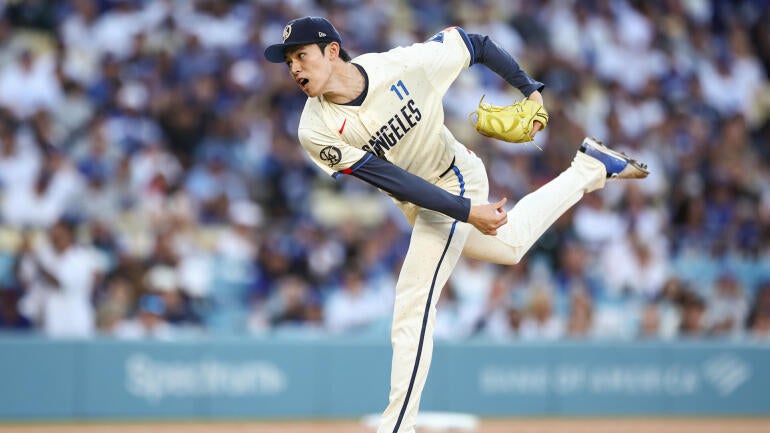
It came with a lot of fits and starts along the way, but Roki Sasaki more than looks like he belongs for the Dodgers these days. That wasn't always the case. In Spring Training and early this season, he barely looked like he belonged in the majors, and there really wasn't much to be excited about.
But there is now. Sasaki isn't a totally different pitcher than he was last season or earlier this season, but he's made some notable tweaks. His sweeper from last season is gone, replaced by a harder slider. His forkball has been separated into two separate pitches, a harder splitter he throws around 90 mph with better command, and the slower forkball he has always had that misses plenty of bats but is a bit more erratic. But the most notable thing we've seen lately is a significantly improved four-seam fastball.
A couple of starts ago, Sasaki showed up with an extra couple of inches of induced vertical break on his four-seamer to go along with an extra inch or so of arm-side movement, and when he pitched Saturday against the Phillies, he had both traits along with an extra tick of velocity. He sat at 98.5 mph Saturday, the highest single-start mark of his career, and the pitch was dominant; he generated eight swinging strikes on 25 swings, an elite mark for a four-seamer.
It's all starting to look like a real starter's arsenal. You probably can't count on the fastball being as good as that every time, but it's clearly improved this season, and the rest of the arsenal looks at least solid, too. He finished May with a 3.18 ERA and 28 strikeouts to six walks, by far the best stretch since he came over to the majors. And I'm at the point where I think Sasaki has shown enough upside to be worth rostering in pretty much all Fantasy formats – and seeing as he is still just 65% rostered, that means plenty of you have a chance to add him this week.
It might all fall apart in the long run, as the track record of success at the MLB level is extremely limited here. But Sasaki finally looks like he doesn't just belong, but might be able to thrive.
Here's who else we're looking to add ahead of Week 11:
Week 11 Waiver Targets
Catcher
Keibert Ruiz, Nationals (45%)
Ruiz isn't as good as his overall production in May, where he is hitting .386/.390/.737, but you don't need him to be that good. He's been trading off a bit of contact lately for better quality of contact, with his average exit velocity jumping from 88.4 mph to 92.1 mph from April to May. This hot streak likely won't last, but he's a viable hot hand play if you're unhappy with your catcher situation right now.
Deep league option: Francisco Alvarez, Mets (34%) – Alvarez was a disappointment even before his knee injury, but if you looked under the surface, you still saw a lot of what made him such a dynamic hitter in the second half of last season. He had cut his strikeout rate to 21.9% (from a career 25.4% mark) while putting up a .400 expected wOBA on contact, the best mark of his career. He may not be able to sustain those gains after coming back from knee surgery, but with his rehab assignment seemingly looming, Alvarez remains a high-upside catcher you can stash now, especially in any two-catcher leagues.
First Base
Curtis Mead, Nationals (34%)
Mead has been playing pretty much everyday against lefties all season, but he hasn't mattered much for Fantasy because they were rarely letting him play against righties. That seems to be changing since they demoted Brady House, as Mead has started five of the past seven games against right-handed pitchers. And Mead probably should just get the chance to play everyday, because he is handling righties perfectly well right now, sporting a career-best .411 xwOBA to back up his career-best .424 wOBA against them. Despite playing more often, he had an even better May than April, hitting .261/.400/.507, and with the underlying numbers backing it up, Mead might be a viable starter, at least as a corner infielder.
Deep league option: Vaughn Grissom, Angels (7%) – Grissom is following a similar path as Mead where he is earning more playing time against righties lately, though he hasn't been nearly as good for nearly as long. In fact,before the past week or so he's been pretty hopeless for a while. But he is 7 for 18 over the past six games and has a solid .339 xwOBA overall, so there might be something here, at least for deeper leagues.
Second Base
Sam Antonacci, White Sox (50%)
I think Antonacci is just good. He's hitting .277/.371/.365 in 42 games since his promotion and the underlying metrics make the case that he's probably been at least a little bit unlucky with his batting average. He makes a lot of contact, and while he isn't a power hitter, Antonacci hits the ball hard enough that he shouldn't be a total zero moving forward. And with eight steals on 10 attempts in the month of May, we're seeing a very well rounded skill set here. I think Antonacci might be a starting-caliber option even in points leagues, but at the very least he's a rock-solid middle infielder who should be a plus contributor in batting average, steals, and maybe even runs.
Deep league option: Jacob Gonzalez, White Sox (16%) – With Munetaka Murakami going on the IL with a hamstring injury this week, the White Sox called on their 2023 first-round pick. He hasn't developed the way the team surely hoped, hitting just .245/.327/.385 in 351 career minor-league games, but Gonzalez has been terrific at Triple-A this season, hitting 19 homers in 52 games without unwieldy strikeout rates. There's real plus raw power here and good enough contact rates at Triple-A this season to think Gonzalez might be able to make this all work, and he should get extended run as the team's first baseman for the next month or so.
Third Base
Ezequiel Duran, Rangers (61%)
I don't really buy Duran's production of late. His .349 wOBA is backed up by a .313 mark, and even if you want to argue he's been hot lately, his .328 xwOBA over the past 100 plate appearances is more decent than great. But he's still a super valuable player to have around in most Fantasy leagues thanks to his eligibility – he has 1B, 2B, 3B, SS, and outfield eligibility, and having an even-just-decent player on your bench with that kind of eligibility has a lot of value from a team-building perspective. Every roster spot you don't have to spend on backups and insurance is a roster spot you can spend on someone with real upside in the long run. For that reason alone, I think Duran is underrostered.
Deep league option: Charles McAdoo, Blue Jays (3%) – McAdoo isn't the most exciting prospect callup of all time, but he's going to get a chance to play for the Blue Jays and has some positional versatility of his own – he has started at second and first base in his first two MLB games. He was hitting .250/.357/.432 with a 25-20 pace at Triple-A and could have some appeal in deeper Roto leagues.
Shortstop
Colt Emerson, Mariners (66%)
Emerson hasn't been perfect. He's struggled against breaking balls and has a 28% strikeout rate through his first 12 games entering play Sunday. But he hasn't been overwhelmed, and that's the most important thing for a top prospect early in his career, especially for a 20-year-old. It means he's going to keep getting chances, and it means he's a good bet to keep getting better, too. He's doing a good job of pulling the ball in the air consistently and is handling fastballs well, so as he gets more reps, he should learn to handle offspeed and breaking balls a bit better, too. Emerson is a viable middle infielder right now, with the upside to grow into a lot more than that as the season goes on.
Deep league option: Jett Williams, Brewers (16%) – They've gotta be pretty close to pulling the plug on the third base experiment. Williams is down at Triple-A playing third base pretty much exclusively, while the Brewers have gotten a combined .231/.298/.286 line from their third basemen this season. Things have actually been even worse at shortstop, another position Williams has plenty of experience playing. With Williams hitting much better in May after a slow start to the season, I think it's only a matter of time before he gets the call, and his solid all-around skill set should include a bit of power and plenty of speed, if not necessarily a great batting average.
Outfield
Ryan Waldschmidt, Diamondbacks (70%)
The main leagues where Waldschmidt remains available are probably points leagues, primarily three-outfielder ones, and that's always a tough ask for an unproven player. But I think he's shown enough to think he's going to matter in all Fantasy formats. There's been a bit too much swing-and-miss in Waldschmidt's game lately, but he's still hitting .296/.359/.394 with a solid, well-rounded skill set. Once he gets the strikeouts out and starts hitting for a bit more over-the-fence power, he's going to be worth using in all leagues, and I expect both to happen.
Noelvi Marte, Reds (38%)
Marte has nothing left to prove at Triple-A, and the Reds need someone besides JJ Bleday to hit in their outfield. He was a disaster in his first stint with the big-league club earlier in the season, but he was also getting inconsistent playing time, so it's hard to know how much to hold that against him. Since his demotion he is hitting .375/.419/.586 with eight homers and nine steals in 38 games and at some point the Reds are going to just have to swallow his limitations and give him a chance against big-league pitching. There is still plenty of upside in his skill set when he gets that chance, and I'm betting it's going to come soon.
Blake Dunn, Reds (5%)
Dunn has been a big part of the Reds outfield plans lately, starting pretty much everyday in right field and even hitting leadoff in his past six games. I don't know how long that's going to last – his .305 batting average comes with a 22% strikeout rate, which makes it tough to sustain without big power, which Dunn definitely doesn't have – but he's getting the chance and is making things happen. And there will probably be some stolen base upside here eventually, though he hasn't run much yet.
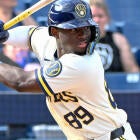
Buster Posey's latest attempt to jump-start his flagging offense comes in the form of the aggressive promotion of Cox all the way from Double-A, where he was hitting .400/.453/.644 with 27 steals in 44 games. Speed is the primary tool in Cox's bag, but he has managed to cut his strikeout rate to a more manageable 17% rate so far this season after hovering above 22% previously. It's a long shot, but you have to figure Cox is going to play regularly if they're jumping him up from Double-A, so in deeper Roto leagues, why not see if he can make an impact with his speed?
Starting Pitcher
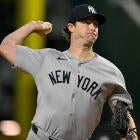
Brown just finished May with a sub-2.00 ERA, 31 strikeouts, and only eight walks in eight innings, and he did that while transitioning from a relief role to the starting rotation mid-stream. And in his most recent two starts he has gone six and seven innings, so yeah, I do think he needs to be viewed as pretty much a must-roster pitcher in all formats. I don't think the last two starts are necessarily indicative of Brown transforming into an innings eater or anything – he hasn't thrown more than 83 pitches in a start yet! – but he sure hasn't struggled with the third-time-through-the-order penalty yet. Brown sure looks like he's taken a big step forward.
Cade Cavalli, Nationals (74%)
I don't buy Cavalli as a mid-3.00s ERA pitcher, which is what he's been in the month of May. But he has tightened up his control after some early struggles and he hasn't struggled as much limiting damage on contact as expected, despite a pretty mediocre fastball. He doesn't have any great pitches outside of his curveball, but maybe the depth of Cavalli's arsenal is enough to help keep hitters off balance until he gets the chance to put them away with his breaker. It's a kind of flimsy profile, but it's working for him right now.
Zebby Matthews, Twins (47%)
Matthews is down about 1 mph from last year on his fastball (and more on his breaking balls), but is overall pitching a lot better. He's lost a bit of swing and miss from last season, but seems to be benefiting from significantly better command, leading to both fewer walks and a lot better results on contact. I'm not sure I quite buy it, but it's working for him now, and the upcoming schedule is pretty promising, with matchups against the Royals, Tigers (in Detroit) and Rangers (in Texas) on the way, all of which should be at least pretty good matchups. You probably won't want to use him in starts against the Dodgers and Astros after that, but he could be useful in the meantime.
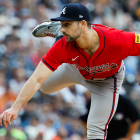
Jump wasn't great in his MLB debut against the Mariners this week, but I remain pretty interested in him. The 23-year-old allowed four runs on nine hits, but struck out five while walking just one and showing off multiple potential swing-and-miss pitches. His home park won't provide much help, but Jump looks like he could be good enough to overcome it. For a recently promoted top prospect, that roster rate just seems too low, even if his debut didn't exactly give us reason to be immediately impressed.
River Ryan, Dodgers (23%)
With Tyler Glasnow and Blake Snell still working their way back from injuries, Ryan just needs one person in the Dodgers' rotation to stumble before he gets a chance. And it might just be a question of how long it takes for the Dodgers to sour on Eric Lauer as the No. 6 starter. Ryan has been utterly dominant so far at Triple-A, striking out 29 and walking just three in 22 innings while seeing a 1.5 mph jump in average fastball velocity relative to 2024, when he last pitched. The long-term picture is cloudy, but Ryan has the kind of profile that could make him a must-add pitcher basically as soon as the opportunity arises.
Relief Pitcher
Trevor Megill, Brewers (66%)
It always seemed like the Brewers wanted to get Megill back into the closer's role eventually, and it looks like they've done just that, as he has saved the past three games for the team across Wednesday, Friday, and Sunday's games. What is even more telling is that Abner Uribe pitched in all three games as a true setup man for Megill, so it really seems like the Brewers are back to trusting Megill most in the ninth. His numbers are still a little crooked because of his early-season struggles, but Megill's underlying numbers look about as good as ever, and we've seen him be a top-12 closer before. He might be back to being one.
Scott Barlow, Athletics (3%)
How much do consecutive saves tell us when they come almost a week apart? Barlow got the save last Sunday and followed it up with another Sunday, but the A's didn't have a save opportunity in between. They haven't really settled on a full-time closer at any point this season, so Barlow should be viewed as a pretty speculative option at best right now. He also just hasn't been very good in a while, last posting an ERA below 4.21 in 2022. But if you're desperate for saves, he might be able to provide at least a few.
David Sandlin, White Sox (23%)
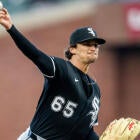
Sandlin was solid in his debut, allowing just one run while striking out four over six innings of work, and he did that after allowing just one earned run in 16.1 runs in the minors this season. He has struggled with control at times in addition to the typical injury issues young pitchers tend to face. But Sandlin's stuff looks good enough to stick in the White Sox's rotation, and there might be some upside here.