

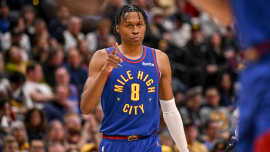
The NBA's second apron claimed its latest casualty on Wednesday when the Denver Nuggets shipped Peyton Watson to the Cleveland Cavaliers in an $88 million sign-and-trade that yielded the Nuggets nothing in the way of actual players. They got Cleveland's 2031 first-round pick and Sacramento's 2032 second-round pick, but no Watson replacement. On Friday, they pivoted to DeMar DeRozan. In 2026, Watson to DeRozan is a downgrade. If you believe otherwise, as the kids say, you don't know ball.
Getting under the second apron is clearly the Nuggets' priority. They're not alone in this endeavor. The Knicks won last year's championship and immediately let Mitchell Robinson walk after owner James Dolan deemed any trip into the second apron as "suicidal."
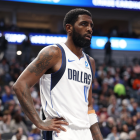
Robinson went to the Celtics, who have moved off of Jaylen Brown, Jrue Holiday, Kristaps Porziņģis, Al Horford and Luke Kornet since winning the 2024 title. Oklahoma City won the 2025 championship and just lost Aaron Wiggins, Lu Dort and Isaiah Joe this summer. The Warriors are currently driving their fans insane by playing it so tight to the vest since their 2022 title. The Bucks won in 2021 and have since blown up.
All of this is to say, if the second apron has arguably made it easier than ever to put together a contending roster as talent has been spread more equitably across the league (I would argue no fewer than 13 teams will enter this coming season with conference-finals-caliber rosters). It has also made it harder than ever to keep these rosters together for the same reason.
Through this lens, the Nuggets having lost Bruce Brown, Kentavious Caldwell-Pope, Michael Porter Jr. and, now, Watson from that 2023 title team is no great sin. It pretty much happens to every team, barring some sort of one-off salary advantage like Jalen Brunson giving the Knicks a discount, or Stephen Curry signing a clearance-rack contract in 2012, or the Spurs having Victor Wembanyama (who has since also given San Antonio a long-term discount), Stephon Castle and Dylan Harper all on rookie contracts at the same time.
The key, then, lies in the margin replacements. It's an extremely tight needle to thread, but fans look at a team like OKC -- which has nailed everything from adding Alex Caruso and Isaiah Hartenstein to drafting Cason Wallace and developing Ajay Mitchell, which has in turn afforded them the talent cushion to lose a starter in Dort and a two-way wing in Wiggins that every other team in the league would kill for without skipping a beat -- and expect their front offices to follow suit.
This is where the Nuggets have fallen short. Again, they never found another 2023 Brown. They didn't want to pay Caldwell-Pope. They tried to swap Porter Jr. for Cam Johnson, thinking they fit the same player archetype, but it turned out Porter Jr. was just way better. Now they lose Watson, their one young, athletic player with the upside to represent at least a plausible path to improvement from last year's first-round-losing team, because they paid Christian Braun $125 million (at least double what he's worth) and couldn't stomach another money dump.
Problem is, Watson "only" got $22 million annually, which isn't star money. That's regular starter money. Which Watson is, or should be, and being that the Nuggets were already over the second apron and thus crippled by the roster-building restrictions that apply anyway, why not just pay Watson?
First of all, that's easy to say when it's not your money. Sure, the Kroenke family is reportedly worth almost $40 billion, but would running your 2026-27 payroll past $400 million -- which would be an NBA record and is what Denver would've been facing had it re-signed Watson at the $88 million he got from the Cavs -- have been a responsible decision for a team that would probably still fall short of true contender status? Probably not.
Should they have done it anyway? The answer to that question would be a resounding no if the Nuggets didn't have Nikola Jokić still at the peak of his powers. But they do. And that's where this gets dicey.
The franchise icon dilemma
When you have not just a superstar, but even one step up from that, a true franchise icon, it becomes impossible for fans to accept anything that could be even remotely perceived as organizational passivity, let alone an owner cheaping out. I'm not sure Denver has been passive, necessarily; I would, in fact, largely commend the Nuggets for their commitment to core continuity since the Aaron Gordon trade, which has indisputably served them well. It's also hard to say the owner of a repeater-tax team heading into next season with a nearly $300 million payroll has cheaped out.
But yes, the Nuggets have cut some costly corners since the 2023 championship, and they're continuing to do so. No, fans are not going to accept that when their homegrown Hall of Famer is still arguably the greatest player in the world and currently set to become a free agent next summer. That's where having a player of this caliber can, in a weird way, go from a blessing to a curse as every season you're expected to set sail toward a championship even if the boat is starting to sink.
It can become a suicide mission if you're not careful. Go ask the Bucks, who mortgaged everything but their soul to try to keep Giannis Antetokounmpo on a team whose window of contention had clearly closed. They waived and stretched Damian Lillard over five years, paying him $113 million to go play for the Blazers, all so they could turn around and pay Myles Turner north of $100 million. They had to trade Giannis anyway, and they'll be digging out from beneath that debt for years.
That should've been an easy decision. The Bucks were done. The Nuggets are not, or don't have to be, but their margins have become impossibly thin as two younger, better teams in the Spurs and Thunder have risen to West prominence. Watson was a margin call. The guy has only started 64 games in his career. He had one big stretch last season during which his potential materialized, and his two-way upside is obvious, but it's also not unreasonable to not think he's worth an $88 million bet when you're already buried beneath the Braun contract as the only second-apron team in the league and probably not a contender anyway.
Frankly, none of the margin calls the Nuggets have made over these last four summers have been unreasonable on their own.
- Brown was a big loss but the Nuggets couldn't have kept him if they wanted to in 2023 because they didn't have his early Bird rights and were limited in the raise they could offer him. When Indiana threw $45 million over two years at him, short of Brown taking about a $15 million haircut in the first year of his new deal, Denver, through no fault of its own, was out.
- The $66 million Orlando gave Caldwell-Pope proved pretty quickly to be a ridiculous contract.
- The Porter/Johnson swap looks bad in hindsight, but, at the time, pretty much everyone was in agreement that Porter was an overpaid third scorer and Johnson, who had just averaged 19 PPG on 39% 3-point shooting in Brooklyn, fit the bill of a similar player for almost half the price.
The frustration, to whatever extent it exists, is in the aggregate of all these compromises. In addition to Watson, the Nuggets have also lost Jonas Valanciunas, who was at least somewhat of a plug for the non-Jokić minutes that have crippled Denver for years, and Sixth Man of the Year finalist Tim Hardaway Jr. from last year's team.
Forgive the fans if the fans if they fail to see the excitement in adding Tyus Jones and Marvin Bagley Jr., and if they're starting, however quietly, to worriedly ponder a question that has always felt like a forgone conclusion.
Will Jokić finish his career in Denver?
All signs still point to yes. Two months ago, Jokić told Serbian reporters that his "desire is to play the rest of my life in Denver," and that he would "probably [re]sign [with the Nuggets] next year." That probably provides some pause, but Jokić opting not to sign the $278 million contract extension for which he was eligible this summer is very likely a purely financial decision. Next summer he can sign for $359 million. Chances are he will. He hasn't given any indication to the contrary.
The concern would be if the Nuggets are taking this fact that Jokic has never threatened to leave for granted, using it as a license to downshift their roster aggression without fear of consequence. This is what has Golden State fans up in arms. No LeBron James team would hoard draft picks and focus on the "next era" because he would be threatening them behind closed doors within an inch of their organizational life. Stephen Curry doesn't do that. He stays in his lane and professes nothing but love and support for all the decisions his ownership and front office make, even if they come at the cost of his last shot at contention.
Jokic has always appeared to be cut from the same go-along-get-along cloth. But to mistake that for a lack of competitive desire would be, well, a mistake. The idea that Jokic doesn't care about winning, or really even the sport of basketball in comparison to his horses, is rooted in romance rather than reality. It's fun to think about a Hall of Fame player not giving a damn, but it's not true. He wants to win. He wants to do it in Denver. But that's starting to look more and more unlikely as this core ages. You can only play the "if Aaron Gordon could just stay healthy" card for so long.
What's funny is Curry's Warriors would be one of the teams that could theoretically pay Jokić next summer if they worked their cap sheet right. No doubt Joe Lacob is dreaming on that as we speak. It's about as likely to happen as the Warriors getting Giannis was.
More likely is Jokić stays in Denver as they either fade more and more from contention or pull a rabbit out of the hat to get back into it -- perhaps by trading Jamal Murray or Gordon at the deadline, or even better, by attaching that 2031 Cleveland pick they got in the Watson deal to Braun and/or Johnson's expiring deal for a meaningful upgrade.
Let's see how it goes. And again, chances are Jokić isn't going anywhere either way. But iI will say this: If ever there was a blueprint for forcing your franchise icon to consider relocation, it would look a lot like a summer in which you allow three significant players to go and replace them with Marvin freaking Bagley. It doesn't mean Jokić is going to leave. I can't state that enough. But until further notice, it sort of feels like the Nuggets are daring him to do so.