

Wednesday's baseball undertakings in Queens served as both a stinging reminder of a season gone awry for the New York Mets and a path forward -- a path that leads toward not contention but rather acceptance of present realities. Or, if you prefer, you can divide up the Mets' latest low point of 2026 another couple of ways. There's what happened on the field and then what happened off of it. What happened on the field was a humiliating pair of losses to the Chicago Cubs. What happened off of it was an evening trade of veteran lefty David Peterson to those same Cubs in a move that may -- or at least should -- signal a wider sell-off leading up to the Aug. 3 trade deadline.
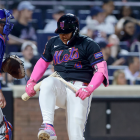
First, there's what happened on the field. "It's embarrassing," manager Carlos Mendoza said to open his postgame presser following the second contest of the day, and that's as accurate as it is unsparing. In the first game -- a make-up of Tuesday's rainout -- the Mets allowed a three-run homer and a grand slam to the theretofore struggling Dansby Swanson in a 10-3 loss. The second game for the Mets marked the return from the injured list of star shortstop Francisco Lindor after nine weeks. Lindor, however, went 0 for 5 and committed an error on his first chance.
Speaking of errors, the Mets in the nightcap committed six of them in the second game -- two each by first baseman Mark Vientos and second baseman Marcus Semien and one apiece from Lindor and third baseman Bo Bichette. That's the first time the Mets have committed six or more errors in a game since 2014, and it's just the second time in franchise history that each infielder committed at least one error in the same game. The first time happened in 1962, the Mets' first season of existence and one in which they lost 120 games. Half the runs the Mets allowed in the 10-5 loss were unearned. That fielding performance is the embarrassment of which Mendoza spoke. And maybe the fact that Swanson racked up a franchise-record 11 RBI in a single day -- and 15 RBI through the first three games of the four-game series -- has a little something to do with it, as well.
Compounding matters, at least in terms of the sour mood, were the "Pete Alonso!" chants from the Citi Field faithful that rained down as offseason addition Devin Williams was in the process of allowing three (unearned) runs in the ninth:
PETE ALONSO pic.twitter.com/nDMZaDhstQ
— dianna (@runwildkian) June 25, 2026
The first baseman Alonso, the all-time franchise leader in home runs and a Mets lifer until this season, was allowed to depart to the Orioles via free agency this past winter. He has 18 home runs on the season and remains acutely missed by Mets fans. He also hit a ninth-inning game-winning three-run home run off Williams in Game 3 of the 2024 National League Wild Card Series to eliminate the Brewers and send the Mets to the NLDS.
Those chants aren't heard if the Mets had lived up to expectations this season. Indeed, they're now a season-low 12 games under .500, and that's backed up by a -46 run differential. The Mets are in last place in the National League East by a wide margin, and in the race for the third wild-card spot in the NL, they're nine games out and behind seven teams. All of that is why SportsLine at present gives the Mets less than a 1.0% chance of making the playoffs despite a payroll north of $350 million.
How'd they get here?
The Mets undertook significant roster churn coming off last year's stretch-drive collapse, but it's a roster shot through with injuries and underperformance. Semien looks done (and himself landed on the IL Thursday with a left hip flexor strain), and Bichette has only recently started to show signs of finding his accustomed level at the plate. Jorge Polanco, expected to be a stabilizer at first base and DH, has a .532 OPS, and injuries have limited him to just 61 plate appearances. Lindor, a future Hall of Famer who got down-ballot MVP votes last year, missed almost exactly two months with a calf strain. As well, the rotation -- normally the bailiwick of lead decision-maker David Stearns -- has been a disaster. Mets starters right now rank 28th in MLB, ahead of just the Athletics and Rockies, who, unlike the Mets, play in run-inflating home ballparks. That's just a partial autopsy, but the corpse has had enough at this point.
All of that brings us to off-the-field matters. Following Wednesday evening's pratfalls, the Mets traded veteran lefty David Peterson to those same Cubs for first base/DH prospect Cole Mathis. The 30-year-old Peterson had been the longest-tenured Met on the roster, as he'd been part of the organization since they made him a first-round pick in 2017. However, this season he's struggled gravely, with 51 runs allowed in 68 innings. The Cubs, though, no doubt see Peterson's much more palatable FIP of 3.85 and figure his strong ground-ball tendencies should play well in front of one of the best infield defenses in MLB. They're also in desperate need of innings, particularly after losing Edward Cabrera and Ben Brown to the IL on Wednesday.
Given all the struggles and disappointments chronicled above, it's easy to see this as the start of a deadline sell-off by the Mets and the increasingly embattled Stearns. However, there's this from The Athletic:
"The trade does not indicate that the Mets are starting a sell-off, according to people familiar with their plans who were granted anonymity so as to freely discuss the situation."
This of course could be posturing in order to cast the Mets as reluctant sellers who will need to be "overwhelmed" by offers, as the deadline parlance of such things tends to go, in order to avert their gaze from distantly possible contention. The truth of the matter, though, is that the Mets should be angling for an organizational reset leading up to the Aug. 3 trade deadline. That's still the likely outcome, the blind-item quote above notwithstanding.
Now what?
So now the question, informed in part by the Peterson departure, becomes: What would a deeper deadline sell-off look like for Stearns and the Mets? Here's a taste:
- Freddy Peralta: He's not been himself this season with a 4.83 ERA and a 4.32 FIP through 16 starts. However, from 2023-25, he ripped off three straight seasons of at least 30 starts and 200 strikeouts for the Brewers. Teams will bet on that track record, especially considering what may be a very light deadline on the sell side. Peralta's in his walk year.
- Luke Weaver: Weaver has emerged as a force among righty setup relievers, and in 2026 he's enjoying perhaps his best season in the bullpen. He also has a bit of closing experience with the Yankees. Weaver is under contract through the 2027 season, which should add to his appeal on the market.
- Brooks Raley: The soon-to-be-38-year-old lefty reliever has enjoyed a strong two-season run with the Mets, and contenders are always starved for bullpen help, particularly from portside, when the deadline rolls around. He's also a pending free agent.
- A.J. Minter: Another bedrock reliever, Minter, 32, has a 137 ERA+ and a 2.83 FIP across his 10-year MLB career. He made his season debut roughly a month ago after recovering from shoulder/lat surgery, and he's yet to allow an earned run in 11 innings. Over that span, he's struck out nine and walked one.
- Clay Holmes: This one comes with a qualifier, since the 33-year-old Holmes is on the 60-day injured list with a fractured fibula. He's set to begin throwing in early July, barring setback, and he'll be eligible to come off the IL in early August, albeit perhaps after the deadline. Still, the Jays proved last year with Shane Bieber that contenders under the right circumstances may be willing to trade for injured pitchers. In Holmes' case, at least it's not an arm injury, and he's thrived since the Mets made a starter out of him going into the 2025 season. His contract includes a $12 million player option for 2027. Player options can sometimes turn into extension opportunities for the club, which is something to note for possible interested parties.
That's not an exhaustive list, but those names are probably the realistic trade candidates who would fetch the Mets the most in return. Elsewhere, Stearns could see if there's any market whatsoever for struggling contributors like Mark Vientos, Brett Baty, and Kodai Senga. And is there a trade opportunity for Bichette? He's fallen shy of expectations, but he's been healthy and durable coming off last year's knee injury. The track record is also strong. He has $42 million player options for each of the next two seasons, which means the Mets may need to include significant cash in any such deal. He also has full-trade protection, but it's not hard to imagine that both player and team would be open to a change.
Such churn obviously won't make Mets fans forget what's become of the 2026 season, but it will begin the process of putting it behind them. Undertaking the sell would on-board additional young talent and achieve some "addition by subtraction" at certain spots. The Mets' failures have turned the rest of 2026 into preparation for 2027 and beyond, and that's the case whether or not the front office accepts this reality. Wednesday's ugliness followed by the trade of Peterson should inform what comes next for the Mets, and what comes next should be trade upon trade, all with the long-term in mind.