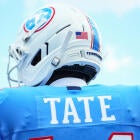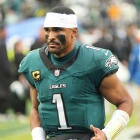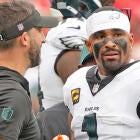


The Titans took Carnell Tate fourth overall, ahead of everybody not named Fernando Mendoza, David Bailey and Jeremiyah Love. That's the kind of draft capital that changes the question. Nobody is wondering whether Tate was a good prospect or belonged in the top half of the first round; Tennessee, however, decided he was valuable enough to pass on virtually everybody else in the class.
So what should the Titans expect in return?
Tate's final Ohio State season offered plenty of reasons to believe the answer could be "a lot." He averaged 3.02 yards per route (49th percentile among recent first-round WRs going back to 2015), earned an 89.0 receiving grade (69th), didn't drop a pass (best in the group) and caught 85.7% of his contested targets (94th) while doing nearly 89% of his work outside (90th). Those are the kind of numbers that get a receiver drafted early.
But there was one part of Tate's resume that didn't mirror many of the receivers we've seen go this high: Ohio State's passing game never completely ran through him. Tate commanded just 17.0% of the targets and 23.3% of the receiving yards in his final season. There is, of course, a very good reason: Jeremiah Smith, who could be the next coming of Ja'Marr Chase in terms of productivity once he gets to the NFL.
That's what makes Tate such an interesting No. 4 pick. Tennessee wasn't drafting the most dominant receiver in college football; it was drafting the route-running, ball skills and consistency and trusting that they would hold up once the workload increased and he was no longer sharing targets with Smith.
And history gives us a pretty good idea of how high the expectations should be.
What does a top-5 pick actually buy you?
There haven't been many receivers drafted in the top-5 in recent years, so we're working with a small sample. In fact, from 2015 through 2025, four fit the bill: Amari Cooper at No. 4 in 2015, Corey Davis at No. 5 in 2017, Ja'Marr Chase at No. 5 in 2021 and Marvin Harrison Jr. at No. 4 in 2024.
Travis Hunter also went second overall in 2025, but he's left out here for a simple reason: Jacksonville wasn't drafting a traditional wide receiver, and Hunter's value included what he could do primarily at cornerback, in addition to his electric receiving and return skills.
The rookie returns from the four conventional top-5 receivers? They were all over the place.
| WR | Pick | Rookie yards | TD | YPRR | Receiving grade |
|---|---|---|---|---|---|
Amari Cooper | 4 | 1,070 | 6 | 1.84 | 71.1 |
Corey Davis | 5 | 375 | 0 | 1.14 | 61.5 |
Ja'Marr Chase | 5 | 1,455 | 13 | 2.51 | 84.0 |
Marvin Harrison Jr. | 4 | 885 | 8 | 1.63 | 77.2 |
On average, those four produced 946 receiving yards, 62 catches and 6.8 touchdowns as rookies. That's substantially better than the other first-round receivers in the 2015-2025 group, but there is an enormous Ja'Marr Chase-shaped qualifier attached to those numbers.
Chase's 1,455-yard, 13-touchdown rookie season does a lot of heavy lifting. Remove him and the other three top-5 receivers averaged 777 yards and 4.7 touchdowns. Cooper still cleared 1,000 yards in Year 1, Harrison put together a solid 885-yard season that felt ordinary only because of the other-worldly expectations, and Davis managed just 375 yards.
The larger sample tells us even more
Four players isn't much of a sample, so widen the lens to every receiver drafted in the top 10 from 2015 through 2025 and the distinction becomes much more useful. There were 14 receivers selected in that range over that span and another 31 taken from picks 11 through 32. The early returns weren't particularly close.
| Rookie production | Picks 1-10 | Picks 11-32 |
|---|---|---|
Players | 14 | 31 |
Average receiving yards | 767 | 535 |
Median receiving yards | 901 | 494 |
Average receptions | 58.3 | 40.4 |
Average TDs | 4.5 | 3.3 |
Median YPRR | 1.77 | 1.51 |
800+ receiving yards | 64.3% | 25.8% |
1,000+ receiving yards | 42.9% | 6.5% |
2.0+ YPRR | 21.4% | 12.9% |
80+ receiving grade | 28.6% | 9.7% |
The difference is hard to miss. Nine of the 14 top-10 receivers reached at least 800 yards as rookies, and six topped 1,000. Among the 31 first-round receivers taken from picks 11 through 32, only eight reached 800 and just two cracked 1,000.
That matters for this year's class because Tate and Jordyn Tyson were drafted in the range where immediate production should be part of the expectation. KC Concepcion and Omar Cooper Jr. weren't. Cleveland and the New York Jets obviously aren't waiting forever, but picks 24 and 30 don't carry the same Year 1 burden as picks Nos. 4 and 8.
There's another warning buried in the history, too. From 2016-2023, the first WR drafted was the best of his class over the first three NFL seasons just twice: D.J. Moore and Chase.
Draft order tells us what teams were willing to pay. It doesn't tell us how the class will play out once the games start. That's especially relevant this year because the fourth receiver drafted actually had the highest Profile Score of the group.
Four first-rounders, four very different bets
We ran Tate, Tyson, Concepcion and Cooper through the same Profile Score used to ask how much a receiver had already shown before reaching the NFL. The six questions are straightforward: Was he dominant? Did he do it early and repeatedly? Could he win in different ways? Did his athletic ability fit those ways of winning? Was there context significantly affecting the resume? And how much was his NFL team still being asked to believe would happen later?
The result didn't match the draft order.
| WR | Pick | Score | Pre-draft/profile takeaway |
|---|---|---|---|
Ja'Marr Chase | 5 | 12/12 | Gold standard; almost nothing meaningful left to prove before entering the NFL |
Amari Cooper | 4 | 12/12 | Dominant from freshman year through final season; polished, versatile and already looked ready for WR1 volume |
Marvin Harrison Jr. | 4 | 11/12 | Premium profile; athletic testing was the main unverified piece |
Justin Jefferson | 22 | 10/12 | Premium profile; final-season slot usage created more concern than his full college resume warranted |
A.J. Brown | 51 | 10/12 | Receiving resume was better than his eventual draft slot suggested |
Omar Cooper Jr. | 30 | 8/12 | Athleticism and role flexibility answered several questions; bigger NFL volume remains the next step |
Carnell Tate | 4 | 7/12 | Highly efficient, polished outside receiver; lighter WR1 volume because of Ohio State context |
Jordyn Tyson | 8 | 7/12 | Strongest evidence of true WR1 usage; injuries were the defining concern |
KC Concepcion | 24 | 7/12 | Role expanded significantly in college; slot-only concerns and focus drops remained questions |
D.K. Metcalf | 64 | 6/12 | Specialized athletic profile; Seattle built an NFL role around what he did exceptionally well |
The first thing that jumps out is that the fourth receiver drafted had the highest score among the 2026 first-rounders. Cooper Jr.'s Profile Score of 8 does not mean he should have been drafted ahead of Tate or that the Jets somehow found the best receiver in the class at No. 30. It means Cooper entered the league with slightly fewer unanswered questions than the other three.
The more interesting part is how the three Profile Scores of 7 got there. Tyson had the strongest evidence of true WR1 dominance, but his injury history created a different kind of risk. Tate had a polished X receiver skill set, but less proof that an offense could run through him. Concepcion's role kept expanding, but questions remained about a slot-only label and the focus drops.
Same score, very different bets.
Carnell Tate: The traits were there, the volume wasn't
Among the four first-rounders, Tate had the best final-season yards-per-route number and receiving grade. He played almost entirely outside, didn't drop a pass and was outstanding in contested situations. The skill set was easy to like, which is why the fourth pick didn't feel nearly as surprising as it might have if you looked only at the raw numbers.
The harder part of the argument is that Tate never had the season Jordyn Tyson did in 2024. Tyson commanded 31.9% of Arizona State's targets and 34.9% of its receiving yards while averaging 3.04 yards per route. Tate's 17.0% target share and 23.3% yard share were both the lowest among the four first-round receivers.
The gravity of Smith explains a lot of that. When one of the best players in college football is standing across the formation, there are only so many targets to go around. But an explanation isn't evidence. The Titans never got to see Tate handle 30% of an offense's targets for a full season because Ohio State never needed him to. Now Tennessee has to trust that the lighter volume was about opportunity, not limitation.
That's the leap you're making at No. 4 overall.
If the efficiency survives when the targets increase, Tennessee could get what it paid for. At Ohio State, Tate, a 5-star recruiting prospect, showed route savvy, ball skills and a knack for maximizing the opportunities that did come his way. What he didn't show was what happens when defenses know he's the guy and the offense needs to target him 10-12 times a game anyway.
Jordyn Tyson: The WR1 evidence was already there
If Tate required some imagination with the volume, Tyson did not.
During his 2024 season, he turned 14.1% of his routes into first downs and showed he could work both inside and outside. Among these four receivers, Tyson produced the clearest example of an offense treating him like a true No. 1 and getting No. 1 receiver production in return.
The first-round question was whether Tyson could stay healthy. He missed time throughout his college career, and that concern has already followed him to New Orleans, where a hamstring injury put him on injured reserve before Week 1.
The Saints didn't use the eighth pick looking for a developmental option behind Chris Olave. They had already seen what Tyson looked like when an offense ran through him.
That's the distinction between the first two receivers drafted in '26. Tennessee needs Tate to grow into a bigger role than he ever had at Ohio State. New Orleans already saw Tyson carry that kind of workload, but his health remains the question.
Same part of the draft, completely different question.
KC Concepcion: How big can the job become?
Concepcion's evaluation is less about one monster statistical season and more about how much his role changed. At NC State as a freshman, 92.7% of his snaps came from the slot. By his final season at Texas A&M, 65.3% came outside. His average depth of target jumped from 8.5 yards to 12.3, yet he still averaged 7.2 yards after the catch per reception while commanding 26.4% of the targets and 27.3% of the receiving yards.
That's important because the easiest way to describe a 5-foot-11, 195-pound receiver with his early college usage would be to put him in the slot/gadget/YAC bucket and move on.
The totality of his career gave us a lot more than that. Concepcion showed he could be effective both outside and in the slot without losing the after-catch ability that made him dangerous. Now the Browns need that versatility to hold up against NFL defenses.
The questions are straightforward. How does he handle stronger press corners? Does his size become more limiting? Do the hands hold up? Can the Browns move him around because he genuinely wins from different spots, or does NFL physicality eventually tell them where he has to play?
At No. 24, Concepcion doesn't carry the same immediate expectations as Tate or Tyson. Only 6.5% of the first-round receivers taken from picks 11 through 32 in our sample topped 1,000 yards as rookies. Concepcion doesn't have to walk into Week 1 and immediately look like a 1,200-yard receiver to justify the late first-rounder. He needs to show that the expanded version of himself we saw late in college wasn't temporary.
Omar Cooper Jr.: the highest score of the four
Cooper Jr.'s Profile Score of 8 is one point better than the other three first-rounders, and his college usage helps explain why. He had already shown he could be productive no matter where he lined up. He played primarily outside in 2024 before spending 83.3% of his 2025 snaps in the slot.
Looking only at his final season would make him seem like a slot receiver; looking at the year before would make that description incomplete at best (if this sounds familiar, it should -- this was Justin Jefferson's M.O. at LSU too). His production improved over time, he earned an 86.0 receiving grade in 2025, averaged 7.2 yards after the catch and confirmed the 4.42 speed and a 37-inch vertical we saw during the pre-draft process.
There was evidence he could play in different spots. There was evidence the athletic ability was real. There was evidence he could create after the catch. What wasn't there was historically overwhelming production or an extensive track record of the offense completely running through him.
The Jets don't need Cooper to match Tate's rookie production for the pick to make sense -- they have Garrett Wilson and AD Mitchell, and athletic tight ends Mason Taylor and Kenyon Sadiq. If Cooper turns what he showed at Indiana in 2025 into consistent rookie production, the Jets will have aced the assignment at No. 30.
Same round, different expectations
These four rookie receivers enter the NFL with four different jobs to do. Tate has to show that elite efficiency on fewer opportunities can become WR1 production when the volume arrives. Tyson handled that kind of volume in college, but a hamstring injury has already delayed the Saints' chance to see it in the NFL. Concepcion has to show his college role can keep expanding against bigger, stronger NFL defensive backs. Cooper has to turn his athleticism and versatility into more consistent production than he showed in college.
So, was Tate worth the fourth pick? The college evidence gives Tennessee a legitimate case. The efficiency was excellent, the skill set already looked NFL-ready and Smith provides a compelling explanation for why Tate's raw volume never matched some of the historical receivers taken this high.
Now comes the part Ohio State never needed Tate to prove: whether he can be the guy when the offense runs through him.