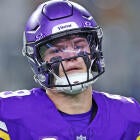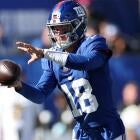


There was always going to be projection involved with J.J. McCarthy.
Two years later, the projection is over in Minnesota. The Vikings traded the quarterback they drafted 10th overall to the Giants on Monday for a 2027 fifth-round pick, ending an unusually short tenure after just 10 NFL starts. McCarthy survived roster cuts in August, but he entered the season behind Kyler Murray and Carson Wentz, and Minnesota has now officially moved on from a quarterback it traded up to select just 29 months ago.
For the Giants, this is a low-cost swing on a 23-year-old former top-10 pick after losing Jaxson Dart for the season. And it's another chance for McCarthy to prove he can play in the league. For Minnesota, though, the trade answers the question that has followed McCarthy since the Vikings signed Murray this offseason: how long were they willing to keep waiting?
Michigan won a national championship in McCarthy's final college season, went 15-0 and beat Ohio State, Alabama and Washington along the way. McCarthy completed 72.3% of his passes, threw 22 touchdowns against four interceptions and entered the NFL as a 21-year-old with athleticism, arm talent, toughness and a reputation as a winner.
The question was never whether McCarthy could make NFL throws. The question was how often he could make them when his team needed him most.
Michigan rarely required that. McCarthy attempted 332 passes during that 15-game championship season, fewer than 24 per game. During the Wolverines' final four games against Ohio State, Iowa, Alabama and Washington, he threw for a combined 656 yards. He was efficient, protected the football and made several big-time throws in big moments, but the offense was built around its running game, defense and an infrastructure that rarely asked its quarterback to carry the operation.
That was part of my concern in 2024. McCarthy was my QB5 with a second-round grade because the traits were there, but there was still a considerable gap between what Michigan asked of him and what an NFL team would require of him as the face of the franchise.
The tape showed a good athlete with a live-enough arm who could create outside structure and, at times, make high-level throws. But we also saw a quarterback who could become frenetic in clean pockets, struggle to layer the second-level throws and hesitate to pull the trigger on tight-window opportunities. At times, it felt like he didn't trust himself.
There was one area, though, where McCarthy looked much more like the quarterback Minnesota eventually believed it was drafting. On third-and-6-to-10 yards during his final Michigan season, he completed 70% of his passes with five touchdowns, no interceptions and 25 first downs. The ball consistently came out on time, he understood leverage, and there were high-level, tight-window throws on tape that seemed to elude him in other situations. Michigan didn't ask him to carry the offense from snap to snap, but on obvious passing downs, the Wolverines trusted him to make the play -- and more often than not, he did.
That's what made McCarthy so interesting. The best version wasn't theoretical -- it was on the tape if you were willing to look. The issue was how often it showed up. There was a substantial difference between seeing McCarthy make NFL-caliber throws in high-leverage situations and projecting him to consistently operate an NFL offense when those throws were required over and over again.
My second-round grade reflected that gap and the concerns that come with the pressure and expectation of going in Round 1. Minnesota looked at many of the same traits and decided the combination of McCarthy's age, athleticism, arm talent, winning background and flashes of advanced quarterback play was worth betting on much earlier.
The Vikings selected him 10th overall.
And in some ways, the environment made the gamble easier to understand. Kevin O'Connell was one of the league's most respected offensive coaches, and Justin Jefferson, Jordan Addison and T.J. Hockenson gave McCarthy a collection of weapons. Minnesota appeared as capable as any organization -- including the Rams and 49ers -- of providing the quarterback-friendly infrastructure young passers rarely inherit. If the unanswered parts of McCarthy's game could be developed, there weren't many better places for it to happen.
Instead, the questions from Michigan followed him to the NFL -- and became much harder to hide. Before Minnesota could even begin answering them, McCarthy's rookie season ended before it began.
A torn meniscus suffered during the preseason required surgery and cost him all of 2024. Sam Darnold took over, had the best season of his career and helped Minnesota win 14 games. That created the first major organizational inflection point. The Vikings could have tried to keep Darnold. They instead allowed him to sign with Seattle and handed the offense to McCarthy in 2025.
That's when projection finally had to become production. It never did.
After McCarthy's first six starts last season, the numbers were staggering. Among 35 first-round quarterbacks since 2016 who received meaningful playing time during their first two seasons, McCarthy ranked 34th in EPA per dropback, 34th in turnover-worthy-play rate and last in both interceptions and passer rating. He also had one of the league's worst sack rates despite pressure arriving relatively late, suggesting many of the negative plays weren't simply an offensive line problem. The same pocket issues that appeared intermittently at Michigan now felt all-consuming in Minnesota.
There were flashes, which made the evaluation even more frustrating. McCarthy's EPA and turnover-worthy play rate both ranked in the eighth percentile among quarterbacks going back to 2015, yet his 7.3% big-time throw rate ranked in the 96th percentile. That's basically McCarthy's career in one statistic: the high-end throws were real, but there was far too much bad football between them.
That was the challenge entering this offseason. He didn't need to develop some new superpower. He needed to become more accurate, play on time, manage pressure better and stop letting negative plays overwhelm everything else.
Minnesota apparently decided it couldn't wait. The Vikings signed former No. 1 overall pick Kyler Murray and called the competition legitimate. McCarthy spent the offseason talking about controlling what he could control and improving one rep at a time, while Jefferson said their private work together had helped McCarthy with timing and route anticipation. But Jefferson also offered the more telling assessment: McCarthy "has to step it up a bit."
That was in late April, months before the competition was decided. Jefferson said the added pressure could force McCarthy to "really lock in a little bit," then added: "It's either now or I'm going to take that back seat again."
This wasn't simply another developmental season. It was McCarthy's chance to show Minnesota he was ready to take the job and keep it. But by Aug. 11, the competition was over. O'Connell named Murray the starter before the Vikings had even played a preseason game.
The team insisted that didn't mean they were giving up on McCarthy. O'Connell said his "development and ongoing growth" remained important and called McCarthy an "incredibly important member" of the quarterback room. But actions matter more than August press-conference diplomacy. Naming Murray the starter before Year 3 made clear how dramatically Minnesota's view of McCarthy had changed.
Then it somehow got worse.
McCarthy went 5 of 10 for 81 yards against Baltimore in the preseason, including a 50-yard completion, but again struggled with accuracy and left the game after getting banged up. An ankle injury subsequently kept him out of the preseason finale against Denver. Meanwhile, Carson Wentz began splitting second-team work with him, turning the question from whether McCarthy could win back the starting job to whether he would even enter the season as Minnesota's clear No. 2.
CBS Sports' Matt Zenitz also reported in August that concerns inside the organization extended beyond the field. Some Vikings players and staffers believed undrafted Max Brosmer was better prepared than McCarthy to start early last season, with questions about managing the offense, commanding the huddle, and McCarthy being described as "unpredictable" from one day to the next.
How quickly other former first-round QBs lost their original jobs
| QB | Draft year | Pick | Drafting team | Time with drafting team | Starts | How the team moved on | Next team |
|---|---|---|---|---|---|---|---|
2022 | 20 | 2 seasons | 24 | Traded | |||
2021 | 3 | 49ers | 2 seasons | 4 | Traded | ||
2021 | 2 | 3 seasons | 33 | Traded | |||
Sam Darnold | 2018 | 3 | Jets | 3 seasons | 38 | Traded |
Trey Lance may be the closest comparison -- injuries left San Francisco with little actual evidence. Even Lance lasted two seasons before the 49ers traded him to Dallas for a fourth-round pick.
McCarthy got 10 starts. That can be interpreted in two ways.
Maybe Minnesota did its young quarterback a disservice. O'Connell himself said last season, "I believe organizations fail young quarterbacks before young quarterbacks fail organizations." McCarthy lost his rookie season to injury, battled additional injuries in Year 2 and was never afforded anything resembling the 30-plus-start runway Darnold and Wilson received.
Or perhaps those 10 starts, plus two years of practices, meetings, installations and film sessions, told O'Connell far more than outsiders could see on Sundays.
Both things can be true.
McCarthy's NFL career now continues in New York. Back in August, after losing his job to Murray, I wrote about recent first-round QBs whose original teams decided to move on. Five of the seven of those quarterbacks started another NFL game, and three made at least 10 more starts. The harder part is turning that second chance into something permanent: only one of those seven clearly reestablished himself as a franchise quarterback, and it just so happens to be the same guy the Vikings let walk to give McCarthy his opportunity: Darnold.
McCarthy will get another opportunity, but history suggests the path back to becoming somebody's long-term answer is much harder.
And the consequences weren't limited to McCarthy. Minnesota fired general manager Kwesi Adofo-Mensah in January, less than a year after giving him a contract extension. Ownership made it explicit that the decision wasn't about a single move, with Mark Wilf saying the organization evaluated Adofo-Mensah's tenure "cumulatively."
But it is impossible to separate the GM's departure from the quarterback decision that defined the end of his tenure. Adofo-Mensah and O'Connell drafted McCarthy 10th overall. Minnesota then watched Darnold play the best football of his career, allowed him to leave, and entrusted a roster coming off 14 wins to McCarthy. The Vikings finished 9-8, McCarthy struggled badly and Adofo-Mensah was gone weeks later.
This isn't hindsight pretending there were no reasons to like McCarthy. There were plenty. But he entered the league having played for one of college football's best programs, on a team that didn't need him to throw 40 times to win. The recurring question was whether the flashes would become more than that in the NFL once the structure disappeared and responsibility increased.
One lost starting job and one extraordinarily short Vikings tenure later, the answer seems clear.
What makes the McCarthy story remarkable isn't simply that the Vikings missed on the 10th overall pick. NFL teams miss on first-round quarterbacks all the time. It's how quickly Minnesota realized it had made the wrong bet.