Agent's Take: Biggest individual dead money charges in 2025, including Daniel Jones still costing the Giants
Russell Wilson makes the list again in 2025, costing the Broncos $32 million
Dead money is a salary cap charge for a player who is no longer on a team's roster. It exists because of how salary cap accounting rules operate.
Signing bonuses, option bonuses and certain roster bonuses are prorated or spread out evenly over the life of a contract for a maximum of five years. When a player is released, traded or retires, the remaining proration of these salary components immediately accelerate onto his team's current salary cap.
There are two major exceptions to this general rule of bonus proration accelerating. Only the current year's proration counts toward the cap with players released, traded or retiring after June 1. The bonus proration in future contract years is delayed until the following league year, which typically begins in early to mid-March.
A team can also release two players each league year prior to June 2 (known as a post-June 1 designation) that will be treated under the salary cap as if released after June 1. With a post-June 1 designation, a team is required to carry the player's full cap number until June 2 even though he is no longer a part of the roster. The player's salary comes off the books at that time unless it is guaranteed.
This means dead money is typically a sunk cost where money isn't owed to a player. A payment is associated with dead money when there are salary guarantees at the time of release or departure comes after the player has already begun receiving a portion of his compensation in that particular league year.
Teams have become increasingly more comfortable with big amounts of dead money. There are eight dead money charges of $20 million or more this year. Here's a look at the eight players responsible for this 2025 dead money.
WR Deebo Samuel, 49ers: $34,106,705
The handwriting was on the wall for Deebo Samuel in San Francisco because wide receiver Ricky Pearsall was selected 31st overall in the 2024 NFL Draft, Brandon Aiyuk signed a four-year, $120 million contract extension shortly before the regular season started and Jauan Jennings took a big step forward. The Washington Commanders acquired Samuel for a 2025 fifth-round pick in March. A $19.847 million salary conversion a couple days after the Aiyuk extension, which the 49ers seemingly developed buyer's remorse about shortly thereafter, added $15,877,600 to Samuel's dead money.
Samuel had a $15,737,270 2025 cap number prior to being dealt. The trade raised San Francisco's 2025 cap charges for Samuel by $18,369,435. The 49ers were able to accommodate the dramatic increase because of having the NFL's highest adjusted 2025 salary cap at $341.46 million primarily thanks to carrying over a little more than $50 million in unused 2024 cap space. A $3,086,105 cap credit will be coming in 2026 from the 2025 proration relating to Samuel's $15,430,529 option bonus that became a Commanders salary obligation in the trade.
QB Russell Wilson, Broncos: $32 million
Russell Wilson claims one of the top spots in dead money for a second straight year, dropping from first to second. That's because Wilson was released with a post-June 1 designation in March 2024 when his marriage of convenience with coach Sean Payton came to an end after one season together. Last year's $53 million is the record for dead money related to an individual player in one league year. The $85 million of residual cap charges taken over two years, 2024 and 2025, is a record for the most dead money relating to a single player contract.
CB Marshon Lattimore, Saints: $31,661,837
Marshon Lattimore's dead money is a byproduct of the Saints constantly pushing cap obligations into the future through salary conversions. It's only the third time there has ever been more than $30 million of dead money with a non-quarterback. The Saints restructured for cap purposes the five-year, $97 million extension Lattimore signed at the beginning of the 2021 regular season on three separate occasions before he was dealt along with a 2025 fifth-round pick to the Commanders for 2025 third-, fourth- and sixth-round picks at the 2024 trade deadline.

WR Amari Cooper, Browns: $22.584 million
The Buffalo Bills acquired Amari Cooper from the Browns for essentially a 2025 third-round pick six games into the 2024 season. Cooper was brought in to help fill a void at wide receiver created by Stefon Diggs' departure to the Houston Texans in an offseason trade.
It was clear that Cooper didn't fit into Cleveland's long-term plans. His efforts for a new deal were rebuffed. Instead, $5 million of not likely to be earned incentives were added to his contract giving him the opportunity to earn $25 million instead of the $20 million he was originally scheduled to make in 2024.
As a part of the reworked contract, $18.79 million of the $20 million was turned into a signing bonus where dummy/voiding 2027 and 2028 contract years were inserted into the deal for proration purposes. The bulk of Cooper's dead money ($15.032 million) is from this contract maneuver.
WR Cooper Kupp, Rams: $22.26 million
Ankle and hamstring injuries and 2023 fifth-round pick Puka Nacua's emergence made the Rams comfortable moving on from Cooper Kupp. The Rams released Kupp in March after a trade market never materialized. The Rams picked up $7.52 million of 2025 cap space in the process by no longer having Kupp's $29.78 million 2025 cap number on their books.
Kupp, who is 32, had two years worth $39.58 million remaining on his contract. He hadn't had a 1,000-yard receiving season since 2021 when he won the receiving triple crown. The Rams clearly didn't have an issue paying an older wide receiver. Davante Adams, who will be 33 on Christmas Eve, was signed to a two-year, $44 million contract with $26 million fully guaranteed as Kupp's replacement.
Kupp signed a three-year, $45 million deal, containing $26.5 million in guarantees, with the Seattle Seahawks a few days after the Rams released him. The Rams are getting a $5 million cap credit from Kupp finding a new football home. The $5 million of his $7.5 million fifth day of the 2025 league year roster bonus that became fully guaranteed in 2024 has an offset.
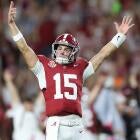
QB Daniel Jones, Giants: $22.21 million
The $22.21 million is a result of the Giants accommodating Daniel Jones' request for his release last November after his benching 10 games into the 2024 season. The combined $69.315 million in dead money over 2024 and 2025 is the second most ever relating an individual player contract. Jones' dead money is almost 30% more than the combined $17,120,657 in 2025 cap charges the Giants have for the quarterbacks currently on their roster (Jaxson Dart, Russell Wilson and Jameis Winston).
QB Aaron Rodgers, Jets: $21 million
The Aaron Rodgers experiment came to an end after two seasons with Aaron Glenn and Darren Mougey being hired as coach and general manager in January. Rodgers, who just turned 42, was released in March with a post-June 1 designation.
From a salary cap standpoint, it was time to move on from Rodgers. Since Rodgers' contract was structured with multiple option bonuses, the total dead money would have increased from $49 million to $63 million by bringing him back for another year.
The Jets will be getting a $7 million cap credit in 2026 from the $7 million of 2025 proration relating to the $35 million option bonus for a 2029 contract year that wasn't picked up due to Rodgers being released. The cap credit is reducing the 2026 dead money from $35 million to $28 million.
WR DK Metcalf, Seahawks: $21 million
Something had to give with DK Metcalf considering he had the NFL's third largest 2025 cap number for a wide receiver heading into the offseason at $31,875,471. The Seahawks opted to trade Metcalf, who was in a contract year, to the Pittsburgh Steelers for the equivalent of a second-round pick rather than give him a new deal. The Steelers signed Metcalf to a four-year contract extension, averaging nearly $33 million per year, in the process.
Seattle's trade compensation is more than what would have been received by letting Metcalf walk in free agency after this season. At best, the Seahawks would have gotten a 2027 third-round compensatory pick. Moving Metcalf allowed the Seahawks to free up $11,875,471 of 2025 cap space.