

The NBA trade market is crazier than ever. All-Stars routinely move out of nowhere. Players are traded for hauls of draft picks. Basically nobody in the league is untouchable. If you're a fan of player movement and chaos, you're mostly a fan of trades, because lately, NBA free agency has been far less exciting.
It's been a slow drip over the past several collective bargaining agreements. Contract extensions have become easier to sign. The best players never reach the market. Teams stop preserving cap space. It's a vicious cycle that has brought us to where we are now: a pretty limited free-agent class. There are names, to be certain, but most of them, for one reason or another, are unlikely to move. Those halcyon days of 2019, when Kevin Durant, Kyrie Irving, Jimmy Butler and Kawhi Leonard all moved as free agents, are long behind us.
But if you need an advertisement for the benefits of free agency, look no further than our reigning NBA champion New York Knicks. They climbed the mountaintop behind one of the greatest free-agent signings in league history. Is anyone in this class likely to become the next Jalen Brunson? No. But Brunson's ascent reminds us that even the unlikeliest of players, when put in the right circumstances, can become an enormously valuable asset.
So let's go through the top free agents this offseason and rank the best theoretically available players. Unrestricted free agents, restricted free agents and players with player options were eligible for consideration. Those with team options, for now, were not, though the class could get a boost if any of them, most notably the handful from Oklahoma City, are set free. In cases where picking up the player option is the obvious move, as with Zach LaVine, we left them off the list. We ranked 40 players in total, so let's dive in:
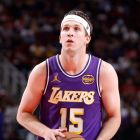
1. Austin Reaves -- player option
Don't get your hopes up, cap space teams. The Lakers want Reaves back. Luka Dončić does too. Reaves is eligible for a five-year contract that starts at 2p5% of the salary cap. That would pay him a projected $239.3 million. Reaves might be able to drum up a true max market if he's willing to engage with the Brooklyn Nets or Chicago Bulls, but in the end, he'll likely return to the purple and gold at slightly below this figure as the Lakers retool their roster around their two young stars.
2. Jalen Duren -- restricted free agent
Duren is technically eligible for more than Reaves. As an All-NBA selection, he can make up to 30% of the cap, or $287.1 million across five years from the Pistons. His disastrous playoff run almost certainly precluded him from making the max or close to it. The Pistons have a real decision to make here, especially with a non-shooting perimeter player in Ausar Thompson critical to their build and eligible for a rookie extension this offseason. If Detroit has doubts, Duren could get a hefty offer sheet from the Lakers, Nets or Bulls. More likely, he's back in Detroit below his max.
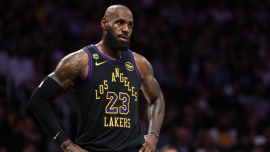
3. LeBron James -- unrestricted free agent
He's arguably the greatest player of all time. He's made max or near-max salaries in each of the past 19 seasons. And he's also 41, presumably picky about destination, and, while he remains enormously productive and a playoff riser, is not nearly the player he was at his peak. The Lakers have home-court advantage through their Bird Rights. They can pay him anything up to his max, which would be just shy of $58 million. If he moves, things get harder, but expect teams like the Golden State Warriors to at least come at him with the nontaxpayer mid-level exception, which starts at around $15 million.
4. Trae Young -- player option
The widespread expectation following his trade to Washington was a three-year extension in the $120 million range. That's still on the table, and yet, there have suddenly been rumblings about Young being a backup option for the Miami Heat if Giannis Antetokounmpo ends up elsewhere. The Nets and Bulls are both blank enough slates to justify big contracts in free agency. It seems Young has a market developing, so the Wizards might have to go higher to lock him up next season and beyond.
5. Walker Kessler -- restricted free agent
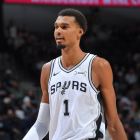
He missed most of last season due to injury, and he's a shaky free-throw shooter, but we're headed into the Victor Wembanyama era, and that's going to put a real premium on size and rim defense. Kessler provides both, along with elite offensive rebounding -- an essential component to New York's championship -- and a hint of 3-point shooting upside. There are bigger names behind him on this list, but at just 24 years old, Kessler's market will be extensive. Reports indicate he's not thrilled with how the Jazz have negotiated, so expect sign-and-trade offers, and if talks really break down, Kessler could accept his one-year qualifying offer and become an unrestricted free agent next offseason.
6. Peyton Watson -- restricted free agent
Watson shares some similarities with Kessler, albeit as a wing. He is not as accomplished as players below him on this list. He's injury-prone and pretty unproven on the highest levels. But he's young, athletic and coming off a monster year in which he averaged just shy of 15 points on over 41% 3-point shooting in the biggest role he's ever played. If we again treat New York as a notable model here, the wing-heavy Knicks relied heavily on OG Anunoby and Mikal Bridges to win their title. The hope is that Watson could grow into such a player on his next deal. The ultra-expensive Nuggets are presumably trying to move off some salary to facilitate a return, but if they can't do so, there might be a number high enough to scare them away from matching.
7. James Harden -- player option
Harden has a $43.3 million player option, but only $13.3 million of that is guaranteed. On the open market, he'd make less than that. We do this dance every spring. Some team trades for him midseason, he looks great at first, and then he disappoints in the postseason. He's now 36. The decline is coming. In all likelihood, he'll opt out of that $43.3 million and re-sign for multiple years at a lower number to help the Cavaliers duck the second apron.
8. Andrew Wiggins -- player option
At 31, the time for Wiggins to cash in on another long-term deal is now, and considering how limited their means of replacing him would be, it would probably behoove Wiggins to opt out and force Miami to the table. The Lakers are an obvious boogeyman if he does so. Wiggins remains a high-level defensive forward who can shoot 3s and create his own looks. He's been an essential component of a championship team. He's probably on the back nine, but is still a high-level player worthy of a rich, multi-year deal.
9. Draymond Green -- player option
Though they are opposites in terms of playoff resume and number of homes, Green actually shares some contractual similarities with Harden. He has a $27.7 million player option for next season, but the sensible move here would be for him to opt out, lower his salary, and re-sign for multiple years so he can hopefully retire with the Warriors. Doing so would also probably go a long way in helping the Warriors fit whatever big-name additions they want to make this offseason under whichever apron-induced hard cap they're stuck beneath. He's a possible free agent in name only. He should be back.
10. Ayo Dosunmu -- unrestricted free agent
Dosunmu really has the Wolves over a barrel. They're so expensive that they have no obvious means of replacing him if he walks, and the last key reserve they lost in free agency, Nickeil Alexander-Walker, just won Most Improved Player. There's probably a deal here above the mid-level exception that scares off most of the field. If the Lakers, Nets or Bulls get involved with cap space, though, that number climbs higher. He's a starting-level player, and without knowing what else Minnesota has planned this offseason, it's reasonable to assume they have a ceiling somewhere.
11. Tari Eason -- restricted free agent
He hasn't taken the offensive leap that Watson did last season, but similar logic applies. Eason is an athletic, defensive-minded wing with an improving jumper and aptitude for offensive rebounding. He just finished his age-24 season, and while Houston's finances aren't as dire as Denver's, the Rockets have to be mindful of Amen Thompson's impending extension, so there's probably a line here somewhere.
12. Fred VanVleet -- player option
A new deal with Houston makes too much sense not to happen. VanVleet is coming off a torn ACL. The Rockets' offense was barely functional in the playoffs without him. Houston could have used his salary to trade for a guard last season and didn't. The Rockets and VanVleet seem to be tied together, so he'll either pick up his option or, more likely, decline it and re-sign for multiple years.
13. Kristaps Porziņģis -- unrestricted free agent
The high-risk, high-reward swing of this free-agent class. Shooting big men are worth their weight in gold in Wembanyama's NBA, and Porziņģis is one of the best. He's also enormously injury-prone. A new deal with the Warriors is the likeliest outcome, but if the Warriors need to preserve their money for James, a trade or some other move, somebody could swoop in with a deal in the mid-level range. Keep an eye on the Spurs here. They've been interested in the past, and Luke Kornet's minutes were a real problem deep in the playoffs. They could give Porziņģis the mid-level exception, minimize his regular-season minutes with Kornet in place, and then unleash him as their backup center and possible Wembanyama front-court partner in the playoffs.
14. Rui Hachimura -- unrestricted free agent
How many 6-foot-8 players in the entire NBA have shot 42.6% from deep in the last three regular seasons... and 50.7% on 3s in the past four postseasons? That's Hachimura. He's not a good defender. He doesn't rebound well enough as a power forward. But he has grown into an absolute sniper with the Lakers, and he's not a standstill scorer, either. He can create some of his own looks and kill closeouts, so if you're looking for an offensive-minded power forward, he's one of your guys this offseason. If the Lakers elect to devote their cap space to external players, Hachimura is probably gettable at the mid-level exception.
15. John Collins -- unrestricted free agent
Collins is a more balanced player than Hachimura, but Hachimura's more consistent shooting gives him the edge among the "too small to play center, not quite quick enough to defend the best 4s" crowd. Still, Collins is a great pick-and-roll big offensively, and while he shouldn't be a primary rim-protector, being able to play him at center in certain lineups is a real bonus. The Clippers are so thin up front after trading Ivica Zubac that a new deal here feels likely.
16. Mitchell Robinson -- unrestricted free agent
He's a starting-level center who can't play starter minutes because of durability concerns. If you're looking for a timeshare center? Robinson is probably your man. Just let him protect the basket, finish lobs and own the offensive glass for 20 minutes and you'll probably win those minutes. If the Knicks are willing to go deep into the second apron, the market is out of luck. If they have a firm budget, well, they're only $13 million or so below that second apron threshold and have at least four roster spots to fill out. Any of the cap space teams are viable suitors, or any center-needy team in the mid-level market (with Charlotte standing out as a fit).
17. Quentin Grimes -- unrestricted free agent
He's spent the bulk of his career as a pretty standard 3-and-D shooting guard. Those players are valuable. But he averaged 25 points in March and April of 2025 in a bigger on-ball role and attempted (and failed) to negotiate a contract last offseason with that in mind. Is there more on-ball juice here than Philadelphia allows him to show? If another team thinks there is, it's hard to imagine a 76ers team as close to the tax line they so frequently duck matching. If he's remaining in Philadelphia, it's probably roughly in the mid-level range.
18. Coby White -- unrestricted free agent
Could Coby White start somewhere? Probably. He scored enough to do so in Chicago. But he settled into one of the best backup roles in the NBA last season for his hometown Hornets and closed their Play-In win over Miami. The Hornets should pay a premium for a high-level backup to LaMelo Ball given his injury concerns, so unless some team wants to bowl White over to get him to start (perhaps Atlanta if they elect to operate below the cap?), he's probably staying in a very good situation.
19. CJ McCollum -- unrestricted free agent
He's the Knicks killer, after all. The champs lost two Eastern Conference playoff games and both of them came at the hands of McCollum's scoring. He's 34 and not nearly the player he was in Portland, but he can still trade buckets with almost anyone. Don't be surprised if the Hawks bring him back on a big one-year deal. Atlanta probably wants to keep its books clean as it considers its long-term strategy, but McCollum was critical to their mid-season turnaround and is the only reliable, off-the-dribble threat they have.
20. Norm Powell -- unrestricted free agent
He was an All-Star last year in Miami and nearly made it for the Clippers two years ago. Those were the two best years of his career. He's now 33 and he tailed off down the stretch two years in a row because of injury. The Heat did not feel comfortable playing him and Tyler Herro together defensively, so his fate may come down to whether or not Herro is traded. If so, Miami likely brings him back on a big, short-term deal to be their designated guard scorer. If not? He might have to settle for someone's mid-level exception.
21. Collin Gillespie -- unrestricted free agent
Gillespie emerged as a starting-level point guard and fringe Most Improved Player candidate last season, and while the Suns would probably like to retain him, there are some complications here. Do they plan to start him? If they want to start Jalen Green next to Devin Booker in the backcourt, Gillespie might be tempted by more minutes elsewhere. The Suns only have about $15 million in luxury tax room now, and they presumably want to stay below that line and reset their repeater clock. Plus, the Suns only have Early Bird Rights, meaning they can offer just 140% of the projected league-average salary. Someone could therefore make them an offer they're not equipped to match. That seems unlikely. One way or another, the Suns are going to want Gillespie back, and something at around the mid-level exception makes sense.
22. Anfernee Simons -- unrestricted free agent
You have to be a star-level offensive player to get away with being the sort of defensive liability that Simons has generally been. Simons is unfortunately a few levels beneath that... but he's still an extremely explosive scorer with a sorely underrated clutch resume. He probably has to come off the bench for good teams given those defensive issues (Boston notably did not start him last season), but something in the mid-level range feels appropriate, or if the Bulls elect to keep him, perhaps a bit more on a shorter-term deal.
23. Bennedict Mathurin -- restricted free agent
Mathurin is a microwave scorer with one elite skill: he gets to the line like crazy. Among players who played at least 25 minutes per game last season, Mathurin had the ninth-highest free-throw attempt rate. The eight players above him were all present or former All-Stars. His shot and defense just haven't come along as hoped, and that's part of why Indiana moved him. But that foul-drawing can swing games, and it pairs nicely with Darius Garland, who isn't as eager to play through contact. Mathurin's long-term destiny is probably as a sixth man, and his market should reflect that. The Clippers won't be eager to lose the asset, so expect them to match any offer sheets, but if he was valued as a starter at the deadline, well, the Pacers probably wouldn't have needed to pay as much as they did for Ivica Zubac.
24. Robert Williams III -- unrestricted free agent
Williams is the cheaper version of Mitchell Robinson. They're both capable of starter-level play. Neither is capable of starter-level minutes. Williams is an even bigger health risk. He played 26 combined games in the 2023-24 and 2024-25 seasons. He bounced back for a healthy and productive season last year, and any team that has a healthy center rotation should consider taking a swing on him for a bigger playoff role. He was great against San Antonio in the first round for Portland.
25. Collin Sexton -- unrestricted free agent
I'm going down with the ship on this: I think there is a viable defensive guard somewhere in Collin Sexton. It's never happened in the NBA. It happened in college. He hasn't ever had real defensive infrastructure around him, but he has the tools. He's improved in every other area of his game. He's a high-level bench scorer and borderline elite shooter who's grown substantially as a playmaker. Until it actually happens, though, he's stuck as a nice backup.
26. Tobias Harris -- unrestricted free agent
I nearly ranked Harris at No. 22 just because he is, astoundingly, the 22nd-highest paid player in NBA history. At this stage, though, I have to imagine Harris' obscene earning days are behind him. He's heading into his age-34 season. You know what you're getting here: decent 3-point shooting, a dash of individual creation (and there was a stretch in the playoffs in which it was much more than a dash) and a great locker room presence. He could still start, but should probably come off the bench for a good team. The Pistons could create a fair bit of cap space by renouncing his cap hold, so don't be surprised if he either has to take a discount or seeks employment elsewhere.
27. Kelly Oubre -- unrestricted free agent
He's somewhat similar to Tobias Harris in that he could start on some teams, but he's probably best-suited to a high-end bench role. It's hard to imagine Philadelphia affording both Oubre and Grimes if they want to duck the tax, so Oubre seems gettable. He's a serviceable enough wing defender who doesn't make enough 3s, but takes plenty and finds 15 points every night. We're not exactly reinventing the wheel here, but wing depth will always be valuable. Harris is just the more reliable shooter.
28. Sandro Mamukelashvili -- player option
How much do you trust your defense? If the answer is "a lot," then Mamukelashvili is the backup center for you, because his shooting and passing are real weapons. He has a player option for the minimum, but he vastly outplayed that in a season in which he got fringe Sixth Man of the Year consideration. He'll get paid high-end backup money, perhaps something similar to what Luke Kornet got from San Antonio a year ago.
29. Landry Shamet -- unrestricted free agent
Landry Shamet was a minimum-salary player the past two years. That made sense when he was a non-factor defensively. He's grown substantially on that end of the floor, and when you pair that growth with his ever-reliable jumper and the championship sheen from this Knicks run, he's probably looking at a contract worth $8-10 million annually. The Knicks have enough guard depth to potentially let him go if they're concerned about the second apron, but if they're willing to dive off the tax deep end, they'd obviously love him back.
30. Keon Ellis -- unrestricted free agent
"Free Keon Ellis" became the cause célèbre of the NBA hipster community when he was wasting away on Sacramento's bench. Then he got to Cleveland and Kenny Atkinson didn't trust him either. He's a plus defender, but a fairly small one, and while he reliably makes 3s, he has very little else to offer offensively. He's a niche player. Stick him on a team with a bunch of creation and a sore need for point-of-attack defense -- the Lakers come to mind here -- and he's still potentially pretty useful. Ask much more out of him and you'll probably be disappointed.
31. Kevin Porter Jr. -- player option
Did Kevin Porter Jr. make a genuine leap last season, or did he put up numbers on a bad team? His scoring numbers in particular were substantially lower when he shared the court with Giannis Antetokounmpo. He's still enormously dependent on contested jumpers to generate offense. But he got to the line much more without Antetokounmpo and seemed to take meaningful leaps as both a playmaker and defender this year. The talent is here, but given the general inconsistency of his career to this point, coupled with the off-court troubles he's had, his market is probably still somewhat tepid. Expect the Bucks to keep him and make him a featured part of their post-Antetokounmpo roster. They'll try to answer the "good stats, bad team" question over time.
32. Marcus Smart -- player option
Age and injuries will prevent Smart from getting too much, but he outperformed the bi-annual exception for the Lakers last season and was mostly very good in the first round against Houston. He can certainly still defend and give you real ball-handling for bench units. The shot is just as inconsistent as ever. Ideally, he's on the Lakers or a team like them next year, one that's good enough not to overburden him with minutes across the 82-game grind.
33. Luke Kennard -- unrestricted free agent
One of the NBA's best shooters and also one of its more annoyingly reluctant ones. We do the Kennard dance every year. Team gets him. Team falls in love with his offense. Defense and shot-selection eventually erode his coach's faith. He's still a valuable player and was a difference-maker against the Rockets, but he's probably stuck to one-year deals below the mid-level at this point in his career.
34. Deandre Ayton -- player option
What do you do with a player who can range from high-level starter to borderline unplayable over the course of a single game? The Ayton experience has forever been maddening. He was talented enough to get drafted before Luka Dončić and frustrating enough for Portland to pay $25 million just to go away last season. He refuses to get to the line and his pick-and-roll defense is a mess. But his mid-range jumper is automatic, he defends the post well and when he's invested, he can be a very high-level rebounder (and when he's not, it gets ugly). We'll split the difference and stick him around the bottom of the list. At his best, he's 20 spots higher. At his worst, he's a legitimate negative.
35. De'Anthony Melton -- unrestricted free agent
How much does the league care about Melton's iffy 3-point shooting last season? That's an outlier for him, and his defense and floor game were strong a season ago. He's a small guard with an injury history, so his market isn't going to reflect his performance, but he should certainly be above the minimum for a good team next season.
36. Jose Alvarado -- player option
Alvarado has a $4.5 million player option. He may opt out to test free agency now, but he's also eligible for an extension, and the Knicks have worked with players to have them opt in and extend for the sake of short-term flexibility in the past (most notably Josh Hart). Alvarado, like Shamet and Robinson, depends on how far into the second apron the Knicks are willing to go. With Tyler Kolek in-house as a possible replacement, he can't be too picky, but he's a Finals hero and local icon, so a new deal makes sense for everyone involved.
37. Dean Wade -- unrestricted free agent
One of my favorite stats of the season: Dean Wade didn't attempt a free throw between the end of January and the Eastern Conference Finals. He's a zero on offense at this point, attempting only 2.4 shots per game in the last two rounds of the playoffs. But if you can defend wings, you have a place in the NBA, and Wade, at least, can do that. The Cavaliers, for now, are struggling with the second apron, so if they don't clear money, some team could swoop in and steal Wade.
38. Mark Williams -- restricted free agent
Williams is a starting-level offensive player. He's not a starting-level defensive player. If health weren't such a big question, he'd probably still get paid. As it stands, the Suns need to find minutes for No. 10 pick Khaman Maluach, and Oso Ighodaro passed him in the pecking order last season. With Gillespie more of a priority for Phoenix's financial flexibility, Williams might be the odd man out there. He's talented enough to warrant a look from a good team. If he can stay healthy and grow defensively for a year or two, he still has a lot of upside.
39. Harrison Barnes -- unrestricted free agent
Something about Harrison Barnes has just never quite translated to the postseason, and after seeing his role essentially eliminated in the Finals, he's little more than a locker room figure and regular-season innings eater for San Antonio at this point. That has some value, but not enough to warrant a long-term deal given the state of their finances moving forward. If someone wants Barnes to be a solid, rotation forward in the regular season and a veteran for their younger guys, he might just make more sense on a team with lower ambitions than San Antonio.
40. Jusuf Nurkić -- unrestricted free agent
His career looked like it might be over in Phoenix before he bounced back strong in Utah. At this stage, you know what he is. He can't really move defensively, and he's never been the finisher he's needed to be, but he's a smart offensive player who can provide stationary rim-protection and rebounding. For a backup center in a league that's increasingly fixated on size, that's more than enough.