

The dog days of August will soon give way to the postseason races of September. Entering play on Tuesday, 21 of the 30 teams were within five games of a postseason spot, and 16 of the 30 teams were within two games of a postseason spot. It's too bad MLB and the MLBPA agreed to do away with Game 163 tiebreakers a few years ago. We could've had some tiebreaker chaos this season.
As we await pennant race baseball, here now are three trends going on around the league to keep an eye on as the regular season begins to wind down.

Fernando Tatis Jr.'s resurgence


In these very internet pages on May 20, we asked and attempted to answer the "what's wrong with Fernando Tatis Jr.?" question. At the time, the Padres star was hitting .237/.308/.277 on the season, and had yet to hit a home run. The contact quality numbers were very strong. Tatis was near the top of the league in exit velocity, hard-hit rate, etc. And yet, no home runs.
Ten days later, Tatis hit his first home run of the season, and it was a bomb: 451 feet to left field. He has been one of the best hitters in baseball since that day, either because he unlocked something mechanically or because he finally got the monkey off his back (or both). In 75 games since May 30, Tatis is a .300/.367/.545 hitter with 17 home runs, the ninth most in baseball.
During his homer drought earlier this year, we noted that Tatis had closed his batted stance after hitting from an open stance for years, and he was also pushing the ball the other way too often. We all love those "nice piece of hitting" opposite field singles, but pulling the ball in the air produces the most damage, and Tatis wasn't doing it early on, partly because he closed his stance.
Tatis' offensive surge since May 30 is tied to (yep) opening up his stance, making contact further in front of the plate, and pulling it in the air way more often. Easy to write and explain, much more difficult to put into practice on the field. Here are the before and after shots:
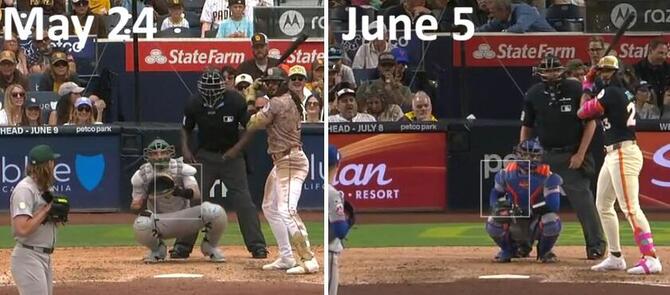
To put numbers on it, Tatis went from 12 degrees open in April and May (roughly league average) to 37 degrees open since June 1. That is one of the most open stances in baseball (11th most open, to be precise) and right in line with Tatis in previous years. As a result, his pulled fly ball rate went from a below-average 7.8% in April and May to a league-average-ish 14.4% since June 1.
Now, a league-average-ish pulled fly ball rate isn't anything special, but it is way better than where Tatis was earlier in the season. It doesn't matter how hard you hit the ball overall. If only one out of every 13 balls in play is in the air to the pull side, like it was with Tatis in April and May, you're just not going to hit for much power. He's roughly doubled his pulled fly ball rate since then.
Why Tatis decided to close his stance early in the year, I do not know. Maybe the logic behind the move was sound. Either way, it did not work, and fortunately for the Padres, Tatis was able to correct it in-season. It really was as easy as "go back to your open stance" in this case. That adjustment and Tatis' overall play have pushed San Diego into the thick of the wild-card race.

Kade Anderson's platoon positioning


Looking to boost their postseason odds, the Mariners called up lefty Kade Anderson this past weekend. Last year's No. 3 overall draft pick is the consensus top pitching prospect in baseball and he held his own in his MLB debut: 5 ⅔ IP, 5 H, 3 R, 2 BB, 5 K, 2 HR vs. the Cubs. The two homers came on the last two pitches he threw, when he was going through the lineup a third time and on fumes.
Anderson, 22, annihilated the minors this season, throwing 93 ⅓ innings with a 1.05 ERA, all in Double-A. He struck out 135 batters and walked only 13. That 10.4 K/BB is three points clear of the next best in the minors. Anderson showed the full arsenal in his MLB debut, throwing his four-seamer, slider, changeup, and curveball all at least 20% of the time. It's an impressive mix and aptitude.
The Mariners rookie sets up on different sides of the pitching rubber depending on the batter's handedness. Against righties, he sets up on the far third base side. Against lefties, he sets up on the far first base side. Here's a visual:
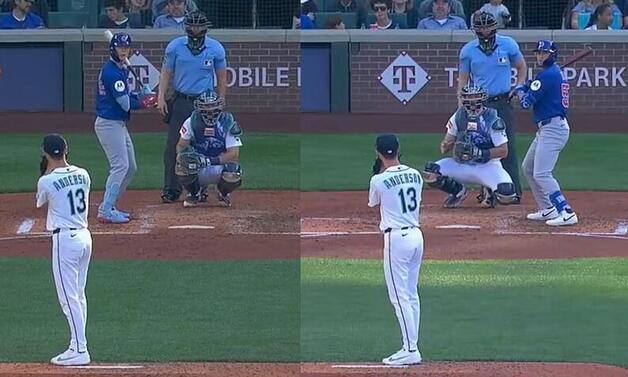
Changing position on the rubber constantly within a game definitely is uncommon -- fellow LSU Tiger Paul Skenes is the only other pitcher who does it consistently -- and it isn't easy. The vast majority of pitchers set up in one spot on the rubber and their delivery cues stay the same. For most, a fastball in to righties and away from lefties is the same pitch with the same mechanics.
For Anderson, those delivery cues are a bit different. His angles to the plate are different, so sweeping a breaking ball away from a lefty is not entirely the same mechanically as backfooting it to a righty. Switching from the two sides of the rubber constantly within a game isn't easy and it's awfully impressive for a young pitcher. It takes great athleticism and great pitching know-how.
As impressive as Anderson is, there are some concerns about his fastball at the next level. The velocity and movement traits (spin, etc.) are just OK, which is not a fatal flaw. It just means his path to being an effective big leaguer may come as a pitcher who leans on his secondary pitches. In that case, the deception created by changing places on the rubber will be a help.
Where have the righty bats gone?
This was a bad trade deadline to need a right-handed bat. Ten major-league right-handed hitters were traded at the deadline (Jo Adell, Joey Bart, Brenton Doyle, Curtis Mead, Heliot Ramos, Jake Rogers, Tyrone Taylor, Lane Thomas, Taylor Ward, Eli White) and they're hitting a combined .202/.287/.329 in more than 300 plate appearances with their new teams. Sheesh.
The lack of quality right-handed bats is not limited to this summer's trade deadline, though. It's a league-wide issue. Only three of the top 10 qualified hitters in OPS+ are right-handed (Pete Alonso, Junior Caminero, Willson Contreras), and only six of the top 20 are righties. Without his injury, Aaron Judge would likely be in the top 10, but still, it's a sport currently dominated by lefty bats.
Here are some numbers as the league's shift away from right-handed bats in recent years:
| PA by RHB | RHB OPS | LHB OPS | LHB OPS minus RHB OPS | |
|---|---|---|---|---|
2022 | 60.5% | .712 | .697 | -.015 |
2023 | 58.9% | .729 | .742 | .013 |
2024 | 58.0% | .704 | .722 | .018 |
2025 | 56.0% | .709 | .732 | .023 |
2026 | 51.1% | .709 | .729 | .020 |
Other than an outlier year in 2020, lefties typically out-OPS righties by 20 points or so. That makes sense, seeing how lefties are at the platoon advantage more often. Righties throw about 70% of all innings in a typical season (it's 70.6% in 2026), which puts lefties at the platoon advantage more often than not. It helps to the tune of 20 OPS points or so league-wide.
The production gap between righties and lefties hasn't changed all that much, if at all. There are just fewer righties. As recently as 2022, righties were taking 60.5% of all plate appearances. This year, it's down to 51.1%. That's an enormous decline league-wide. That's one fewer right-handed hitter stepping to the plate every 11 plate appearances or so compared to just five years ago.
MLB's ban on infield shifts may have contributed to this. The shift ban didn't boost batting averages or overall offense like the league hoped, but maybe it made teams more comfortable leaning into lefty hitters. It's also possible, if not likely, that this is just a blip. Almost everything in this game is cyclical. Wait a few years and we'll probably wonder where the lefty hitters went.
No doubt, though, quality right-handed hitting is becoming a scarce commodity. It was hard to find at the trade deadline because a) there isn't much of it out there to start with, and b) the teams that have it want to hang onto it. This will continue into the offseason, too. The demand for righty bats has been heightened while the supply has been thinned out.