Not everyone can be a starting pitcher. It's an oversimplification to say every reliever is just a failed starter, but it's only a mild oversimplification. Starters are asked to shoulder a much heavier burden than relievers, even now, and being able to both physically hold up to a starter's workload and get through a lineup multiple times while remaining effective is a combination few pitchers can routinely manage.
Because of this, no team in baseball ever has enough starting pitching. Nope, that team you're thinking of? They don't have enough starting pitching, even if it looks like they do right now. They don't. Or, at least, they won't.
MLB teams can't develop them fast enough in the minors to replace the ones who are getting hurt and falling apart in the majors, in large part because the guys in the minors are also getting hurt and falling apart. This inevitably leads them back to the relief pitcher class.
Teams have grown more aggressive about moving pitchers from the bullpen back to the rotation in recent years, and we've seen some very high-profile success stories in that regard. Garrett Crochet is probably the most notable, but we saw success stories in the form of Reid Detmers, Griffin Jax, and Justin Wrobleski in 2026, and names like Michael King, Nick Pivetta, Clay Holmes, Nick Martinez, and Seth Lugo over the past half-decade or so, too. In part, that's because expectations for starters keep getting lowered – nobody is throwing 110 pitches every time out these days, and few starters are even asked to throw 180 innings in a season now.
But, given the proliferation of mountains of data about pitching in the past decade or so, we also just have a better understanding of which pitchers have the stuff to move back to the rotation. Add in the growth of pitch design labs around baseball, and teams are much more able to be aggressive about taking shots with pitchers who move from the bullpen to the rotation.
What does that look like? And who might get the call for 2027? We'll try to answer both questions today, first by looking back at what has happened with reliever-to-starter conversions, and then by projecting who might be able to make it work in the future.
To start with, let's look at 25 pitchers between 2021 and 2026 who threw at least 50 innings as a reliever in one season and then followed that up with at least 50 innings as a starter in the following season, focusing on what those pitchers' velocities looked like in each role, and what the quality of their arsenals looked like, based on the Stuff+ metric on FanGraphs.com (which takes into account the physical characteristics of each pitch in a pitcher's arsenal to try to quantify, well, the quality of their stuff, where 100 is average):
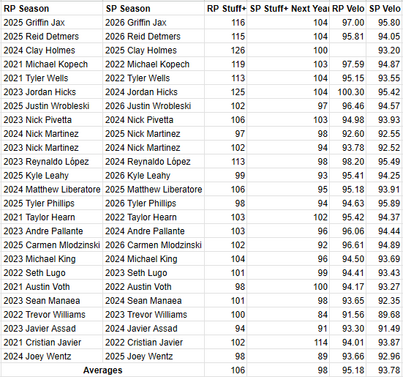
The key takeaways here are mostly what you'd expect: Pitchers lose something moving from the bullpen to the rotation. On average, a pitcher's Stuff+ drops about eight points, from an above-average mark to a slightly below-average one. That comes along with an average drop of about 1.4 mph of fastball velocity, though neither is the same for every player.
For example, Clay Holmes' Stuff+ dropped from 126 to 100 when he made the leap, while Cristian Javier actually went from roughly average to elite stuff in his full season as a starter. Every situation is different, and the results aren't always what you'd expect, either – Nick Martinez has seen his stuff collapse from 2023 to 2024, only to more or less hold steady from 2024 to 2025.
But the general direction is clear, and there is usually some kind of penalty. Pitchers can make up for it with a widened arsenal or improved command, but as a general rule, you should expect a pitcher to be less effective in a starting role than as a reliever. Obviously.
With this in mind, let's take a look at eight candidates to make the move from the bullpen to the rotation, and what we might expect from them for Fantasy in 2027.
Reliever conversion candidates
Grant Taylor, White Sox
2026 Stuff+ rating: 104; Translated Stuff+ as SP: 98
Taylor is the one we know for sure will be making the transition, and with that in mind … this is kind of underwhelming? But it might be underselling him. He averaged 98 mph with his four-seamer, but he did that while recording more than three outs in 31 of his 60 appearances. He made a postseason appearance in which he tossed 54 pitches over 2.1 innings with five strikeouts, averaging 97.5 mph on the four-seamer; he followed that up with six strikeouts over four innings, averaging 98.1 mph in his very next outing. His four-seamer was his primary strikeout weapon, though, so any diminishment of velocity or shape could affect him more than most pitchers.
Taylor has a four-pitch arsenal, but he doesn't necessarily have a go-to weapon against left-handed hitters. That wasn't much of an issue in 2026 (he actually had a higher strikeout rate against lefties than righties), but it's one thing to watch for as he makes the transition. I would guess we'll hear reports this offseason about him working on a changeup, a cutter or both.
Taylor's translated Stuff+ is still right around average, but honestly, that doesn't necessarily pass the sniff test for me. I don't think he's likely to be an ace, but the upside is there. His early ADP is right around 100 overall, which made sense when you could project him as a closer, but is way too rich with the question marks as a starter. Keep in mind, the 84 innings he threw in 2026 (92.2 including the playoffs) are by far a career high; he had never even hit 70 innings at any level prior.
I think I'd be willing to make the bet on Taylor as a top-60 starting pitcher, probably closer to 150 in drafts. If he remains around 100th overall, it'll be pretty easy to pass on him, personally, with these question marks and a likely innings limit around 140 or 150.
Didier Fuentes, Braves
2026 Stuff+ rating: 116; Translated Stuff+ as SP: 108
It is a bit surprising that Fuentes rates out better than Taylor by this measure, I'll admit. Both basically feature a three-pitch mix – Taylor has two fastballs, which he throws a combined 56% of the time, along with a slider and a curveball. At the same time, Fuentes leans on his four-seamer 69% of the time, with sliders around a quarter of the time and the occasional splitter. Neither necessarily has a fully well-rounded arsenal, but Fuentes' combo of a breaking ball plus an off-speed pitch might beat out Taylor's dual-breaking-ball combo.
But it's also at least a little bit because Fuentes' slider is just a devastatingly effective pitch, holding opposing hitters to a .175 expected wOBA in 2026 while generating whiffs 38% of the time, both better than either of Taylor's breakers. Fuentes kind of has the Spencer Strider starter kit here; his fastball doesn't have quite as much ride as Strider's did at its best, but he makes up for that with more horizontal run. That two-plane movement may not hold up quite as well as a bat-misser, but he missed plenty of bats while limiting damage on contact with it in his relief role, and the breaker looks like a potential wipeout pitch.
Fuentes also does have a longer track record as a starter in the minors. He hasn't racked up a ton of innings as of his age-21 season, but he did get up to 75.2 innings in 2024, 70 in 2025, and 97 in 2026; Taylor's 92.2 innings in 2026 are the only time he has ever reached even 70. There will still be workload concerns for Fuentes, and his role is less certain than Taylor's at this point. Still, I have a little more faith in his ability to work effectively as a starter than Taylor, especially if the splitter continues to develop. It doesn't hurt that he also has a curveball he rarely used in 2026 but which rated out well when he threw it in his brief 2025 run.
Adrian Morejon, Free Agent
2026 Stuff+ rating: 129; Translated Stuff+ as SP: 121
For some context, a 121 Stuff+ would have been second only to Jacob Misiorowski among starters, and his closest comp among lefties would probably be Chris Sale. Morejon could lose three ticks off his fastball and still have elite velocity for a left-handed starter. He has a devastating arsenal, complete with a slider that rates out as a plus pitch and a changeup that simply looked like one of the best pitches in the league in 2026; among all pitches thrown at least 300 times last season, only Mason Miller's slider had a higher whiff rate than Morejon's 56% rate with his changeup. The .127 expected wOBA allowed was the best of any pitch.
And teams are reportedly interested in Morejon as a starter. The only catch? Morejon apparently prefers to remain a reliever. The soon-to-be 28-year-old came up as a starter as a prospect, but never made more than 16 starts in a season as he struggled to stay healthy before moving to the bullpen full time in 2023. If that report is true, you have to admire the rare level of self-awareness Morejon is showing here, but it would be a bummer not to get to see him at least try to be a starter because he might have true ace potential in that role.
Instead, he seems likely to sign somewhere as a closer, and he should be one of the absolute best in baseball in that role coming off a 107-strikeout season with a 2.83 ERA and 1.08 WHIP.
Aaron Ashby, Brewers
2026 Stuff+ rating: 118; Translated Stuff+ as SP: 110
Ashby has emerged over the past few seasons as one of the best left-handed pitchers in baseball, and he just threw 107.1 phenomenal innings in 2026, including one of the most dominant postseason runs we've ever seen from a reliever. He has a legitimate four-pitch mix, including weapons for batters of both handedness, and he was starting as recently as 2024. Moving him to the rotation feels like a slam dunk, no?
But, as Jarrett Seidler noted in his excellent breakdown of Ashby over at BaseballProspectus.com a few weeks ago, the case isn't quite as obvious as it seems. Ashby struggled with severe command issues during his times as a starter and always pitched better in relief than in the rotation. And, for as much as the Brewers leaned on him in 2026, he hasn't really been used in a high-volume role in a while, with Seidler noting Ashby has faced more than 12 batters once since 2024. Ashby told manager Pat Murphy as recently as Game 1 of the World Series, "I still want to be a starter," per The Athletic.
On another team, Ashby might be a lock to at least get a look early on as a starter. But the Brewers churn out serviceable pitching like few teams in baseball, and Ashby's flexibility out of the bullpen might be more valuable to them than an extra 50-60 or so less effective innings as a starter might be, especially with Trevor Megill looking like a pretty obvious trade candidate for an always cost-conscious franchise. If we get a sense Ashby will be moving to the rotation, he might be the most interesting option among these names. But I'm not counting on it at this point.
Louis Varland, Blue Jays
2026 Stuff+ rating: 115; Translated Stuff+ as SP: 107
Cards on the table: I think there's basically zero chance the Blue Jays actually make this move. Varland put up a 4.06 ERA in Triple-A as a starter and flopped badly in the majors before he was moved to the bullpen, and he has been so effective in that role that he was one of the key pieces in the team's World Series run in 2025 and then won the AL Reliever of the Year award for 2026.
But they would be doing themselves a disservice if they didn't at least consider it with Varland. He's throwing 3-5 mph harder than he did as a starter, and that mostly held even when he was used a whopping 18 times in the 2025 playoffs. With four pitches he throws at least 8% of the time (plus a sinker he could surely lean on more if needed), it's definitely a starter's arsenal, especially with a clearly putaway pitch against hitters of both handedness in his knuckle curve and changeup. He has held his elite velocity despite bigger workloads than most relievers, including 16 appearances in 2026 with at least four outs recorded.
Varland might be too valuable to the Blue Jays' bullpen to justify the experiment. But it might be worth chasing, given the question marks in their rotation.
Spencer Miles, Blue Jays
2026 Stuff+ rating: 101; Translated Stuff+ as SP: 93
Fair warning: The names get a lot less interesting from here on out. Miles is the most interesting of the remaining ones, but I'll admit this one is more about the eye test than anything. Miles wasn't used as a traditional reliever in 2026, anyway, starting eight games and averaging nearly two innings per appearance, so the translated Stuff+ there may carry a lower penalty for him than for some others. He showed off a solid combination of above-average strikeout skills and good control as a rookie, though when you dive into his arsenal, he's missing a true standout putaway pitch; his best whiff rate came on his four-seamer, at a good, but not elite 27%. He limited hard contact well, but that skill doesn't necessarily carry over from one season to the next the way something like strikeout rate does.
There is one extenuating circumstance worth keeping in mind with Miles, however: 2026 was basically his first time pitching as a professional. Because of back surgery and then Tommy John, he has thrown just 23.1 innings since he was drafted in 2022, and he only made it onto a major-league roster because he was a Rule 5 pick. In that context, the fact that Miles more than held his own as a rookie looks a lot more impressive, doesn't it?
Betting on Miles is a long shot, for sure. The track record here is largely nonexistent. But he also feels like a candidate for an unconventional career arc, so I'll definitely be keeping him in mind as a late-round sleeper if it looks like the Blue Jays are going to give him a real chance.
Antonio Senzatela, Free Agent
2026 Stuff+ rating: 104; Translated Stuff+ as SP: 96
Believe it or not, Senzatela has actually somehow been worse away from Coors Field than he was there – 4.93 career ERA in Coors, compared to a 5.26 mark elsewhere. That might be enough to write this one off entirely, especially after he struggled so much following a trade to the Brewers in the second half of 2026. There is still some swing-and-miss upside with his four-seamer, cutter, and curveball combo, and I imagine some team will take a flier on him this offseason, but the track record doesn't provide much reason for optimism. If Senzatela is in someone's rotation next spring and his fastball is sitting around 97 mph again, I'll check back in. For now, I don't see much reason to be optimistic.
Paul Blackburn, Free Agent
2026 Stuff+ rating: 100; Translated Stuff+ as SP: 92
I'm only including Blackburn here because he's coming off a 1.59 ERA while pitching out of the Yankees' bullpen in 2026. He did that while striking out just 20.5% of opposing hitters with a walk rate near 10%, leading to a 3.68 xERA that shows how far over his head he was. I wouldn't be shocked if some team decides to give Blackburn a call as rotation depth, but I would be shocked if he mattered much for Fantasy in 2027.