Before Packers-Broncos in Week 15, a look back at the 'Elway Copter' and Super Bowl that changed everything
In 1998, Denver dethroned the Packers in a Super Bowl for the ages


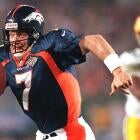
Late in the third quarter of Super Bowl XXXII, John Elway showed the world what lengths he would go to win his and the Broncos' first Super Bowl.
Elway and the Broncos' offense were facing a third-and-6 from the Packers' 12-yard line with the score tied 17. As he dropped back to pass, Elway spotted a running lane on the left side of Green Bay's defense and decided to take off. After taking a quick glance at the first down markers, Elway turned upfield before launching himself into two Packers defenders, who hit him high and low but were unable to prevent the 37-year-old quarterback from picking up the first down.
"The Elway-Copter"
— Kevin Gallagher (@KevG163) January 25, 2025
Super Bowl XXXII
John Elway's clutch 8-yard, third-down run in the third quarter of #Broncos' first Super Bowl triumph. #BroncosCountry
January 25, 1998 pic.twitter.com/4fim3E57r3
While Elway's "helicopter leap" has gone down in Super Bowl lore, there are several other reasons why the Broncos' 31-24 win over the Packers is considered one of the greatest games of all-time.
Previous Super Bowl losses
Elway and the Broncos were back in the big game eight years after losing their third Super Bowl in four years. Each of those losses came in decisive fashion, including a 55-10 loss to the 49ers in Super Bowl XXIV, which remains the largest blowout in Super Bowl history. Denver also lost to the Giants, 39-20, in Super Bowl XXI and was routed, 42-10, by Washington in Super Bowl XXII.
Denver fell into the background in the early '90s as the Bills replaced them as the AFC's preeminent team. That started to change, however, after the Broncos hired Mike Shanahan, who had just won a Super Bowl as the 49ers' offensive coordinator prior to coming to Denver.
Shanahan led the Broncos to an AFC-best 13-3 record during his second year in Denver. But the Broncos' 1996 season ended in heartbreak after they were stunned by the Jaguars (then a second-year expansion team) in the divisional round of the playoffs. Elway has said that the loss was worse than any of his previous Super Bowl defeats.
Fittingly, the Broncos decided to have a facelift going into the 1997 season. They ushered in new uniforms, which actually helped compel longtime Chiefs pass rusher Neil Smith to sign with them that offseason (he had stated that he couldn't see himself wearing the Broncos' old uniforms after going against them so many times in Kansas City). The new-look Broncos started hot, winning nine of their first 10 games.
But Denver struggled down the stretch, losing a last-second game to the Chiefs at Arrowhead Stadium before suffering decisive road losses to the Steelers and 49ers. And while they ended the regular season by blowing out the Chargers, the sentiment was that the Broncos were not a hot team going into the playoffs.
The Broncos clearly got a second wind in the playoffs, though. In what was hailed as a redemption tour, they dismantled the Jaguars in the wild-card round before edging the Chiefs on the road in the divisional round. The Broncos then clinched their Super Bowl ticket after holding off the Steelers in Pittsburgh.

Packers trying to make history
Despite their postseason success, the Broncos were 11.5-point underdogs entering their Super Bowl showdown against reigning league MVP Brett Favre and the rest of the defending Super Bowl champion Packers.
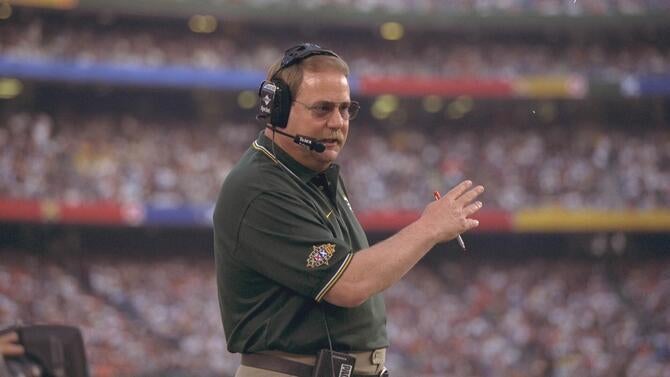
Led by coach Mike Holmgren, the Packers had a star-studded roster that included Favre (who had just won his third of three consecutive league MVPs, sharing the award that year with Barry Sanders) and fellow future Hall of Famers Reggie White and LeRoy Butler. Green Bay had a dynamic receiving corps, a punishing running back in Dorsey Levens and a massive defensive line that featured White and 340-pound defensive tackle Gilbert Brown.
Green Bay did not, however, have special teams wizard Desmond Howard, who signed with the Raiders shortly after becoming the first special teams player to win Super Bowl MVP following Green Bay's win over the Patriots in Super Bowl XXXI.
In addition to trying to win back-to-back Super Bowls, the Packers were also trying to extend the NFC's Super Bowl winning streak. The NFC had won 13 straight Super Bowls, and it appeared to be a foregone conclusion that the streak would reach 14 after the Packers scored a touchdown on the game's opening drive. Ironically, Green Bay's scoring drive included three 13-yard gains before Favre and Antonio Freeman connected for a 22-yard touchdown.

Davis' record-setting performance
While they were massive underdogs, the Broncos had an ace up their sleeve in Terrell Davis, who rushed for 1,750 yards in the regular season before rushing for 184, 101 and 139 yards in Denver's three playoff games, respectively.
"The NFC's [mentality] was, 'Just show up and you'll win the Super Bowl.' And we felt all that," Davis recalled in a previous interview with CBS Sports. "Every single doubter was out there saying, 'Same old Broncos.' And we knew we were a totally different team. We were built different. We were more of an NFC-style team in how we ran the ball. We were physical, and our defense was really good."
In his third season, Davis overcame humble beginnings to become an NFL star. He was lightly recruited out of high school and spent his freshman season at Long Beach State before the program dissolved before his sophomore season. Davis was picked up by Georgia, but issues between him and his coach prevented him from reaching his potential in three seasons with the Bulldogs.
A sixth-round pick in the 1995 NFL Draft, Davis cracked the Broncos' starting lineup as a rookie and rushed for 1,117 yards. He led the AFC in rushing the next two years while excelling in Shanahan's zone blocking scheme.
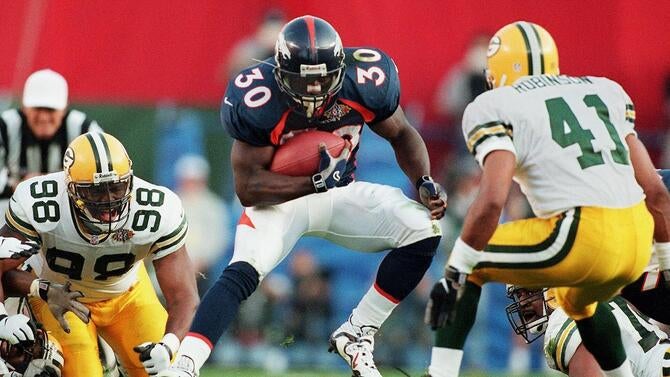
Davis capped off the Broncos' first drive with a touchdown run against the Packers, marking the first time in Super Bowl history that both teams scored on their opening drives. The Broncos took the lead moments later on a short touchdown run by Elway, but things were not looking good for Denver's talented running back.
Davis, who had a long history of migraine headaches, forgot to take his medication prior to kickoff. He immediately realized his faux pas after being inadvertently kneed in the head by a Packers defender near the end of Denver's second scoring drive.
Davis immediately started suffering the symptoms of a migraine, which included loss of sight. He quickly informed Shanahan, who implored Davis to return to the game as a decoy on Elway's eventual touchdown run off play-action.
Following Elway's score, Davis went to the locker room, and the Broncos' offense basically left with him. With Davis gone, Denver didn't gain a single rushing yard in the second half. They took a precarious 17-14 lead into intermission after the Packers ended the half with a 95-yard scoring drive.
Denver appeared to be on its way to another Super Bowl collapse when Davis -- who returned for the start of the second half -- fumbled on the first play of the third quarter. Denver's defense minimized the damage, though, by forcing the Packers to kick a game-tying field goal.
Davis and the Broncos' offense responded moments later with a 92-yard drive that included eight runs by Davis, a 36-yard completion from Elway to Ed McCaffrey (the father of Christian McCaffrey, who was in attendance) and Elway's iconic helicopter leap.
With the score tied again late in the fourth quarter, runs of seven and 17 yards by Davis set up his third touchdown run of the day, a Super Bowl record. It was part of an MVP performance by Davis, who rushed for 157 yards on 30 carries despite missing virtually the entire second quarter.
All three of Davis' one-yard touchdown runs were capped off with a patented "Mile High Salute."
Terrell Davis Super Bowl XXXII Montage
— Kevin Gallagher (@KevG163) January 25, 2025
The #Broncos stud fights through migraines to become the first player to rush for three touchdowns in a #SuperBowl.
157 hard yards, 3 TD, MVP#BroncosCountry's first ring
January 25, 1998 pic.twitter.com/hOettEyF9a
A San Diego native, Davis won Super Bowl MVP honors in his hometown while becoming the second player from his high school to win Super Bowl MVP. Ironically, the first player from Lincoln High School to win Super Bowl MVP was Marcus Allen, a fellow running back who won the award the last time the AFC won the Super Bowl before Denver's upset of Green Bay.
Davis' success was a testament to the Broncos' small but mighty offensive line, which had its way with Green Bay's massive defensive front that included White and Gilbert Brown, the 340-pound defensive tackle. While many thought their size would be an advantage against the Broncos, it turned out to be a detriment, as attrition became a key factor in the second half.
Super Bowl XXXII was part of a historic three-year run for Davis, who would win league MVP the following season while becoming the fourth player to rush for over 2,000 yards in a season. Davis also set the NFL record for rushing yards in a season -- including the postseason -- in consecutive seasons. His record lasted 26 years before Saquon Barkley topped it last year.
Elway vs. Favre
One of the greatest quarterback showdowns in Super Bowl history, Elway and Favre's performances in this game are both memorable for different reasons.
Elway's leap has rightfully overshadowed his underwhelming stat line (12 of 22 for 123 yards and a pick). His leap -- which was immediately hailed by Broncos play-by-play announcer Dave Logan as "the greatest eight-yard run in Super Bowl history" -- not only set up Davis' go-ahead touchdown, it gave the Broncos an unshakeable confidence that they would win the game.
An iconic play that almost wasn't. 🚁@johnelway & Mike Shanahan break down The Helicopter:#UnbeatableMoments pic.twitter.com/tRz79t94V6
— Denver Broncos (@Broncos) January 25, 2023
Denver had a golden chance to distance itself further on the ensuing kickoff when Tim McKyer pounced on a fumble by Freeman. Elway, however, gave the ball right back to the Packers after his reckless pass was picked off in the end zone by Eugene Robinson.
Favre immediately responded with a 27-yard pass to Freeman, who ended the drive by catching a bullet from Favre that tied the score early in the fourth quarter. At this point, everyone watching was well aware that they were witnessing one of the greatest Super Bowls of all time.
Over the next 10 minutes, Elway and Favre each had two possessions to mount a go-ahead drive. Each drive ended the same way: both quarterbacks failed to come up with a clutch third-down pass, leading to a punt. Favre is likely still haunted by his third-down pass to Freeman that was just off the mark.
That incompletion set the stage for what was the game-winning drive, which started on the Packers' 49-yard line. The drive's big play was Elway's 23-yard completion to fullback Howard Griffin that included a bone-shattering block by McCaffrey on unsuspecting Packers linebacker Brian Williams.
Ed McCaffrey picks up a HUGE block for Howard Griffith
— The Broncos Daily 🗞 (@TheBroncosDaily) May 13, 2024
Super Bowl XXXII
Broncos vs Packers
January 25th, 1998 pic.twitter.com/FNJ7zYvRCB
Needing to travel 70 yards in 1:39, Favre quickly went to work with completions of 22 and 13 yards to Levens, who finished as Green Bay's second leading receiver with 56 yards on six catches. But after a four-yard completion to Levens, Favre misfired on his next two passes, setting the stage for a fourth-and-6 play that would either keep Green Bay's hopes alive or jumpstart Denver's celebration.
Favre quickly scanned the field before throwing a short pass to tight end Mark Chmura, who had caught a touchdown pass earlier in the game. The pass was broken up by Broncos linebacker John Mobley, which led to immediate euphoria from Elway and the rest of the Broncos' sideline.
The throw was Favre's final one in the Super Bowl competition. In many ways, that game was a microcosm of Favre's 20-year career. While he was capable of doing some brilliant things, Favre's penchant for committing turnovers (he committed two turnovers in the first half that led to 10 Broncos points) was often his and his team's undoing.

Holmgren's controversial decision
Davis' game-winning touchdown looked odd the second he waltzed into the end zone. Davis scored with so much ease -- he wasn't touched while going through a hole you could have driven a bus through -- that it quickly became obvious that Holmgren had instructed his defense to allow the Broncos to score so that it would give Favre and the offense more time to try to tie the score and force overtime.
"It was a strategy," Holmgren said afterward. "I felt it was our only chance to win the football game."
While his logic made sense, the fact that it didn't work has made it one of the most controversial decisions in Super Bowl history. It may also be why he hasn't yet been inducted into the Pro Football Hall of Fame, despite a résumé that includes being the first head coach to lead multiple franchises to the Super Bowl. He also has an impressive coaching tree, including Chiefs coach Andy Reid, who was the Packers' quarterbacks coach and assistant head coach during Super Bowl XXXII.
It's also fair to question Holmgren's offensive game plan. Despite facing a Broncos defense that had allowed the highest yards-per-carry average of any Super Bowl team up to that point, Holmgren gave Levens (who rushed for 1,435 yards during the regular season) the ball just 19 times for 90 yards.
'This one's for John'
After one kneel down, Elway thrust his arms into the air before being engulfed by teammates and photographers. He was briefly placed on the shoulders of several teammates before making his way to the podium, where he was flanked by Shanahan, then-Broncos owner Pat Bowlen and then-NFL commissioner Paul Tagliabue.
Tagliabue then presented the Vince Lombardi Trophy to Bowlen, who made some brief remarks before turning to his quarterback.
"There's only four words: This one's for John!"
With that, Elway put down the game ball so he could lift the trophy that had eluded him for 15 years.
25 Years Ago Today
— Kevin Gallagher (@KevG163) January 25, 2023
"THIS ONE'S...FOR JOHN!" 🏆#Broncos owner Pat Bowlen delivers the Lombardi to John Elway
Super Bowl XXXII, #Denver's first ring pic.twitter.com/XWNr99ZwlM
Aftermath
At the time, the Broncos' victory was the second-biggest upset in Super Bowl history and the biggest since the Jets' upset win over the Colts in Super Bowl III. It is still the fifth-largest upset in Super Bowl history.
The Broncos became the second team in history to win the Super Bowl as a wild card team (the 1980 Raiders were the first team to do so). Since Super Bowl XXXII, only five other wild card teams (the 2000 Ravens, 2005 Steelers, 2007 Giants, 2010 Packers and 2020 Buccaneers) have won the Super Bowl.
Green Bay was denied the chance of becoming the seventh team to win back-to-back Super Bowls. Ironically, the Broncos would earn that distinction a year later after dominating the Falcons in Super Bowl XXXIII. Elway was named MVP after throwing for 336 yards and scoring two touchdowns. He retired that offseason, thus ending the Broncos' two-year reign atop the NFL.
Holmgren left the Packers after Green Bay's 1998 season ended with Steve Young's dramatic, game-winning touchdown pass to Terrell Owens in the wild-card round. He resurfaced in Seattle, where he enjoyed a successful 10-year run that included the franchise's first Super Bowl appearance in 2005.
Shanahan remained in Denver through the 2008 season before finishing his career in Washington. Part of his legacy is his impressive coaching tree that includes Sean McVay, Mike McDaniel, Matt LaFleur, Gary Kubiak, and his son, Kyle Shanahan, who was on the sideline during Super Bowl XXXII.
Super Bowl XXXII featured eight future Hall of Famers: Favre, Elway, Davis, White, Butler, Broncos tight end Shannon Sharpe, Broncos guard Gary Zimmerman and Denver safety Steve Atwater. Shanahan and Holmgren are still awaiting their gold jackets despite being perennial Hall of Fame candidates.
"Mike was phenomenal," Davis said of his former coach. "He was a teacher. The way he prepared us for games. The way he allowed us to have input and to create the environment for training, recovery, nutrition, all that stuff.
"We probably had the most people on our staff in terms of people who weren't coaches that Mike brought in because players said, 'Mike, I think this guy would be good if we bring him in on our staff.' That's how we rolled."
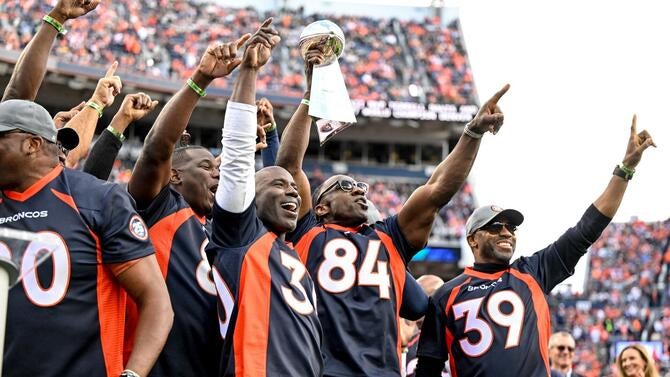
In 2019, Super Bowl XXXII was voted the 27th greatest game in NFL history, with Elway's "helicopter spin" ranked the 33rd greatest play in league history. The 1997 Broncos were tabbed as the 50th-greatest team of all time, while the '98 team was ranked 14th all time.
"We are one of the greatest teams to ever play," Davis said. "We're a team that could go play in any era [because] we weren't a gimmick team. Sometimes you see a team that runs the Wildcat where they might be successful because they were new and no one saw that. Now you've got the RPOs, where when they first started doing it, defenses couldn't stop it. ... We didn't have anything gimmicky like that.
"We had really, really good players. We had outstanding coaching. We had a solid system. We had a combination of really unselfish guys who played for each other who didn't really care who got the credit, and that's rare. And we had a singular focus. We were the Patriots before the Patriots. They talk about the Patriot Way; well, we had the Bronco Way. We had players who didn't buy into that, and Mike moved them out of there."
Elway, the driving emotional force behind those teams, served as general manager and executive vice president when the Broncos captured their third and most recent Super Bowl win at the end of the 2015 season. On the podium following Denver's 24-10 win over the Panthers, Elway had a full-circle moment as he dedicated the win to Bowlen, who had given Elway that honor 18 years earlier.