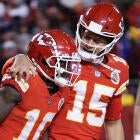


Bo Nix is 28-12 through his first 40 NFL starts, more victories than John Elway and Peyton Manning had over that same stretch. Among active quarterbacks, only Patrick Mahomes and Lamar Jackson had better records at this point in their careers.
There's just one problem: Nix is directing one of the NFL's least productive offenses, and his individual numbers are getting worse. So what exactly should we make of all that success?
Thursday night's 17-14 overtime victory against Seattle might have been the most extreme example yet. Denver managed 168 yards of offense, averaged 2.9 yards per play and gained a grand total of 38 yards on 25 plays after halftime. Nix finished with 107 passing yards, averaging exactly four yards per attempt.
Former NFL quarterback Ryan Fitzpatrick wasn't nearly as forgiving. During Amazon's postgame show, he ripped Nix's performance, saying, "He's not playing competitive football right now," and later calling it "almost disrespectful to the quarterback position."
So, yeah … the Broncos improved to 4-2 and extended their streak of one-score victories to 14 games. Their defense dominated for long stretches, forcing turnovers and capitalizing on Seattle's mistakes. And it's not a stretch to suggest they accomplished all this in spite of, not because of Bo Nix.
Denver has a defense capable of carrying this team to the Super Bowl. But if Nix can't give the Broncos more than he has through the first six games, none of that matters. Put more bluntly: How much longer are they willing to wait for him to figure it out?
What Nix's first 39 starts actually tell us
It's easy to look at Nix's 2026 numbers, throw your hands up and conclude that he's suddenly fallen apart. The third-year quarterback has undoubtedly gotten worse this season, but some of the problems have been there all along.
Nix threw 29 touchdowns and 12 interceptions as a rookie in 2024 and helped Denver reach the playoffs. He followed that with another winning season, and through his first 39 starts, he'd thrown 60 touchdowns, completed 64.2% of his passes and piled up 8,648 passing yards.
Those aren't bad numbers, and Nix, at times, has looked comfortable running Sean Payton's offense. Enough to give Denver reason to believe it had found its long-term answer. But look a little deeper, and the picture starts to change.
Nix's efficiency -- how consistently he moves the ball, creates big plays and avoids negative ones -- doesn't quite match his impressive record, according to TruMedia. To put that into perspective, we compared him to a sample of 74 other quarterbacks drafted since 2008, looking at how each performed through his first 39 starts over his first three NFL seasons.
Nix | Rank | |
EPA/dropback | +0.05 | 30th |
Success rate | 43.4% | 40th |
Yards/attempt | 6.4 | 59th |
Adjusted yards/attempt | 7.0 | 73rd |
Explosive plays/dropback | 7.4% | 45th |
Sack rate | 3.7% | 1st |
Pressure-to-sack rate | 11.2% | 75th (best) |
Nix excelled at avoiding sacks, getting the ball out quickly and keeping Denver out of trouble. But there was a tradeoff: He wasn't making nearly enough big plays through the air, and his 6.4 yards per attempt ranked 59th among the 75 quarterbacks in our sample.
In other words, Nix was good at avoiding mistakes, but not nearly as good at making plays that could change a game. And through six games in 2026, even that formula has started to fall apart.
The warning signs are getting harder to ignore
Nix isn't just throwing shorter passes. He's taking fewer chances downfield, making more turnover-worthy plays and struggling to move the offense. And when he does drop back, he's getting less out of those opportunities than at any point in his career.
Consider how his numbers have changed since his rookie season.
2024 | 2025 | 2026 | |
Yards/attempt | 6.7 | 6.4 | 5.6 |
EPA/dropback | +0.05 | +0.11 | -0.12 |
Average depth of target | 7.8 | 8.0 | 6.3 |
Big-time throw rate | 3.5% | 4.8% | 2.4% |
Turnover-worthy play rate | 1.9% | 2.8% | 5.0% |
Accuracy percentage | 76.7% | 75.6% | 74.7% |
Pressure-to-sack rate | 13.3% | 10.1% | 10.1% |
There was genuine progress in 2025. Nix's EPA per dropback increased, his big-time throw rate improved and he did a better job of avoiding sacks when pressured. That's meaningful, and it offers at least some evidence that he was improving.
But through six games in 2026, those gains have largely disappeared. His big-time throw rate has been cut in half, his turnover-worthy play rate has nearly doubled from last season and his EPA per dropback has turned negative.
And while his accuracy rate has remained stable, he's generating fewer first downs, explosive plays and touchdowns. And he's putting the ball in harm's way more often.
There's also the ankle injury to consider. Nix underwent surgery after fracturing his right ankle in January's playoff win over Buffalo, but he has repeatedly insisted he's fully healthy. Asked directly after Denver's Week 4 loss to San Francisco whether the injury was affecting his play, he offered a one-word answer: "No."
It's certainly fair to wonder, based on what we've all witnessed this season, if that's not entirely true. There's also the fact that Payton has commandeered play-calling duties from offensive coordinator Davis Webb, hoping to jump-start an offense that had struggled through its first four games.
So far, it hasn't helped. Denver managed just 224 yards against the Chargers in Week 5 and 168 against Seattle, and the Broncos now rank 31st in yards per game and last in yards per play. Payton helped Nix develop over his first two seasons, but the last two weeks have only raised more questions about whether he'll ever become the quarterback Denver envisioned when they drafted him.
How Nix compares to the other QBs in that 2024 draft class
Nix was the 12th overall pick, and the sixth quarterback taken in the 2024 NFL Draft, behind Caleb Williams, Jayden Daniels, Drake Maye, Michael Penix Jr. and JJ McCarthy.
Some two-and-a-half seasons later, how does Nix stack up against his classmates?
Maye helped lead the Patriots to the Super Bowl in Year 2, while Daniels took Washington to the NFC Championship Game as a rookie. Williams made significant strides under Ben Johnson in 2025, leading Chicago to a division title and a playoff victory, and Penix has been surprisingly impressive this season. Even with injuries complicating the comparisons, there's enough evidence to suggest every quarterback in this class not named Nix or McCarthy is developing into the player their teams envisioned.
2024 first-round QB class: NFL passing production, 2024-26
Quarterback | Games | YPA | EPA/dropback | TD-INT |
Drake Maye | 35 | 8.1 | +0.17 | 54-25 |
Jayden Daniels | 27 | 7.1 | +0.14 | 36-12 |
Michael Penix Jr. | 17 | 7.6 | +0.11 | 15-7 |
Bo Nix | 40 | 6.4 | +0.05 | 60-26 |
Caleb Williams | 36 | 6.7 | +0.05 | 49-14 |
J.J. McCarthy | 10 | 6.7 | -0.10 | 11-12 |
Nix has started more games than anyone in the group, and unlike several of his classmates, he's had the same coach and offensive system since arriving in the NFL. That stability should have helped his development, and for a while, it appeared to. But through six games in '26, Nix is heading in the wrong direction.
That doesn't mean Denver should give up and move on. But after 40 starts, his struggles raise a bigger question: How much longer should the Broncos expect to wait for a breakthrough?
What history says about young QBs who struggle this long
So what happens to quarterbacks whose numbers look like Nix's after some 40 starts? Do they figure it out, or is three seasons enough to know what you have?
The good news for Denver is that some quarterbacks do turn things around. The bad news? Most don't suddenly become stars. There's a big difference between improving enough to keep your job and becoming the guy who can carry a team to the Super Bowl.
We used TruMedia data to look at 24 quarterbacks whose early-career efficiency resembled Nix's, then compared their first 39 starts with their next 21. Nine improved their EPA per dropback by at least 0.05. But just four reached +0.10 or better, and as it turns out, even that didn't guarantee long-term success.
What happened to quarterbacks who started their careers like Bo Nix?
Quarterback | First 39 starts | Starts 40-60 | Starts 61-80 |
+0.06 | +0.15 | +0.21 | |
+0.06 | +0.18 | +0.12 | |
+0.05 | +0.17 | -0.02 | |
+0.06 | +0.10 | -0.10 | |
+0.01 | +0.06 | -0.08 | |
0.00 | +0.06 | -0.02 | |
+0.01 | +0.03 | +0.15 | |
-0.03 | +0.05 | -0.09 | |
Mitchell Trubisky | +0.01 | -0.02 | — |
0.00 | -0.13 | — |
Josh Allen and Dak Prescott give Denver some hope. Both started with numbers similar to Nix's, took major steps forward over their next 21 starts and continued to produce at a high level over the following 20 games. Andy Dalton, stylistically a much closer comp to Nix than Allen or Prescott, needed a little longer, making his biggest leap between starts 61 and 80.
Others followed a different path. Tua Tagovailoa, Jared Goff and Baker Mayfield initially improved, only to see their numbers fall off during the next 20 starts. Derek Carr and Blake Bortles also made gains before regressing, while Mitch Trubisky and Mark Sanchez, both top-5 picks in their respective draft classes, never made much progress. Of course, Goff and Mayfield eventually turned their careers around, which shows that development is rarely linear.
And there's another catch: Our comparison only includes quarterbacks who had at least 300 dropbacks after their first 39 starts. Some struggling quarterbacks never got that opportunity because their teams moved on. Put another way: The odds of a turnaround may be even worse than our numbers suggest.
So where does that leave Nix? He's done enough to keep his starting job for now, but his performance has gotten worse in Year 3. History offers some hope that he can still figure things out, but it also gives Payton and general manager George Paton good reason to wonder how much longer they should wait.
How much longer can Denver afford to wait?
Under ordinary circumstances, the answer might be straightforward. Nix is still young. He's won a lot of games, and the Broncos have invested heavily in his development. Give him more time and see where things go.
But Denver isn't in an ordinary situation.
The Broncos have a defense capable of keeping them in every game. They have a coach who has already won a Super Bowl, and they've built a team that doesn't need its quarterback to throw for 350 yards every week.
What they need is an offense that can consistently move the ball. Right now, it's nonexistent.
And that's what makes the coming offseason potentially so important. Nix is under contract through 2027, with Denver holding a fifth-year option for 2028. The Broncos don't have to decide his long-term future just yet, but they can't afford to waste a championship-caliber defense waiting for him to develop.
There's no guarantee this defense will be this dominant in 2027, never mind 2-3 years down the road; injuries happen, contracts expire, players and units regress, and championship windows can slam shut.
That doesn't mean Denver needs to move on from Nix, but they would be foolish not to start considering other options. Nix can change the conversation over the next few months. But Payton and Paton also need to prepare for the possibility that the quarterback they have isn't the one they need to win a Super Bowl.
That could mean using a 2027 draft pick on a quarterback or bringing in legitimate veteran competition. Neither would necessarily mean giving up on Nix – J.J. McCarthy might like a word, I know. Either way, it would give Denver another option if his struggles continue.
(By the way, I've documented – extensively, some might say – Arch Manning's struggles this season for Texas. He wasn't a first-round pick in my latest mock draft, or the latest mock draft we did on the "With the First Pick" podcast … that said, imagine if Payton got his hands on him. Just something to think about.)
The Broncos have spent two-plus seasons waiting for Nix to grow into a franchise quarterback. They can afford to give him more time, but they can't afford to squander a Super Bowl window hoping for a breakthrough that may never come.