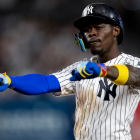
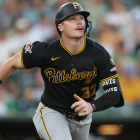
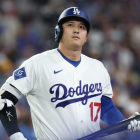
While the New York Mets have made the biggest splash of all in the soon-to-be-paused offseason of 2026-27 with their $450 million investment in ace Tarik Skubal, the Chicago Cubs have been the most active club this winter.
Consider the free-agent additions the Cubs have made so far:
- Signed left-handed starting pitcher Trevor Rogers to a five-year, $120 million contract;
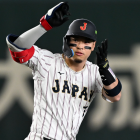
- Signed outfielder Teruaki Sato out of Japan to a six-year, $120 million contract;
- Agreed to terms with right-hander Hiromi Itoh out of Japan;
- Signed lefty reliever Ryan Yarbrough to a one-year, $2.5 million contract with a $3.5 million club option for 2028.
That's four signings, two of which -- Rogers and Sato -- landed the Cubs a pair of the top free agents in the current class. That's almost a quarter-billion dollars in free-agent investments, and that's before you account for Itoh's as-yet-unknown terms. However, there's more to the story here.
Coming off a fourth-straight winning season and second-straight playoff berth, the Cubs are squarely in contending mode, even though they share a division with the world-champion Milwaukee Brewers, winners of the last four National League Central titles. The moves above, though, can't be viewed in isolation. This isn't a team stacking up improvements and reinforcements to make up ground on the team ahead of them (although that could of course be the end result).
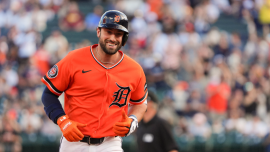
Rather, this is a contender trying to retain that status in the face of what figures to be an offsetting number of free-agent departures. It's churn, in other words, but churn of important core contributors rather than back-of-the-roster types. These somewhat uncommon circumstances mean the Cubs' offseason to date merits a closer look. Let's undertake that now.
What the Cubs stand to lose
There's still a lot of offseason left, and things could change. Right now, though, the Cubs figure to be one of the hardest-hit teams when it comes to free-agent departures. Consider which members of the 2026 Cubs model are presently available for hire or have already signed with other clubs:
- Outfielder Seiya Suzuki (5.1 WAR in 2026);
- Outfielder and Cubs lifer Ian Happ (2.7 WAR in 2026);
- Lefty starter Shota Imanaga (2.0 WAR in 2026);
- Starting catcher Carson Kelly (1.9 WAR);
- Lefty starter Matthew Boyd (1.1 WAR);
- Lefty starter David Peterson (0.9 WAR, signed with Colorado Rockies);
- DH Michael Conforto (0.7 WAR);
- Deadline rotation additions Clay Holmes and Kevin Gausman (signed with Detroit Tigers).
Add it up, and that's 14.6 WAR out the door, or the rough equivalent of two strong MVP candidates in terms of gross value, and that's not getting into a large number of bullpen departures. That's 86 starts out the door on the pitching front, and it's also more than $75 million in 2026 salaries off the books.
As you can see, there's no way to evaluate the Cubs' signings thus far without recognizing that a lot of talent is on the way out. In a sense, lead decision-maker Jed Hoyer and the Cubs are not powering up as much as they're attempting to hold serve.
What the Cubs have gained
These are obviously significant additions -- additions that notably improve the Cubs' post-exodus baseline. Rogers is a key addition to a rotation that's been fairly hollowed out by injuries and pending departures (Justin Steele, Cade Horton, and Ben Brown, meanwhile, are all working their way back from injuries and aren't fully known quantities for 2027). Rogers has a stuffed repertoire and stuff and pitch traits that all suggest he's got a higher ceiling. He's also still on the right side of age 30.


Itoh, 29, posted a 3.18 ERA, 1.26 WHIP and 159/34 K/BB over 172.2 innings during his most recent season in Japan. He's got a full pitch mix even by the standards of NPB, and he's been durable despite, it would seem, his modest 5-foot-9, 180-pound stature. In MLB, he projects as a reliable back-end starter with perhaps some untapped velocity. While he lacks Rogers' upside, Itoh has "stabilizer" potential.
Sato, considered a primary corner infielder coming into the offseason, will instead plug one of the Cubs' corner-outfield vacancies. He'll play the entire 2027 season at age 28 and is coming off a .306/.383/.609 slash line with 39 home runs, which won him Japan's first Triple Crown since Munetaka Murakami achieved the feat in 2022. The power is real, but so is the swing-and-miss. He's also not as patient of a hitter as Murakami is for the crosstown Chicago White Sox. He's going to be a quality player in MLB, but replacing Suzuki, which is what is, in essence, happening barring further additions, is a tall order.
Additionally, Yarbrough, who soon turns 35, gives them a badly needed second lefty in the pen.
Where it leaves the Cubs
Let's circle back to all those outgoing free agents and emphasize that the cupboard is hardly bare on the North Side. Reigning NL MVP Pete Crow-Armstrong is locked up through 2032, and going into his age-25 campaign, he should still be operating at peak. The excellent defensive infield of Alex Bregman, Dansby Swanson, and Nico Hoerner is back, and Matt Shaw may be poised to take the next step now that he's slated for every-day duty in left field.
The rotation is in reasonable shape, albeit with some health and effectiveness concerns in spots. The Cubs are no doubt hoping that Brown and Horton provide a boost in the second half or down the stretch. It's not unreasonable for Hoyer and company to target a third rotation addition this offseason, given the scale of the losses.
On the bullpen front, there's more to do. As a group, the four departing relievers don't constitute much of a loss, as they combined for a 4.42 ERA and a 5.31 FIP in 116 appearances. Trent Thornton's quality innings, however, will be missed, and a play for additional depth from the right side is in order.
In the end, what do you have? You have a Cubs team that, once the debits and credits are tallied up, still projects as a playoff threat in the NL. However, they do not currently appear to be a serious threat to the 103-win Brewers atop the NL Central. Much has been done in Chicago, yes, but much stands to be lost.
Ultimately, the story of the 2027 Cubs will be told not necessarily by whether they topple the Brewers, but rather by whether they're able to make a deep October run for the first time in roughly a decade.