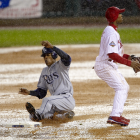


The 2026 MLB trade deadline wasn't simply about talent changing teams. It was about front offices confronting ideas they had spent years believing.
Some executives finally stopped clinging to prospects, cashing them in to improve their major league clubs. Others held onto them, only to learn that patience can backfire, too.
"No fan base is ever satisfied," one American League executive said.
More than anything, though, the deadline proved that making a trade is hard enough. Admitting the way you've been thinking no longer works is even harder.
Four American League East clubs embodied that reality in very different ways. Let's break it down.
Craig Breslow's Red Sox change their philosophy
When chief baseball officer Craig Breslow acquired Curtis Mead from the Nationals in exchange for starter Connelly Early, it signaled a shift in his thinking. Early, a 24-year-old left-hander, was widely viewed throughout the industry as the superior talent with the brighter long-term outlook.
For more than five years, the Red Sox have prioritized tomorrow over today, valuing promise over proven production. Most evaluators viewed Early as a future rotation fixture.
Sure, Mead unlocked a swing that helped tap into his power potential, producing 17 home runs and an .854 OPS in Washington. But Early represented exactly the type of prospect Breslow had spent his first three years in charge acquiring.
The trade suggested Breslow's philosophy had changed. His words confirmed it.
"A lot of front offices are looking at very similar information, so trying to find an opportunity to win a trade is not as easy as maybe it would have been at another point," he said. "And instead, in this position I've tried to shift to -- our goal is not to win the trade, our goal is to make our major league team better."
Then came the Adley Rutschman trade. Breslow doubled down, surrendering right-hander Anthony Eyanson (the organization's No. 2 prospect), right-hander Kyson Witherspoon (No. 4), outfielder Enddy Azocar (No. 5) and MLB catcher Carlos Narváez. Boston also acquired catcher Jake Rogers and cash considerations.
Asked why he was willing to pay such a steep price, Breslow reiterated that philosophy.
"He is a proven star in this league," Breslow said about Rutschman, the three-time All-Star catcher. "We've obviously seen him a lot over the last few years in a position where we felt like there was an opportunity to bring someone in and improve the outlook here, [you do it]."
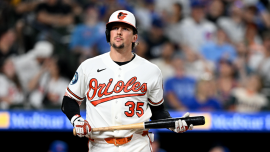
The Red Sox -- who are an MLB-best 31-9 since June 18 and have vaulted themselves into playoff position -- also sent shortstop and former highly touted prospect Marcelo Mayer to the Giants for reliever Erik Miller and later dealt pitcher Tyler Uberstine to the Braves for outfielder Eli White.
With Rutschman, the Red Sox are betting they can get back the catcher who was widely viewed as one of the best in the game when he burst onto the scene in 2022. As one American League scout put it, Rutschman was essentially big-league ready the day the Orioles drafted him out of Oregon State in 2019. He immediately delivered, helping transform Baltimore into a contender while earning All-Star selections in 2023 and 2024.
Since then, injuries and inconsistent play have slowed him. Although Rutschman was named an All-Star again this season, he's landed on the injured list three times and is currently sidelined with left wrist inflammation.
In years past, Breslow has come off as tone-deaf at times to some of his colleagues around Fenway Park, unable to see beyond the projection models. This trade deadline was a shift.
"Honestly, I'm glad that he opened his eyes and had the balls to operate like a baseball man," said one major league source.
The Mayer trade shouldn't have come as a shock, either. In many ways, it was probably the best outcome for both sides. Mayer grew frustrated with his playing time during his brief stint in the big leagues, often retreating to his locker, visibly unhappy when he wasn't in the lineup. And despite his obvious talent, there were members of the Red Sox's coaching staff who questioned whether he would ever trim the swing-and-miss from his game enough to become an everyday player. Mayer posted a 35.6% whiff rate against breaking pitches this season, and durability remained another concern. He has yet to play 100 games in a professional season.
"He was a really big part of this organization," Breslow said, "and someone that was looked upon to be part of a core. And I still think that's going to happen. It's going to happen with the San Francisco Giants at this point."
The Red Sox saw an opportunity to reward their big-league club, which had climbed back from 14 games under .500, gone on a 15-game winning streak and now finds itself in the middle of a playoff hunt with the division in sight, trailing the Yankees by just 2½ games for the first wild-card spot.
Prospects and promise could no longer be a part of this run.
Breslow made that clear.

Orioles' failures on full display
It wasn't so long ago that the Orioles clinched their first 100-win season in more than four decades, as well as an American League East title. It was 2023. Rutschman and Gunnar Henderson personified development. Growth from within. That if you stick to the process, the flowers will bloom.
"That's the goal that we set for ourselves," Red Sox shortstop Trevor Story said after the O's clinched nearly three years ago. "And it was realized by them."
What the Orioles would do to go back to that moment.
Because for as many prospects as they held onto, too many failed to reach their potential. Much of that falls on president of baseball operations Mike Elias. Unlike his former Yale teammate, Craig Breslow, Elias never strayed from his prospect-first approach, perhaps because he never faced the same pressure that comes with running baseball operations in Boston. His reluctance to cash in those prospects and address the club's pitching needs ultimately backfired.
Elias admitted as much Monday, telling reporters he got caught up in the narrative.
"Baseball is very humbling. It's not linear, it's constantly changing," he said. "There's injuries and regression. But while there has been a step back, we have a lot going for us in this organization."
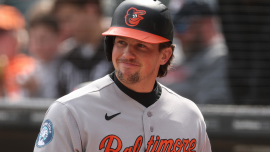
The Orioles surrendered one of their franchise cornerstones in Rutschman, and finding a path to retool around Henderson could prove difficult, with the shortstop just two years away from free agency. The talent is still there, but according to one source, player development has evolved into a one-size-fits-all approach. One former Orioles player told CBS Sports it is "the most analytically driven organization I've ever played for."
Elias is at the forefront of that.

Yankees mostly stand pat, earn ire of the fanbase
Just what did the Yankees do at this deadline to move the needle?
They acquired infielder Luis García Jr., who wasted little time making an impact with a two-run homer Monday against the Cardinals. They also added Giants outfielder Heliot Ramos. That was it.
The Yankees were also in on Adley Rutschman. But general manager Brian Cashman said Monday the asking price became too steep, as evidenced by what the Red Sox ultimately surrendered. Still, watching a division rival land the catcher who filled one of New York's biggest needs won't sit well with a fan base expecting the club to capitalize on its championship window.
Compounding matters, the Yankees still don't know when Aaron Judge will return. They've managed to stay afloat without their captain, but they've hardly flourished, going 27-28 since he landed on the injured list, including Monday night's loss, which came after blowing the lead that García's home run gave them.
New York also pursued Tarik Skubal, but Cashman acknowledged the Tigers "wanted a very specific player," an apparent reference to top prospect George Lombard Jr. (who was called up by the Yankees on Tuesday). Rather than pivot aggressively to other options, the Yankees largely stood pat, making this one of Cashman's more heavily scrutinized deadlines in recent memory.
Blue Jays take a middle ground
When reporters asked Blue Jays general manager Ross Atkins why the 53-60 club decided to keep impending free agent George Springer, his answer was simple: "We wanted him here."
The decision wasn't a surprise. CBS Sports reported Monday that a full-scale selloff in Toronto was unlikely despite the club's sub-.500 record and that the chances of Springer being moved were even slimmer. The Blue Jays ultimately struck a middle ground, trading starter Kevin Gausman, outfielder Daulton Varsho and reliever Jeff Hoffman while holding onto Springer. They also made additions, acquiring starter José Soriano, who doesn't become a free agent until 2029, as well as pitcher Spencer Arrighetti and infielder Josh Smith. This allows the Blue Jays to retool and, in that same regard, contend, as they are just four games out of the final Wild Card spot.