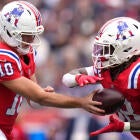
The waiting-on-quarterback strategy has arrived in Superflex leagues.
For the first time in years, it doesn't feel like you have to force quarterbacks onto your roster with your first two picks. You can wait a little bit and still be satisfied with your top two starters at QB.
That happened sooner than expected in our late July Superflex mock when eight passers went in the first two rounds. Only one drafter started QB-QB and just two others took two passers with their first three picks. It has not always been this way.
Grizzled Superflex veterans might think it's crazy to wait too long to collect two signal-callers. Superflex newbies could be goaded into drafting two QBs just so they don't feel like they're falling behind. It's not unreasonable to drag your feet a little, especially since there are only so many promised studs atop Fantasy drafts at other positions. You may be compelled to get the elite-tier players at running back, receiver and tight end before splurging on a second quarterback (and maybe even a first).
You'll know whether or not you feel this way by looking at a rank list of quarterbacks and setting a number of how many you're OK having as your first QB, then another number with how many you're OK having as your second QB. The larger those numbers, the more you should wait to take quarterbacks.
There are exceptions: A chance at Josh Allen shouldn't be passed up. Any of Lamar Jackson, Drake Maye or Joe Burrow before, say, 10th overall shouldn't be passed up. Another five quarterbacks in everyone's rankings after those first four shouldn't be available to draft after Round 2. After that, it might be more of a quarterback trickle than an arms race.
That leaves three strategies to consider for Superflex leagues, each of which must also be coordinated with your sentiments for other positions.
Wait on QBs
Take advantage of the depth, don't rush passers onto your roster in the first two (or three, or four) rounds, then chase quarterbacks who have a pathway to 17 starts and over 20 Fantasy points per game (six-point TDs) or 16 Fantasy points (four-point TDs).
Examples from our Superflex mock:
| 4th overall | 11th overall | ||||
| Rd | Pk | Player | Rd | Pk | Player |
| 1 | 4 | B. Robinson RB ATL | 1 | 11 | J. Taylor RB IND |
| 2 | 21 | J. Jefferson WR MIN | 2 | 14 | A. Jeanty RB LV |
| 3 | 28 | T. McBride TE ARI | 3 | 35 | J. Dart QB NYG |
| 4 | 45 | B. Mayfield QB TB | 4 | 38 | B. Nix QB DEN |
| 5 | 52 | G. Wilson WR NYJ | 5 | 59 | T. McLaurin WR WAS |
| 6 | 69 | C. Ward QB TEN | 6 | 62 | J. Waddle WR DEN |
It's a little strange to think about building a team nucleus without a quarterback in Superflex, but both of these managers waited until at least 35th overall to take a passer and came away with really great non-quarterbacks early. It's probably a lot easier to look at Team 11's quarterbacks and hope for strong seasons than it is for Team 4's, but the key to waiting for a quarterback is to get a pair who can outperform expectations based on where you drafted them. It also helped that Team 4 got two guys who don't figure to lose their jobs. Even in the cases of Baker Mayfield, who was awesome until he got hurt last year, and Cam Ward, who has considerable upgrades around him in Tennessee, there's hope for an upswing.
Draft one QB early
This is probably going to be how most Superflex managers draft their teams: Find a stud early on and then wait for a good value later on. It certainly feels safer, plus it gives a manager a shot or two at adding a non-quarterback with big, fat upside early on.
Examples from our Superflex mock:
| 1st overall | 8th overall | ||||
| 1 | 1 | J. Allen QB BUF | 1 | 8 | J. Smith-Njigba WR SEA |
| 2 | 24 | B. Bowers TE LV | 2 | 17 | J. Hurts QB PHI |
| 3 | 25 | D. London WR ATL | 3 | 32 | A. Brown WR NE |
| 4 | 48 | C. Olave WR NO | 4 | 41 | D. Smith WR PHI |
| 5 | 49 | T. Shough QB NO | 5 | 56 | C. Loveland TE CHI |
| 6 | 72 | T. Etienne RB NO | 6 | 65 | Q. Judkins RB CLE |
I included the first overall pick because pretty much everyone in a Superflex draft will take Allen with the 1.01. That could give you enough conviction to try this plan since your anchor is the best Fantasy passer over the past five years. And candidly you wouldn't complain about Travis Etienne as your RB1 if it meant having Allen, Bowers, London and Olave all on the same squad. I think it's reasonable to expect a similar outcome with your team from this draft slot.
Team 8 went in a similar direction but waited even longer to draft a second quarterback -- Round 8 to be exact (Jacoby Brissett). That manager did not take another quarterback the rest of the way, not even Cardinals rookie Carson Beck, who is a fine handcuff for when/if Brissett is eventually benched. I may have done exactly that move and thus felt a lot better about the build of this team, which like Team 1 is absolutely loaded with pass catchers.
This takes me to an important point: If your league scoring doesn't heavily favor quarterbacks, you can get by starting a non-thrower in your Superflex. But we're talking full-PPR and at max four points per passing touchdowns and at least two points for turnovers. That kind of scoring would allow for the better RBs and WRs to be considered for a Superflex spot over the worst of the QBs. Keep this in mind when it comes to this specific strategy in Superflex leagues.
Draft two QBs early
Maybe even as recently as last season, this was the way a lot of drafters went about their Superflex leagues. It calls for two quarterbacks within the first three selections, if not two. Naturally that meant landing two top-12 Fantasy quarterbacks, an obvious lineup advantage for a team assuming both quarterbacks play well.
Examples from our Superflex mock:
| 3rd overall | 6th overall | 7th overall | ||||||
| Rd | Pk | Player | Rd | Pk | Player | Rd | Pk | Player |
| 1 | 3 | L. Jackson QB BAL | 1 | 6 | P. Nacua WR LAR | 1 | 7 | D. Maye QB NE |
| 2 | 22 | C. Brown RB CIN | 2 | 19 | D. Prescott QB DAL | 2 | 18 | J. Daniels QB WAS |
| 3 | 27 | C. Williams QB CHI | 3 | 30 | B. Purdy QB SF | 3 | 31 | R. Rice WR KC |
| 4 | 46 | T. Higgins WR CIN | 4 | 43 | K. Williams RB LAR | 4 | 42 | G. Pickens WR DAL |
| 5 | 51 | Z. Flowers WR BAL | 5 | 54 | J. Love RB ARI | 5 | 55 | E. Egbuka WR TB |
| 6 | 70 | C. Skattebo RB NYG | 6 | 67 | D. Adams WR LAR | 6 | 66 | B. Hall RB NYJ |
So the good news is that each of these teams have really good quarterbacks given the format, setting their lineups separate from everyone else. Each team also has at least one stud at a different position and a couple of other very good supporting cast players.
The bad news is two-fold: One, if they're wrong on either of their quarterbacks then their team will suffer. That's the case for every team but when early draft investments don't pan out it's trouble. Two, they don't have the same level of elite non-QB talent as their competitors; every team will have a very good supporting cast of non-quarterbacks. Your interest level in non-QB talent may depend on your league's scoring system.
I think you'll need conviction on just how great the top-tier quarterbacks will be in order to take two of them early. But taking two with your first three picks may be a matter of value -- Caleb Williams at 27th overall is arguably the best QB value in the entire draft. You cannot and should not pass up value at quarterback in this type of format, even if it alters whatever plans you have.
The best plan?
This is the best season to not rush drafting two quarterbacks early. The depth at the position makes it easier, and the lack of others in your league rushing to take quarterbacks makes it easier. I'd absolutely change course if it meant getting a steal (like Williams at 27th overall), but otherwise the best plan is to take one early and take at least one other quarterback after the start of Round 4.
There were nine managers who didn't collect a second quarterback until Round 4 in our mock. I'd be surprised if that many waited to get another gunslinger but even if that number was six it would create some good value opportunity for your roster, both in terms of that second quarterback and adding multiple top-tier non-quarterbacks.
I'd also make it a point to snag at least three quarterbacks for obvious reasons. Bye weeks, injuries, benchings ... these are all issues every manager must deal with over the course of the year. But unlike one-QB leagues, the most valuable trade assets in Superflex are for-sure quarterbacks. Imagine snagging Jacoby Brissett or Jaxson Dart last year and dealing them off for an incredible return. Every quarterback you draft is an opportunity to have that kind of potential, even if it's not a great thrower. Sometimes a warm body who will make starts can get you a quality starter at another position in return.
Here's a list of Superflex sleepers with a target round for each.
| Superflex Sleepers | Target Rd |
| Malik Willis, MIA | 5-6 |
| Tyler Shough, NO | 6 |
| Baker Mayfield, TB | 6 |
| Cam Ward, TEN | 6-7 |
| Jacoby Brissett & Carson Beck, ARI | 7 & 11+ |
| Sam Darnold, SEA | 8-10 |
| Michael Penix, ATL | 11+ |
| Fernando Mendoza, LV | 11+ |
| Joe Flacco, CIN | 13+ |
| Anthony Richardson, IND | 14+ |