Fantasy baseball waiver wire: JJ Bleday is quickly becoming a must-add bat with everyday upside
Surging bats, emerging closers and new roles lead the latest waiver wire targets

I've been pretty sure the Marlins would call up Braxton Garrett whenever the first need arose in their rotation. Now I'm pretty sure I was wrong.
The need has arisen, as the Marlins designated Chris Paddack for assignment Tuesday after he put up a 7.63 ERA in his first seven games with the team. But, despite the fact that Garrett both has the most experience of any of the Marlins' top alternatives at Triple-A and is already on the 40-man roster, the Marlins opted to have Garrett make his regularly scheduled start Tuesday at Triple-A. And he threw 80 pitches across five innings in the start, which makes it pretty clear that he isn't going to be the guy they call on when Paddack's turn in the rotation comes around Friday.
So it's probably going to be Robby Snelling. That's not guaranteed, of course. The Marlins could turn to Ryan Gusto or Bradley Blalock, both of whom have MLB experience and are on the 40-man roster already – Blalock, in particular, has had a strong start to the season down in Jacksonville and struck out 12 in his most recent start. It's definitely not a guarantee that it'll be Snelling.
But it probably will be. And it probably should be. He's arguably the team's top pitching prospect and one of the top left-handed prospects in baseball, and it could not be more clear that there isn't much left for him to learn down in the minors. He had a breakout season in 2025 and has now put up a 1.46 ERA with 132 strikeouts in 98.2 innings across 18 career starts at Triple-A. He's had the occasional bout of wildness this season, but he's also coming off a no-hit outing in five innings during his most recent start and has at least nine strikeouts in three of his past five. Plus: His scheduled day to pitch is already Friday, lining him up perfectly for Paddack's spot in the rotation.
There hasn't been any reporting yet indicating which way the Marlins are leaning, but it's hard to come up with a baseball reason why it shouldn't be Snelling. He's the most talented option who is immediately ready and available, and the Marlins clearly have an expectation of competing this season – hence the notoriously frugal front office agreeing to eat the remainder of Paddack's $4 million contract, plus the decision to send Agustin Ramirez down to Triple-A amid his slow start. Passing on Snelling for Blalock or Gusto when he's pitching this well would be hard to justify.
That doesn't mean it's a sure thing. We'll surely find out well in advance of Friday's start, but either way, Snelling will be in the majors before long. If it isn't Friday, it's only a matter of time. He doesn't necessarily project as an immediate ace, but he's a polished lefty with a very good four-seam fastball and multiple secondary pitches with a whiff rate over 40% this season. I don't think he's necessarily an ace, but Snelling has dominated the high-minors since joining the Marlins and has a chance to be an impact arm.
I wouldn't drop someone like Payton Tolle for him, necessarily. But if you'd taken the flyer on JR Ritchie or Cade Cavalli in recent weeks, I'd be happy to drop either for Snelling now. I'd have a tougher decision to make with someone like Logan Henderson, who I like plenty, too, but I do think I would prioritize Snelling over Noah Schultz; he would be a priority stash ahead of Jared Jones, too.
Which is all to say: I would be looking to add Snelling in most leagues even before we know he's going to get called up for sure. The path to a promotion is open, and even if the Marlins don't put him on it this way – though I suspect they will! – he shouldn't be far.
Here's what else you need to know about from Tuesday's action around MLB:
Wednesday's top waiver-wire targets
Here's who we're looking to add coming out of Tuesday's action:
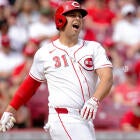
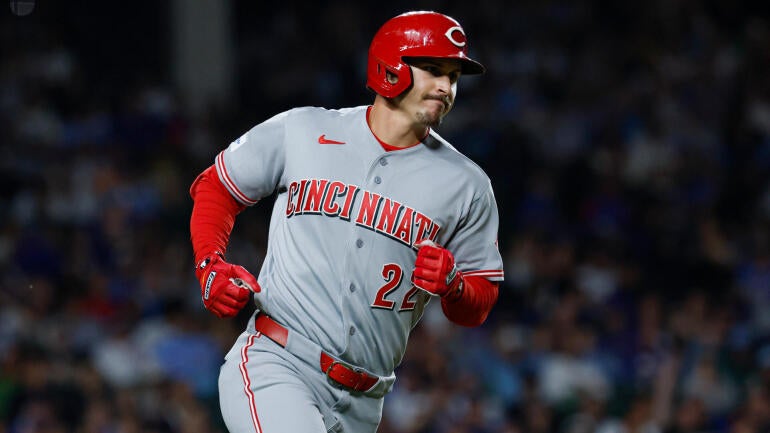
JJ Bleday, OF, Reds (7%) – There's probably going to be a ceiling on how high Bleday's roster rate can climb, seeing as he's likely to remain a platoon bat, but I don't think we're near the ceiling yet. The former top prospect is off to an incredible start to the season, as he homered for the second straight game and third time in four Tuesday, giving him four in eight games since joining the Reds. He's doing that while also showing a great approach at the plate and even a significant increase in bat speed, a sign that this might not just be a hot streak. At the very least, it's worth playing the hot hand until he slows down.
Tony Santillan, RP, Reds (24%) – Emilio Pagan suffered another hamstring injury Tuesday, and this one looks like it's going to be serious. He hopped off the mound after delivering a pitch and immediately went down, ultimately needing a cart to come out and get him off the field. Santillan has been the team's primary eighth-inning option and figures to step up in Pagan's absence. He'll need to keep the walks in check (15.3% walk rate is nearly six points higher than last season), but the strikeouts are still here, and he's been a very good reliever over the past few years for the Reds. He's probably not a shut-down closer, but he could be good enough to provide a boost in saves for as long as Pagan is out.
Jesus Rodriguez, C, Giants (3%) – My assumption when the Giants called Rodriguez up was that it was to serve a relatively small role – backup catcher and perhaps part-time utility player at some other spots to take advantage of his versatility. But the thing is, the Giants are getting absolutely nothing from Patrick Bailey, and it's hard to stomach a .400-ish OPS in your lineup, even from the best defensive catcher in baseball. Especially when you're as desperate for something positive to happen as the Giants clearly are. Which is to say, Rodriguez might have the chance to force their hands here, and he started off well with a homer and a couple of hits Tuesday, his second MLB game. He was hitting .330/.400/.440 at Triple-A before his promotion, and has very good bat-to-ball skills with a surprisingly well-rounded offensive skill set for a catcher. There might be some room for him to steal a lion's share of the work behind the plate from the slumping Bailey, and is perhaps worth a look in deeper two-catcher leagues.
Ryan Zeferjahn, RP, Angels (2%) – The Angels are still searching for their closer, but Zeferjahn is starting to get some pretty high-leverage work. And that includes the final four outs for his first save Tuesday, the third straight game where he has worked in the ninth inning now. Zeferjahn is far from a perfect pitcher – he has walked 11 in 19.2 innings, including two Tuesday – but he's getting the opportunity and does at least have some strikeout upside. I could see Kirby Yates still factoring into this situation now that he's healthy, but he'll need to prove something first. Until then, Zeferjahn should continue to get his chances.
Rico Garcia, RP, Orioles (30%) – Garcia didn't get the save Tuesday, but he did pitch in a closer-ish situation, which is good enough as we look for the Ryan Helsley replacement in Baltimore's bullpen. He pitched the final four outs of the game, coming in with the game tied in the eighth inning and closing it out with a one-two-three ninth after the Orioles took the lead. That's not definitive proof that Garcia is the closer here, of course, and Helsley might be back soon enough that there isn't much time for this situation to get settled. But if you're speculating, Garcia seems like a decent target.
Tuesday's standouts
Bubba Chandler, Pirates @ARI: 5 IP, 2 H, 2 ER, 6 BB, 4 K – Okay, now this one was just weird. Chandler had a 28% called-plus-swinging strike rate, which isn't great, but isn't "more walks than innings" levels of disaster. He had an acceptable 46% zone rate and even threw 63% of his pitches for strikes, including 16 of 22 first-pitch strikes. Those are all at least respectable numbers, if not outright good. And then there's the six walks in five innings. He just couldn't seem to put guys away, which continues to be an issue for Chandler, who has struck out just 40.3% of hitters who have reached a two-strike count against him – an impossibly low number for a guy with the kind of stuff Chandler has when the league average is 41.9%. That's not the only issue for Chandler, but it's an awfully big one for a guy who is supposed to be an elite strikeout pitcher. The stuff is clearly here, but the approach and execution leave much to be desired. I'm still very much inclined to hang on to Chandler and bet on him being able to figure this out, but it's been a very frustrating ride.
Cristopher Sanchez, Phillies vs. ATH: 8 IP, 3 H, 0 ER, 1 BB, 10 K – In two starts since he surrendered six runs on 12 hits, Sanchez has given up two runs on just seven hits in 14.2 innings of work. His WHIP has been a bit higher than you'd like so far this season, which might just come with the territory when you're an extreme groundball pitcher like Sanchez. Oh no, your ace has a sub-3.00 ERA, but it comes with a 1.10 WHIP at the end of the season. There are worse outcomes to befall an ace.
Shohei Ohtani, Dodgers @HOU: 7 IP, 4 H, 2 ER, 0 BB, 8 K – So, we might be at the point where there needs to be some real concern about the impact Ohtani's pitching is having on his hitting. Not that I think his (relatively) slow start is because he's pitching, of course. But Ohtani has now been out of the lineup three times already this season on days when he is pitching, after he sat out just four games as a hitter all of last season. The Dodgers want Ohtani pitching on five days' rest more regularly this season, and he wants to compete for a Cy Young, and those goals might be at odds with maximizing his value as a hitter (especially since he's probably more like a 15-steal guy when he's pitching, anyway). The upshot is Ohtani has more value as a pitcher than ever before in leagues where you get credit for his pitching. But it does make it less likely he'll justify the 1.1 price you paid for him as a hitter.
Framber Valdez, Tigers vs. BOS: 3 IP, 9 H, 7 ER, 1 BB, 3 K – I saw some discussion that perhaps Valdez was tipping his pitches here, which would make sense. He also just hasn't been as good as we're used to so far this season, as he entered this start with an 18.5% strikeout rate, his first time since 2021 below even 23.3% (and it's only going lower after today). Valdez's curveball hasn't been as effective at generating whiffs as usual this season, and that's something that just happens from time to time for him – he had a similar 35%-ish whiff rate on the curveball in May and June 2024 before rediscovering the feel for the pitch in the second half. Valdez is, perhaps, unusually prone to these kinds of stretches relative to other putative aces, but the end results are usually excellent by the end of the season, so I think it's best to avoid overreacting to the highs and lows along the way.
Logan Webb, Giants vs. SD: 4 IP, 7 H, 6 ER, 0 BB, 4 K – I've seen a couple of possible explanations for why Webb struggled Tuesday (and has struggled generally this season). The one I find more convincing is that he was pitching through knee soreness Tuesday, something manager Tony Vitello acknowledged after the game. That would make sense as an explanation for why Webb has been off his game. The other explanation is that Webb has gone from leading the majors in called strikes on pitches outside of the strike zone from 2023 through 2025 to being run of the mill this season – the implication being that he is being especially harmed by the ABS challenge system's tighter strike zone. It's an interesting theory, but not one I totally buy. For one thing, Webb has actually only had one called strike overturned by a challenge. And for another, there just isn't much evidence that called strikes on pitches out of the zone are happening significantly less often on the whole – about 9.1% of called strikes this season have been out of the strike zone, compared to 9.85% last season. That's not nothing, but it comes out to about one extra called strike every four starts or so. Again, not nothing, but probably not our answer here. Webb is seeing fewer called strikes on pitches out of the zone, and maybe there's something about his specific style of pitching that makes him more likely to be affected than your typical starter. But my guess is that's just a bit of small-sample noise, and the bigger issue for Webb is that he just isn't pitching well right now. As long as he's healthy, I suspect he'll figure it out, but that knee issue does potentially change the calculus.
Kevin Gausman, Blue Jays @TB: 6 IP, 6 H, 2 ER, 1 BB, 3 K – The results have still mostly been fine, but the strikeouts have not been there for Gausman since the first two starts of the season. Remember when Gausman struck out 11 batters in his first start and then followed that up with 10 in his next start? Well, in six starts since, he has just 22 strikeouts, or one more than those first two combined. Gausman is still generating plenty of whiffs with his splitter (six in this one), but his putaway rate with the pitch has fallen a couple of points since last season overall. I'm not sure I have a good explanation for why that's happening, since the whiff rate both overall and in two-strike counts is basically identical to last season, so I'll split the difference and say something like his overall 23.2% strikeout rate will be what to expect moving forward. That's right in line with last season's 24.4% rate, which all sounds about right.
Gavin Williams, Guardians @KC: 6 IP, 8 H, 5 ER, 2 BB, 7 K – It's a roller coaster. He's put up two of his best starts of the season in his past four and has immediately followed them up with arguably his two worst. That's just life with Williams, who has always struggled with consistency. I won't say he always will, because I can't see into the future, but I don't think Williams has solved that issue just yet. He's probably a mid-to-high 3.00s ERA pitcher (3.75 xERA entering play Tuesday) with a bunch of strikeouts, and that's a top-30 SP, if not the ace he might look like at his best.
Sandy Alcantara, Marlins vs. BAL: 4.1 IP, 8 H, 7 ER, 3 BB, 5 K – Oh boy. The stuff still looks good, and the swinging strike rate is closer to his peak than 2025, but Alcantara now has a 6.91 ERA and 1.90 WHIP over his past five starts. It's starting to look a lot like last season, where he just had long stretches where he couldn't consistently hit his spots. He eventually figured that out and was excellent in the second half, but it's especially frustrating to see him regressing like this after he figured it out in 2025. I generally remain bullish on Alcantara, but my confidence that he would bounce back to being a must-start pitcher has definitely been shaken – and Miami's continually shaky defense certainly isn't helping.
Taj Bradley, Twins @WAS: 6 IP, 4 H, 2 ER, 2 BB, 8 K – I view Bradley a lot like I view Williams, just with a lower baseline talent level – when he's on, he can be great, but I just don't have a lot of faith in him doing it consistently. Certainly not consistently enough to sustain a sub-3.00 ERA, even with the strikeout upside. He entered this start with a 4.00 xERA, and I still think he ends up with an ERA closer to that than to 4.00, but he's made me look silly so far for doubting him.
Bryce Elder, Braves @SEA: 6 IP, 2 H, 2 ER, 3 BB, 9 K – I still don't buy it, but the strikeouts here are especially impressive, as he entered the start with an improved but still pretty bad 20.9% strikeout rate. His slider remains a solid swing-and-miss weapon, but it was joined by five whiffs on the changeup in this one, too. If he could do that consistently, we might have something to buy into, but Elder is mostly succeeding on the strength of weak contact this season, and that's usually not a profile you want to buy into. Especially when the track record is as poor as it is for Elder. It's a long season, and I'll continue to bet against him.
Cade Cavalli, Nationals vs. MIN: 4 IP, 5 H, 3 ER, 3 BB, 2 K – I was interested in seeing what Cavalli could do to follow up his consecutive double-digit strikeout efforts, and what he did was turn back into a pumpkin. That was always the likeliest outcome for a pitcher with an excellent breaking ball and not much else to hang his hat on, but it was still worth keeping an eye on him just in case the light was going on. In this case, I don't think that's what happened, so you can feel free to let him go back on waivers.
Brayan Bello, Red Sox @DET: 7 IP, 4 H, 1 ER, 1 BB, 7 K – This was an all-time "He really needed this one" start for Bello, who might have been pitching for his roster spot. He mixed in a few more sweepers, four-seamers, and curveballs in this one, and the sweeper had a couple of inches more break in both directions, which is an interesting note, even if it only generated three whiffs. Bello's fastballs still got crushed, and he gave up an average of 94.1 mph on contact, so he isn't entirely fixed. But he might have done enough to at least save his rotation spot, and perhaps put a bit of pressure on Payton Tolle to continue pitching well. I have significantly more faith in Tolle than Bello at this point, of course.