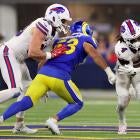
During the second quarter of the Washington Commanders' loss to the San Francisco 49ers, Niners' RB Christian McCaffrey took off through the middle of the defense on a screen pass. As Commanders' rookie Sonny Styles took McCaffrey down, EDGE K'Lavon Chaisson came flying in…throwing a punch at the football. The Peanut Punch, specifically.
The ball jumped out of McCaffrey's hands, onto the ground, and ended up being recovered by LB Frankie Luvu for a Commanders' turnover.
Elite peanut punch by K'Lavon Chaisson 👊 pic.twitter.com/zp180jRnz0
— ESPN (@espn) October 20, 2026
Fumbles are more and more common around the NFL this year, and part of it is due to the Peanut Punch. Once a novelty made legendary by Bears' CB Charles "Peanut" Tillman, the Peanut Punch has become the primary cause of fumbles around the NFL. Through six games, there have been 175 forced fumbles, the highest number through six weeks since 2013. If we divide it between rushing and receiving, the 1.4% fumble rate on receptions is tied for the fifth-highest since TruMedia started tracking in 2000.
While there are many reasons for fumbles being so high, the expansion of the Peanut Punch around the league has been a very fun aspect to watch throughout the season. From players truly connecting on the punch and forcing fumbles to the wacky misses that end up seeing players get ejected for punching a guy's helmet, the Peanut Punch has become a constant threat to watch whenever your favorite team has the ball.
How coaches install the Peanut Punch
Despite being 2-4, the New York Jets have been one of the quietly fascinating teams to watch this season, mainly because they're forcing turnovers. They're second in the NFL in forced fumbles (10) through six games and have nine forced fumbles on the defensive side of the ball. In their loss to the Patriots on Sunday, LB Jamien Sherwood showed off some incredible hustle to force a fumble. When he got in range, guess what he did? That's right, he punched at the ball.
Jets head coach Aaron Glenn spoke to CBS Sports about how his team trains the timing of their punch-outs and how to judge punching the ball versus traditionally ripping it.
"I think it's two totally different situations," Glenn said. "There are some punch outs where, man, you want physical body on body, where you can punch and wrap. And then there are times when you're making an attack from an angle perspective to where, man, you want to take the ball, you want to rip it out.
"We practice both of them. We put in the same amount of time [practicing] both of them. I think they're both very effective techniques to be able to get the ball. I don't know where we're at for punch outs, but we have a number of balls from the ground. I think you can see our guys actually practicing those things. You get both of them from the punchouts and the rip out."
In a video the NFL released about the Peanut Punch, Philadelphia Eagles' HC Nick Sirianni mentioned having the Eagles' video guy get them a cut-up of every fumble Tillman forced in his career, and he showed it to every coach and player on the team. Sirianni mentioned a blueprint the Eagles use to determine how and when to use the punch and get the ball out, and the Eagles have executed it well. Since Sirianni took over in 2021, the Eagles are second in the NFL in forced fumbles, behind the Pittsburgh Steelers.
What makes the Peanut Punch so useful?
What's really stood out about the Peanut Punch and its usage is that they've come from different angles. Players running in behind the ball carrier, angling in to help on a tackle. We've even seen DBs use it to force incompletions at the last second. In this story written about the Peanut Punch by ESPN's Matt Bowen in 2016, Tillman is using the punch after squaring up a ball carrier and standing in front of them.
Tillman has used the punch from different angles before, but you don't really see many defenders squaring up and punching the ball out. It's primarily used to help defenders, coming in from different angles. Being able to get the ball out in practice like that is cool, but players attacking the football when the speed of the game is ratcheted up to 100 is what separates good teams from championship ones.
How do offenses protect against the punch?
So how do ballcarriers protect themselves from the Peanut Punch? NFL legend and CBS Sports colleague JJ Watt broke it down during the Bills-Raiders broadcast. He showed that establishing more points of contact as a ball carrier prevents the ball from coming loose at the bottom, near the elbow, where it normally breaks free.
Holding the ball tightly and wrapping your other arm to create a harness with the ball prevents NFL players from getting the ball out, but it can also potentially break wrists (as evidenced by Jim Nantz):
JIM NANTZ JUST TRIED TO PEANUT PUNCH @JJWatt 🤣
— NFL on CBS 🏈 (@NFLonCBS) October 18, 2026
"I did not think you were gonna go that hard"
"my wrist is broken" 😭 pic.twitter.com/ocdRBn282r
Ball carriers on offense have to be hyper-aware of players punching at the ball in scrums and close quarters. New England Patriots' RB Rhamondre Stevenson has been on the wrong end of many fumbles in his career (seven since entering the league in 2021, to be exact), and with teams honing in on his hands, he has seen how teams are attacking the football.
"I think teams are just focusing on getting the ball out, no matter what they gotta do to get it," Stevenson said. "I think there's more punching, more ripping at it [the ball], and doing whatever they can to create a turnover."
Ballcarriers have to practice security against the Peanut Punch more often than ever now, because teams are going after them so much more.
Special teams is an area where Peanut punches can be especially chaotic, as is the case with kickoff or punt returns. New York Giants' special teams coach Chris Horton said he talks with his team a lot about ball placement as a way to prevent becoming a victim of the Peant Punch.
"When we practice, we spend a lot of time emphasizing being intentional about protecting the football," Horton said. "If I'm running to the left, the ball should be on the left side, that way the defender can't punch it, or if he does, the ball is on the sideline and out of bounds. When we're out here [in practice], we want our guys going after the ball so we can get that experience so we know how to take care of the football."
The Peanut Punch has gone from a rare individual play to something you see in every game you watch on Sundays. When you're watching your favorite team protect or attack the football, you know that the punch is coming.
Most of the time, offenses know it too.
Yet, they still can't stop it.