Why shots have stopped falling for the Lakers, who face a potential historic collapse vs. Rockets
The Lakers' offense has stalled in the last two games, and L.A. is in jeopardy of blowing a 3-0 series lead

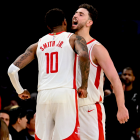
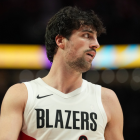
After Houston's practice on Tuesday, Jabari Smith Jr. called the Rockets "obviously the better team" in their first-round matchup with the Los Angeles Lakers. On paper, it's a strange thing for a player to say when trailing 3-1 in a series that his team entered as heavy favorites, and it's the sort of bulletin board material that can get a rise out of opposing players.
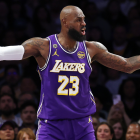
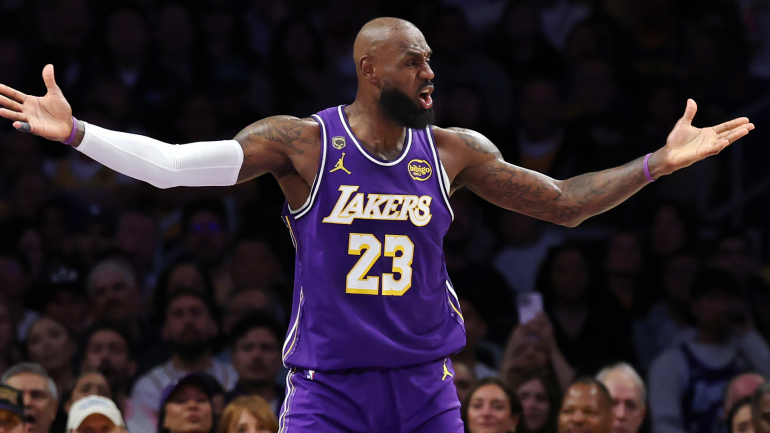
"I'm too old for this shit," LeBron James said in response after Game 5.
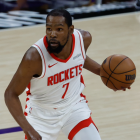
It's hard to argue too much with Smith's point. The Lakers are still without Luka Dončić, and Austin Reaves wasn't great in his Game 5 return. Houston has played largely without Kevin Durant in this series, but as the far younger, deeper team, the Rockets have always been better-equipped to play shorthanded. There's a reason they entered this series as a heavy favorite.
Why the Lakers thrived early in the series
A combination of bad luck and worse process doomed Houston early in the series. The Lakers shot 60% on non-restricted area 2s in Game 1 while making more than half of their 3s. Then they shot 14 of 17 at the rim while flirting with 50% on 3s again in Game 2. Shooting variance happens.
This much of it was lethal to a Rockets team that did little to prevent it. Houston didn't really start hunting Luke Kennard defensively until Game 4, allowing the Laker killing them most to operate unimpeded. They shot their own offense in the foot by limiting Reed Sheppard to 11 minutes in Game 2. Without his shooting threat on the floor, the Lakers were free to double-team Durant into nine turnovers.
The shooting numbers evened out a bit in Game 3. Houston's young players weren't ready for the moment, blowing a six-point lead with 30 seconds to play—nearly a 97% win probability, according to ESPN's metric—before ultimately folding in overtime. But the signs of process improvement were there. Ime Udoka finally embraced his best players, starting the second-youngest lineup in playoff history: Sheppard, Smith, Amen Thompson, Alperen Sengun and Tari Eason. That unit played only nine minutes in Games 1 and 2, winning them by seven points. The group played 44 minutes in Games 3 and 4, winning them by 23 points. By Game 5, Houston had trimmed its rotation to eight. No more ugly Clint Capela or Jae'Sean Tate minutes.
What's gone wrong in Games 4 and 5
Right as the Rockets got their act together, the shooting luck turned. The Lakers shot 12 of 49 from deep in Games 4 and 5, but more concerningly, just 63% at the rim. That's an 11.5% drop from their league-leading rim field goal percentage during the regular season. The Lakers were never an especially effective 3-point shooting team, but making those 3s early in the series forced Houston to defend them, which in turn opened up the paint.
That's no longer happening, which poses a dangerous math problem: the Lakers and Rockets have played five games, and the Rockets have attempted 69 more field goals across those five games. Barring further youthful indiscretions on Houston's part, the Lakers are not likely to start winning the possession battle any time soon. The Rockets are by far the NBA's best offensive rebounding team. Houston's superior defensive athleticism, coupled with the ball-handling limitations the Lakers are dealing with as Dončić recovers, means the Rockets are just going to have an easier time generating turnovers.
The Lakers cannot reasonably expect to take more shots than the Rockets. Their path to winning a fourth game lies in making more of the shots they do take. There are some process-oriented fixes here. Kennard, after functioning in a heavy on-ball role while Reaves was out, struggled to adjust to moving back off of the ball in Game 5. He didn't make a single 3-pointer, but the Lakers didn't involve him enough in the offense. They're going to have to scheme shots for him because he's one of the only consistent jump shooters here, especially since Reaves is still getting his touch back after a long absence. They probably can't rely on another 5-of-7 3-point shooting night out of Marcus Smart.
The Rockets are getting wise to a lot of the ways the Lakers generated shots early in the series. They toned down the doubles and help on James as Game 5 progressed, a sensible choice given the burden on LeBron's shoulders. He certainly can beat, say, Alperen Sengun off the dribble, but how many times can he afford to hit the gas like that at this age? He'd much rather dissect a defense as a passer and preserve his energy. James had seven assists in Game 5, but three came on the first 10 Laker points. Sheppard is probably the only Rocket who truly can't be left on an island against James from a physical perspective, and if Houston's defense maintains its integrity elsewhere, it forces James to generate more individual offense than he'd likely prefer. The Rockets took away the easy stuff in Game 5.
That's not uncommon for any playoff series that reaches this stage. By Game 6, you've usually taken every punch an opponent can throw. You've adjusted to the adjustments, and winning or losing just comes down to who has better players and who has better luck. We can't account for the latter. The former, to Smith's point, is probably settled for the time being. Unless James can turn back the clock and give the Lakers a vintage performance or Reaves can force Houston's defense back into over-helping, Houston is younger, deeper and more talented even before accounting for Durant's possible return for Game 6 or 7.
It's an unfortunate development for a Lakers team nobody expected to be in this situation in the first place. Had they simply lost the series in five as most expected, nobody would have batted an eye. They over-performed early on through a combination of variance and strategy, but as the series has achieved a new and perhaps proper equilibrium, they're faced with potentially becoming the first team in NBA history to blow a 3-0 series lead. Right now, the better team is winning, and if the Lakers can't shoot their way into another upset, they're headed for an embarrassing place in the history books.