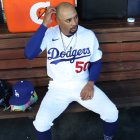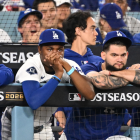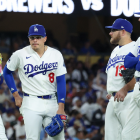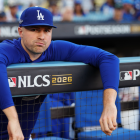


LOS ANGELES — For much of the Dodgers' dugout, there was nothing left to see.
Only a few players stood on the top step of their third-base dugout, arms draped over the rails they had climbed over in celebration far more often than leaned against in defeat for the 10 years.
Those rails weren't used to that. So, most didn't give them that indignity.
Because this veteran group knows the climb. Knows defeat, too, believe it or not, even after spending the better part of a decade ruling baseball like emperors.
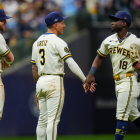
There was no need to watch the Brewers, a young club that had just swept the sport's Goliath in four games, celebrate their conquest on Los Angeles soil.
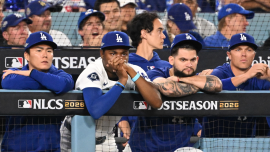
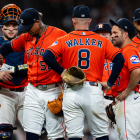
So the Dodgers gathered their equipment after Thursday's 6-4 loss in Game 4, disappeared down the dugout steps and retreated into their clubhouse to lick wounds that winning had long allowed them to forget.
"We came up short," Freddie Freeman said. "It sucks. It really does. We grind for eight months to come up short. Near the end, it really does hurt. But we give it our all. Sometimes you just get outplayed."
Outplayed? That wasn't supposed to be part of the Dodgers' vocabulary.
Not after two straight years of governing baseball with an iron grip, bending the sport to their will on the way to back-to-back World Series titles. For this decade, beginning with Mookie Betts in February 2020 and culminating with Tarik Skubal in August 2026, this behemoth, collectively, bought, traded for and developed talent better than anyone else in the sport.
Dodger blue meant blueprint. Because that's what they were.
Another championship felt inevitable.
But nothing in sports is inevitable. Payroll doesn't dictate the terms. Performance does.
Blake Snell sat at his locker beside his good friend and teammate, Tarik Skubal, the scene itself telling a story that needed no words. Between them, four Cy Young Awards. Two apiece. Both started in this series, neither earned a victory.
Both wound up on the losing end against a Brewers club that refused to yield. A young bunch that proved resilience isn't measured by reputation or payroll.
"It's extremely difficult [to win]," Skubal said. "There are a lot of really good teams, a lot of really talented players across the league. It's so hard to win. Seeing what the Dodgers have done the last two years, you think it's easy, but it's it's really not. The hardest thing to do in baseball is win a World Series."
The weight of another team's reputation means nothing if you refuse to carry it.
And, perhaps, this is what this series was about more than anything. Refusal.
Milwaukee refused to be intimidated by the memory of getting swept one year ago in the same round against the same team.
They wouldn't relent against Skubal in Game 1, Yoshinobu Yamamoto in Game 2 or Snell in Game 3.
They remained stubborn. Tough.
And Game 4 captured that defiance more vividly than the previous three combined.
For months, Los Angeles waited for the deliverance of its superstar, Shohei Ohtani.
Hobbled and slumping, he hadn't homered since Aug. 18. He was the missing piece in all of this. At least supposedly. His greatness had masked so many of the Dodgers' flaws during last year's run to the Fall Classic.
So, in the bottom of the second inning of a bullpen game for Milwaukee, with Los Angeles already leading by a run, Ohtani clubbed a three-run shot off Dustin May, stretching the Dodgers' lead to four.
He roared toward his dugout. The Los Angeles crowd roared with him. He flung his bat into the air as if proclaiming hallelujah.
Finally. He was back.
He sang a song that had been waiting in the pews of Dodger Stadium.
At least, that's how it felt.
Yet to the Brewers, none of it mattered.
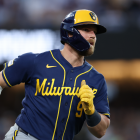
Milwaukee put up two runs in the fourth against Tyler Glasnow. Ultimately knocking him out of the contest after just 4 ⅓ innings. Two more in the fifth. A Garrett Mitchell solo shot in the sixth broke the tie, and a David Hamilton solo homer in the ninth sent Dodgers' Miguel Rojas into retirement.
These are the misfit Brewers. The team that is a Goliath in its own right, despite not arriving with the names.
"They have a bunch of hall of famers," manager Pat Murphy said. "We have a bunch of gamers."
And just like that, a Dodger dynasty crumbled.
"It was hard, man," Betts said of his team's mission at a threepeat, only accomplished in the last 50 years by the Y2K Yankees. "It's been a grind. I don't really have words to describe it. It's part of the game. It's part of life."
The Dodgers' life as they move forward will have its questions, namely around Shohei Ohtani. He intends to pitch next season, he said postgame, but is uncertain if he will need surgery on his ailing right bicep and gimpy left knee.
"It's hard to tell at this point," Ohtani said through an interpreter. "It's something that's going to be analyzed and discussed in the offseason and see if that's the viable thing to do."
The finality brought tears to Rojas' eyes. A World Series hero just a year ago, he now found himself confronting the end of his career.
A cloud of disappointment hung over the Dodgers' clubhouse. The path to a threepeat had appeared so clear after dispatching the Braves in the NLDS. L.A. had been the 2026 title favorites since lifting the Commissioner's Trophy 50 weeks ago. That distinction now belongs to the Brewers, who will face either the Rays or Guardians in the World Series.
Who could have imagined Milwaukee would dismantle that dream in such ruthless fashion? That four games would be all the Brewers needed to bring baseball's reigning empire to its knees?
So, there was no need to watch the Brewers celebrate. No need to see Jackson Chourio race around the warning track in sheer exuberance as he recorded the final out in left field.
Because this Dodger team had seen it all.