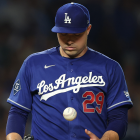


The Tarik Skubal trade to the Dodgers is more than just a baseball move.
Taking the mound Tuesday against the Cubs at Wrigley Field was about more than Skubal's Dodgers debut. Even in a losing effort, his first start symbolized something much bigger than one game.
Sure, on paper, it further proves why Los Angeles is baseball's gold standard. If healthy, the Dodgers' rotation has a chance to be remembered as one of the most complete and dominant of its generation. This trade also makes them the unquestioned favorite to become the first team since the 2000 Yankees to win three straight World Series titles.
The best team in baseball just got the best pitcher in baseball for prospects who might be good someday.
That doesn't sit well with people.
Fans don't like watching the rich get richer, especially when they're already winning. They like it even less when those riches belong to a franchise in one of the sport's most desirable markets, one that hardly needs another advantage to attract stars.
The Skubal trade only deepened the resentment many already have toward the Dodgers.
But don't hate the players. Don't hate the Dodgers.
That's low-hanging fruit.
Because the Skubal trade is about more than one ace changing teams. It's about a labor battle already taking shape.
'Owners and the league are pumped'
The players have made one thing abundantly clear: they won't accept a salary cap this winter when the current collective bargaining agreement expires. Many owners, meanwhile, have long believed a cap is the only path to creating greater competitive balance.
The Skubal trade didn't just make baseball's best team even better. It handed ownership another powerful exhibit for the case it intends to make when collective bargaining begins.
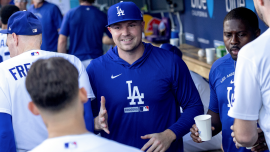
As one high-ranking executive with direct knowledge of the trade put it: "I can assure you, owners and the league are pumped."
In some sense, the biggest shareholders in the sport were rooting for this, affirming a belief that has scattered throughout the industry and for season-ticket holders of their respective clubs. Because if the Dodgers do, in fact, end up winning the World Series, the case of commissioner Rob Manfred and the owners is even stronger. Or at least they think.
They'll take the stance that the balancing act is off-kilter. That their current system is broken. That a salary cap needs to be in place so the Dodgers can't run away with baseball.
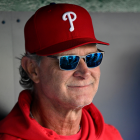
Former pitcher Rich Hill, who suited up for a record-tying 14 franchises over his 21-year career, including parts of four seasons with the Dodgers, believes owners are solving the wrong problem.
"If we're going to cap the players, cap the owners as well," Hill said. "Cap all the refreshments. Cap the hot dogs. Sales are going to continue to go up. They're going to raise all the prices. Ticket prices are going to go up if there's a salary cap. So that's not going to change anything."
The change that made the Dodgers champs
More than chasing championships, ownership groups have spent much of the last two decades protecting assets.
The game became increasingly more risk-averse. Big leaguers were valued on spreadsheets. Prospects became capital. Baseball operations began to resemble hedge funds.
The Dodgers were part of that trend, too, at one time.
When Andrew Friedman arrived from the Rays after the 2014 season, the president of baseball operations brought with him the principles that had made Tampa Bay one of baseball's most efficient organizations. Los Angeles developed one of the deepest farm systems in the sport. It built roster flexibility, moved players around the diamond, mixed and matched lineups, and found value where others didn't. The Dodgers won division after division and made deep postseason runs.
But for all the success, something was missing.
They couldn't finish the job.
Then, Friedman recognized there was a difference between building a perennial contender and building a champion. Prospect capital had value only if it was eventually spent.
Enter Mookie Betts in 2020.
"When it comes to Mookie, I think he's definitely the best player I have ever traded for and probably, I feel confident saying, it's the best player I ever will trade for," Friedman said at the time. The Dodgers have won three World Series titles in Betts' six seasons since.
Los Angeles has built this from the ground up and was humble enough to admit when it was wrong -- and then pivot.
'Where is that money going?'
Now, there are legitimate reasons why some fans and owners are disgruntled. Not every club has the same cash flow or financial flexibility as the Dodgers.
Deferred salaries are one aspect that figures to be addressed in the next CBA. The Dodgers have committed more than $1 billion in deferred payments, a strategy many smaller-market clubs would be reluctant or unable to match given their more modest local television revenue.
The Diamondbacks used deferred money as part of their push to win the 2001 World Series. But when new ownership took over in 2004, it inherited hundreds of millions of dollars in debt and long-term financial obligations, illustrating the risks that can come with pushing money into the future.
The Dodgers, however, operate from a different financial reality. Their 25-year regional television deal with Time Warner Cable's SportsNet LA, valued by Forbes at roughly $8.35 billion, provides the type of long-term revenue stream that gives the organization confidence it can absorb those deferred obligations.
Maybe a salary cap could help.
But what about a salary floor?
The Guardians' payroll sits around $76 million, the lowest in baseball. The Marlins are around $80 million, the second-lowest.
According to Sportico, the Dodgers will contribute more than $200 million in revenue sharing in 2026. The Guardians and Marlins receive a share of it.
"Where is that money going?" Hill said.
The Dodgers are once again the favorites to win the World Series. They have the stars. They have Skubal. They have Shohei Ohtani, plus more.
And they understand when prospects stop being capital and become currency. That's the part the rest of baseball should be studying. A salary cap may narrow the financial gap. But it won't teach organizations when to push their chips to the middle.
And for the owners who were "pumped" that Skubal landed with the Dodgers because they believe it strengthens their case for a salary cap, that's their prerogative.
But even if they get the system they want, it still won't make them the Dodgers.