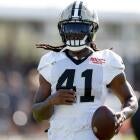


Through the first three years of his career, Detroit Lions running back Jahmyr Gibbs has been one of the most explosive players in the NFL, regardless of position. Gibbs has been a home-run hitter, ranking seventh in the league in rushing yards and second in yards per carry behind only De'Von Achane of the Miami Dolphins. He's also second in the league in explosive rushes, per Tru Media, and second in the share of rushing attempts that resulted in an explosive gain. He's done all this while also gaining five-plus yards a clip at the seventh-highest rate and breaking tackles at the sixth-highest rate among the 50 backs with 250 or more carries during that three-year period.
Now, though, Gibbs is going to step into a larger workload than ever before. Just ask his head coach.
"He's going to be our bell cow now," Dan Campbell said, via the team's official Twitter account. "He really became more of that last year, but we're going to hang our hat on him quite a bit. We're going to do a lot of things we feel like he does well."
Gibbs has been in a rotation through the first three years of his career, splitting time with ex-Lions running back David Montgomery. He played 57% of Detroit's offensive snaps as a rookie and 56% during his second season, but as Campbell alluded to, he leaped up to 67% during his third year. He didn't see a corresponding increase in rushing attempts during his third season, though; his attempts per game actually went down between Year 2 (14.7) and Year 3 (14.3). Instead, it was his passing game role that increased, as he went from 71 targets as a rookie to just 63 as a sophomore before ballooning up to 94 in his third year.
If Campbell's comments are any indication, Gibbs could get up into the 75-80% snap range in Year 4, and potentially push for considerably more opportunities than he's had through his first three years. His career high in carries is "just" 250, set in 2024. There were four backs (Jonathan Taylor, Christian McCaffrey, James Cook and Derrick Henry) who topped the 300-rush mark during the 2025 season and six who did so in 2024 (Taylor, Henry, Saquon Barkley, Kyren Williams, Bijan Robinson and Josh Jacobs).
If you extrapolated Gibbs' 17-game career averages (234 carries for 1,242 yards and 13.5 touchdowns) out to a 300-carry workload, he'd produce 1,592 rushing yards and 17 rushing touchdowns. If you just took his averages from the last two years (when he had a much larger workload than he did as a rookie) and did the same, you'd wind up with 1,603 yards on the ground and 18 rushing scores.
If Gibbs plays more snaps, it'd also be reasonable to expect him to get even more targets, which would be pretty incredible considering he was already the third-most targeted back in the league last season, with only McCaffrey (129) and Robinson (103) seeing more opportunities through the air. If Gibbs could get to 100 targets and maintain his career 79.4% catch rate and 8.0 yards-per-reception averages, he'd wind up with 79 grabs for 632 yards.
If he somehow reached McCaffrey's 2025 workload of 311 carries and 129 targets and maintained his career per-opportunity averages, Gibbs' production would spike through the roof: 1,650 rushing yards, 18 rushing touchdowns, 102 catches, 819 receiving yards and four receiving touchdowns. That'd yield a 2,469-total-yard season, which would be the second-most total yards in the history of the NFL. And that's just if he had CMC's workload and career-average efficiency. If he somehow put together a better season than he has previously, as he heads into his physical prime (he just turned 24 years old in March), he could potentially break or even shatter that record.
Of course, it's incredibly difficult to maintain efficiency while scaling up usage. We even saw that last year with Gibbs, who dropped to a mere 5.0 yards per carry (which, to be clear, is still an elite mark) after posting averages of 5.2 and 5.6 per carry during his first two seasons, and also slid back from 9.9 yards per reception as a sophomore to 8.0 in Year 3. Even if he saw a corresponding decrease in efficiency alongside the bump in workload, we're still talking about astronomical numbers if Gibbs can stay healthy while handling the increase in volume.