

The 2018 quarterback draft class will go down as a historic one for a number of reasons. It produced multiple MVPs, a Super Bowl champion, and a PFWA Rookie of the Year, none of whom were the same person. It was also the start of an interesting trend that's swept through the NFL ever since - the shorter quarterback. From the AFL-NFL merger announced in 1966 up until the 2018 draft, only one quarterback shorter than 6-foot-3 went No. 1 overall. That quarterback was Michael Vick in 2001, and it's safe to say it wasn't his work as a passer that got him drafted there.
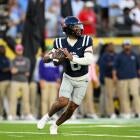
Then came the 6-foot-tall Baker Mayfield. Fresh off a Heisman campaign at Oklahoma, the Browns made Mayfield the No. 1 overall pick in 2018 over the likes of 6-3 Sam Darnold (No. 3 overall), 6-5 Josh Allen (No. 7), 6-4 Josh Rosen (No. 10), and 6-2 Lamar Jackson (No. 32). While not a bad athlete by any means, Mayfield was being coveted purely because of his passing ability in a frame that had never been coveted that highly before. The early returns were gangbusters as he broke the rookie passing touchdown record with 27.
Mayfield's overnight success greenlit the Cardinals to draft his even shorter former Sooners teammate, Kyler Murray, No. 1 overall the very next year, and the floodgates were opened at the position. Then came 6-0 Tua Tagovailoa in 2020, 5-10 Bryce Young in 2023, and 6-1 Caleb Williams in 2024 - the stigma around using premium picks on shorter quarterbacks was gone.
But should it be? That conversation is coming back into the mainstream because the best quarterback in college football through three weeks is the 5-11 ⅞" Ole Miss signal caller, Trinidad Chambliss. This is nothing new, as Chambliss showed out in relief of Austin Simmons all last season and through the playoffs - only losing to Miami in the semifinal after putting up the most points anyone had scored vs. the Hurricanes all season (27).
If Chambliss were 6-foot-4, this wouldn't even be a conversation. It would have been a serious debate for the Raiders on whether to pick Chambliss or Fernando Mendoza last spring - that's how good his tape was against top competition. But he's not. Chambliss would be the fourth-shortest quarterback in the NFL if he hadn't gotten clearance for a 6th-season last winter:
Quarterback(s) | Height |
Kyler Murray and Bryce Young | 5-10 1/8 |
5-11 1/8 | |
Trinidad Chambliss | 5-11 7/8 |
Tua Tagovailoa | 6-0 |
6-0 1/4 | |
6-0 1/2 | |
Brock Purdy, Sam Howell and Baker Mayfield | 6-0 5/8 |
Unfortunately, that's not great company to keep at the position, as that list has not been known for its consistent success in the NFL. In fact, the one common denominator amongst the group seems to be their inconsistency - especially over the past few seasons. I don't think that's a coincidence, but rather part of a larger league-wide trend.
You see, when Mayfield and Murray entered the NFL, it was the age of the spread offense. 11 personnel was the norm as offenses tried to air it out at all costs. The NFL is cyclical, though, and defenses steadily found answers for themselves. That ushered in the era of 2-high shells, nickel base defenses, and amoebus blitzing front-sevens. It's that last trend that I believe has given shorter quarterbacks the most problems. The sightlines for a 6-foot quarterback when facing only four down linemen with four split wide receivers are a heck of a lot different than having to face seven standup rushers posted along the line of scrimmage. Just look at Kyler Murray's immediate post-snap picture on his interception Week 1 (and then how ugly the throw looked).
Keisean Nixon intercepts the first pass of the game
— NFL (@NFL) September 13, 2026
GBvsMIN on CBS/Paramount+
Stream on @NFLPlus pic.twitter.com/rV7m8xe3TQ
That is a throw from someone who did not see a darn thing behind the line of scrimmage.
How this relates to Chambliss's prospects is difficult to say for several reasons. The first is that it only takes one team to fall in love with a player to take him highly. The second is that Mayfield, Tagovailoa, Murray, Purdy, and Young are all objectively among the top 32 quarterbacks in the NFL. Sure-fire starters, but not top-10 starters.
Finally, and most importantly, Chambliss is his own quarterback coming into the league at a different time. Not only are his strengths and weaknesses different from all the other short quarterbacks above, but he's also faced a different college football landscape than those quarterbacks did as well. The transfer portal and NIL era have raised the level of play at the upper echelons of college football. Those same defensive trends that are occurring in the NFL are also happening across the SEC. Chambliss is not only more experienced than all those guys at 24 years old, but his weekly tests are preparing him far more than those of the guys who came before him.
So how can Chambliss buck the trend? By staying the same fearless quarterback he is now. The biggest thing that separates Chambliss from the other short quarterbacks is his tools and confidence in the pocket. Chambliss has comparable arm talent to Baker Mayfield, with much more horsepower as a runner. Physically, he's more similar to prime Russell Wilson than any of the short quarterbacks today.
Trinidad Chambliss arm talent reel
— Mike Renner (@mikerenner_) September 21, 2026
Spins it so consistently. We can argue about his ceiling at his height, but this is a starter in the NFL pic.twitter.com/Y2KdX7pguD
Like Wilson, he has elite escapability and playmaking outside the pocket. Unlike end-of-career Wilson, though, Chambliss is more than willing to hang in when his pockets get tight and deliver downfield. That's a skill that's been missing for quarterbacks like Bryce Young and Kyler Murray, but kept someone like Brock Purdy afloat as a starter. Chambliss has a lofty 11.7-yard average depth of target this season under pressure and has taken only three sacks on 29 pressured dropbacks. Being willing to attack downfield while not taking sacks under pressure is a great combination to have at the position.
So, how high should the NFL draft Trinidad Chambliss? If we didn't see another snap from every quarterback in this draft class, the No. 1 overall pick wouldn't be too high. That's more an indication of his floor than his ceiling, but you can't watch what he's done to top-notch defenses the past season and not think he can at least join the likes of Mayfield and Purdy in the NFL. The good news is we'll have nine more regular-season games, and likely more after that, to reach a conclusion on Chambliss. If he keeps passing test after test, chances are NFL evaluators will look the other way when the measuring stick comes out at the Combine in Indy.