

The 2027 NFL Draft class enters the season with plenty of hype, especially at quarterback, but the strength of this group goes well beyond the most important position. My preseason top 50 features both bona fide difference-makers and depth to make this class really, really fun.
The 2027 quarterback class has been called loaded for so long that it already feels like settled fact. It isn't. There are recognizable names, former five-star recruits and the physical tools to understand the excitement, but this isn't the 2024 class. Caleb Williams, Jayden Daniels, Drake Maye, Michael Penix Jr., J.J. McCarthy and Bo Nix were among the first 12 selections that year, and you could argue that all but McCarthy consistently flashed first-round potential during their final college seasons.
Right now, much of the optimism surrounding the 2027 class remains based on what these quarterbacks could become.
Dante Moore and Arch Manning enter the season at Nos. 1 and 4 on my board, and Julian Sayin has already played like a first-rounder in stretches. But meaningful questions remain throughout the class. Manning must make his late-2025 improvement the weekly standard. Sayin needs to become more effective outside structure, and gambling violations cost Brendan Sorsby his final college season.
Jayden Maiava, Darian Mensah, Trinidad Chambliss and CJ Carr all have early-round ability, but each still needs to build on a promising 2025 season. At this point, that makes this group look closer to the 2025 and 2026 classes -- a few strong candidates surrounded by some projections -- than what we saw in 2024.
And quarterback isn't the only reason this class has a chance to be deep. Eight QBs made this initial top 50, but so did seven wide receivers, six edge rushers and five defensive linemen. Jeremiah Smith remains the headliner at receiver because there really isn't much he can't do, but Cam Coleman isn't far behind — and better quarterback play at Texas could unlock an even bigger season (I'm half-joking, half-serious here).
Meanwhile, on the other side of the ball, Colin Simmons and Dylan Stewart enter the season as the two best edge prospects in the country. The interior group may be just as fun; Will Echoles has violent hands, terrific balance and a pass-rush plan from wherever he lines up. Justin Scott may not have the same flashes, but he keeps showing up to tape because he's strong, smart and relentless. That's the larger theme beyond all the quarterback hype: premium-position talent runs throughout this Top 50.
Want more on the 2027 class? Check out our "With the First Pick" summer scouting series for every position: QB (Nos. 1–5 | Nos. 6–10) | RB | WR | TE | OL | DL | EDGE | LB/DB.
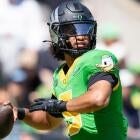
1. Dante Moore, QB, Oregon
Dante Moore is a consistently composed, accurate passer from a clean pocket, one of the best deep-ball passers in college football, and can make something out of nothing without looking to run at the first sign of trouble. The biggest concern is how he responds when defenses disguise pressure and coverages after the snap. He'll need to clean that up, but the arm talent, anticipation and pocket presence give him the highest ceiling in the class.
2. Jeremiah Smith, WR, Ohio State
There really isn't much Jeremiah Smith cannot do. He wins at all three levels, catches everything away from his body and is a problem after the catch because of his strength and contact balance. Maybe he can improve as a blocker, but you're not taking him with a top-5 pick because he's the next coming of Hines Ward.
Me and @RanCarthon talked about our favorite comp for Jeremiah Smith (and it isn't Julio Jones): pic.twitter.com/FDOORWT2Rj
— ryan wilson (@ryanwilsonCBS) July 16, 2026
3. Leonard Moore, CB, Notre Dame
Long, physical and comfortable playing on an island, Leonard Moore has the recovery speed to stay in phase on vertical routes and the instincts to make plays in zone looks. He also tackles like a safety. My comp for him is Patrick Surtain II. And the comp from my co-host on With the First Pick, former Titans GM Ran Carthon? Jalen Ramsey.
4. Arch Manning, QB, Texas
Arch Manning's best stretches show why he has been viewed as a potential top pick. He can throw with anticipation, push the ball downfield and create outside structure, while his size, speed and athleticism make him a legitimate part of the running game. He also became much more comfortable as 2025 progressed. The evaluation remains uneven, however. His feet and internal clock can become hurried, leading to routine misses and poor decisions, and he must prove the late-season improvement represents his new baseline rather than another temporary stretch.
5. Colin Simmons, EDGE, Texas
The first-step explosiveness immediately gets your attention, but Colin Simmons is more than a speed rusher. He has the twitch, power and urgency to take over games against SEC competition. The next step is producing that same level of disruption every week.
6. Dylan Stewart, EDGE, South Carolina
At 6-foot-5, Dylan Stewart uses his length and overpowering strength to set the edge, then surprises offensive tackles with how suddenly he can collapse the pocket. The physical tools are obvious. Now he needs to turn them into more consistent week-to-week production.
7. Will Echoles, DL, Mississippi
Will Echoles plays with a low center of gravity, violent hands and some of the best balance in the class. He can win with quickness or power and already has a legitimate pass-rush plan. He occasionally gets too high against double teams, but that feels like nitpicking at this point.
8. Trey'Dez Green, TE, LSU
At 6-foot-7, Trey'Dez Green is an obvious mismatch who moves like a much smaller receiver. He can win vertically, make defenders miss and contribute as an inline blocker. The concerns are focus drops — fix that and the Kyle Pitts comparisons will get louder and more frequent.
We talked our favorite draft-eligible tight ends heading into the college football season and I asked @RanCarthon a very simple question: Can LSU's Trey'Dez Green be a top-10 pick by the time it's all said and done? pic.twitter.com/8lndtxPWHg
— ryan wilson (@ryanwilsonCBS) July 21, 2026
9. Jordan Seaton, OT, LSU
For a tackle with Jordan Seaton's enormous frame, the movement skills are fun to watch. He anchors against power, mirrors in pass protection and can overwhelm defenders in space. After transferring from Colorado, the remaining question is how quickly everything comes together at LSU.
10. Cam Coleman, WR, Texas
The fun part with Cam Coleman is watching a big, physical receiver run routes and change direction like a much smaller player. He has terrific contact balance, punishes defensive backs after the catch and has never fumbled in college. More consistent quarterback play could unlock another level. Ran's comp is a fun one: George Pickens.
11. David Stone, DL, Oklahoma
The five-star tools started turning into consistent production in 2025, when David Stone led SEC defensive tackles in pressures. His size, power and athleticism make him a problem in one-on-one situations. Now, finishing more of those pressures with sacks is the next step.
12. Ryan Coleman-Williams, WR, Alabama
Few receivers in this class get in and out of breaks as suddenly as Ryan Coleman-Williams, and his track speed allows him to stack cornerbacks down the field. He plays bigger than his thin frame at the catch point, but nine drops and a lack of functional strength cannot be ignored, especially after a down sophomore campaign.
13. Julian Sayin, QB, Ohio State
Julian Sayin is an incredibly patient and accurate pocket passer who consistently works through his progressions and gives receivers YAC opportunities with ball placement and timing. He has the touch to make throws at all three levels, and his arm looked better in person at the Ohio State pro day last spring than it sometimes appeared on tape. The questions come when the play moves beyond structure. Sayin can be a half-tick late on intermediate throws, needs to throw with more anticipation and is considerably less comfortable when forced to create on the move.
We're going to be talking a lot about Julian Sayin this fall. He's QB3 on our @NFLDraftCBS summer scouting rankings. One of the biggest obstacles for him will be overcoming the "Ohio State QB" stigma and how that has translated to the NFL in recent years. https://t.co/epgicpimOP pic.twitter.com/pHmG3aGSEZ
— ryan wilson (@ryanwilsonCBS) June 27, 2026
14. Jadan Baugh, RB, Florida
Jadan Baugh looks like a power back until he makes a defender miss with an effortless jump-cut like he's Le'Veon Bell in his prime. He is patient, difficult to bring down and a natural receiver out of the backfield. Cleaning up his pass protection is something to work on in '26.
15. Justin Scott, DL, Miami (FL)
There is nothing particularly flashy about Justin Scott's game, but he is strong, smart and consistently in the backfield because of heavy hands and a high motor. He can penetrate gaps or collapse the pocket with power, and he's going to be in the first-round conversation all fall.
16. A'Mauri Washington, DL, Oregon
When A'Mauri Washington plays with leverage, his explosiveness and strength at the point of attack can overwhelm interior offensive linemen. He needs to play with more consistency from one snap to the next, but he would have been a top-50 pick in the '26 class had he declared.
17. Charlie Becker, WR, Indiana
Ask Charlie Becker's teammates and none of them were surprised by his success last season once he finally got his opportunity. His size, huge catch radius and outstanding deep-ball-tracking ability allow him to win through contact and make difficult catches look routine. He's also a willing blocker and excels on special teams.
18. Jamari Johnson, TE, Oregon
This is what a complete tight end looks like. Jamari Johnson catches the ball naturally, runs like a bruising running back and blocks with purpose. He can win inline or from the slot but needs a better feel for finding space vs. zone coverages.
19. Kenyatta Jackson Jr., EDGE, Ohio State
Power, heavy hands and a non-stop motor are all over Kenyatta Jackson Jr.'s tape. He'll need to more consistently play with a low pad level and diversify his pass-rush arsenal, but he's the latest defensive standout for the Buckeyes.
20. Ty Benefield, S, LSU
Ty Benefield marries old-school safety physicality with both range and ball skills. The problem is that he occasionally hunts for the highlight hit instead of simply making the tackle; if he can improve as a tackler in space, he'll be one of the best defenders in the class.
21. Ashton Hampton, CB, Clemson
Ashton Hampton plays cornerback like a strong safety; he's disruptive in press-man coverage, will limit yards after the catch when playing off and driving on the route, and punishes receivers at the catch point. He can be handsy at times, but you can say that about most college corners since it's rarely called at this level.
22. KJ Duff, WR, Rutgers
KJ Duff simply does not move like a 6-foot-6 receiver. He can sink his hips, separate at the top of routes and beat press coverage. He is already one of the class's best contested-catch targets, which will inevitably raise questions about his straightline speed, but he plays much faster on tape than whatever his timed speed may be.
23. Sammy Brown, LB, Clemson
There are not many linebackers with Sammy Brown's combination of speed, strength and range. The movement skills and physicality make him a Day 1 three-down defender at the next level.
24. Will Heldt, EDGE, Clemson
Will Heldt is a long edge rusher who relies on superior hand usage, leverage and power to push the pocket. He lacks the bend of high-end edge rushers, but at 6-foot-7 that isn't unusual.
25. Nick Marsh, WR, Indiana
A big-bodied, boundary wide receiver with strong contested-catch skills and physical YAC abilities, Nick Marsh won't consistently separate on downfield routes. That said, he's incredibly reliable -- he caught 100 passes at Michigan State without fumbling -- and will fill the void left by Elijah Sarratt.
26. Ellis Robinson IV, CB, Georgia
The confidence, instincts and ball skills jump off the tape. Ellis Robinson IV can play press or off coverage and understands how to attack the catch point, even at just 180 pounds.
27. Greg Johnson, OG, Minnesota
Balance and power might be Greg Johnson's best traits, and his movement skills and ability to sustain blocks should make him especially appealing to zone-scheme-heavy offenses.
28. Brauntae Johnson, S, Notre Dame
The closer Brauntae Johnson gets to the line of scrimmage, the more dangerous he becomes. His length, range and physicality work from the box or over the slot, and he arrives downhill with bad intentions.
29. Ahmad Hardy, RB, Missouri
Built low to the ground with legitimate home-run speed, Ahmad Hardy is extremely difficult to tackle once he hits the second level. The rushing abilities are easy to like; his value as a receiver and pass protector remains largely unanswered.
Summer Scouting continued on the @NFLDraftCBS pod this week. @RanCarthon's comp for RB Ahmad Hardy? Maurice Jones-Drew, in part because of these big-boy passpro reps: pic.twitter.com/IbNeTrNQPl
— ryan wilson (@ryanwilsonCBS) July 3, 2026
30. Brendan Sorsby, QB, Texas Tech
Brendan Sorsby has a huge arm, a sturdy frame and the athleticism to create explosive plays as both a runner and passer. He can generate velocity from different arm angles, push the ball downfield without a perfect platform and shrug off pressure to extend plays. The physical tools are obvious; the consistency is not. More than that, because he is ineligible for 2026 due to gambling issues, teams will have to evaluate him without another season of game tape and with a lot of off-field questions.
31. KJ Bolden, S, Georgia
KJ Bolden plays like he's been shot out of a cannon coming downhill but is rarely out of control. He's a wrap-up tackler in space and improved in coverage as 2025 progressed, though guessing on routes and defeating perimeter blocks are things he needs to work on in '26.
32. Jayden Maiava, QB, USC
Jayden Maiava has the size, arm strength and touch to make high-level throws from a clean platform or a muddy pocket. He stands tall under pressure, will keep his eyes downfield and can layer throws to the second level. The biggest concerns are the careless turnovers that got him in trouble at times last season.
33. Darian Mensah, QB, Miami
Darian Mensah has a big arm, excellent pocket movement and the ability to make difficult off-platform throws look routine. He will predetermine throws at times, but he also has a chance to be the next good QB to come out of the U.
34. Zach Lutmer, S, Iowa
Zach Lutmer can cover slot receivers, match tight ends, blitz off the edge and mix it up against the run. That versatility and route recognition make him a valuable chess piece, but he must do a better job of getting ball carriers on the ground in the open field.
35. Trinidad Chambliss, QB, Mississippi
Trinidad Chambliss plays with urgency from the pocket and uses subtle movement to buy time while keeping his eyes downfield. He has a quick release, throws accurately on intermediate in-breaking routes and consistently creates outside of structure. The next step is getting through his reads more consistently. His game is part Russell Wilson, part Kyler Murray, and he'll have a chance to make a first-round push with a good '26 season.
36. Kyngstonn Viliamu-Asa, LB, Notre Dame
Kyngstonn Viliamu-Asa can play off the ball, rush from off the edge or even line up in the slot. That versatility makes him a fun prospect, though his recovery from a late-season ACL injury now becomes part of the evaluation.
37. Trevor Lauck, OT, Iowa
Trevor Lauck is not the longest or most imposing tackle in the class, but he is balanced, technically sound and difficult to move once he anchors.
38. Chris Cole, LB, Georgia
Chris Cole brings edge-rusher power in the body of an off-ball linebacker, which opens up all sorts of possibilities. He can set the edge, rush from several alignments and move naturally in coverage.
39. Yhonzae Pierre, EDGE, Alabama
Yhonzae Pierre may need to add weight, though he certainly plays like he's 260 and not 10 pounds lighter. His low center of gravity, strength and quick first step make him a problem as an edge rusher.
40. CJ Carr, QB, Notre Dame
CJ Carr is a good athlete inside and outside the pocket, but his anticipation is the most encouraging part of his game. He will throw receivers open on intermediate outbreaking routes and balls up the seam, and he has already shown the ability to get through his reads. The concern is what happens when defenses speed up his internal clock; he can drop his eyes, hold the ball too long or occasionally leave clean pockets. Improving his blitz recognition and remaining composed against pressure will determine how high he climbs.
41. Trevor Goosby, OT, Texas
On his best reps, Trevor Goosby looks exactly like a future high-end tackle — enormous frame, long arms, easy movement and overwhelming power. There are also reps where he plays with high pads and questionable footwork. The physical tools are there; the technique has to improve in '26.
42. Clev Lubin, EDGE, Louisville
Clev Lubin's power and non-stop motor stand out first, but there is more here than a grown-man bull rush. He flashes an inside counter, can set the edge and even looks comfortable dropping into coverage.
43. Niki Prongos, OT, Stanford
Niki Prongos consistently plays in control. He anchors against power, uses active hands to redirect counters and has the lateral movement to pass off stunts as well as reach defenders at the second level. He can get overaggressive in the run game, but as an older player, there's very little projection in what his game will look like at the next level.
44. Kade Pieper, OG, Iowa
At roughly 290 pounds, Kade Pieper is undersized for an NFL guard, but he already looks polished in pass protection. His feet, balance and awareness allow him to mirror rushers and handle stunts. Adding mass and functional strength will be essential for creating movement in the run game going forward.
45. Xavier Atkins, LB, Auburn
At 210 pounds, Xavier Atkins is undersized, but nothing about the way he plays feels small. He flies downhill with violence, rushes from just about anywhere and moves naturally in coverage for a linebacker. Bigger linemen can engulf him if they can get their hands on him, but there is so much to like about his game.
46. Myles Graham, LB, Florida
Myles Graham plays stronger than his 228-pound frame and rarely wastes movement getting to the football. He takes good angles, wraps up consistently and excels in coverage for a linebacker. Just a junior, the floor feels remarkably high.
47. Tavion Gadson, DL, Kentucky
For his size, Tavion Gadson covers a lot of ground. He's long, powerful, plays with heavy hands and flashes the lateral mobility to disrupt runs and collapse pockets.
48. Mario Craver, WR, Texas A&M
Mario Craver weighs roughly 165 pounds, but he does not play like it with the ball in his hands. He has game-changing speed and can win at every level. He'll struggle vs. physical corners in man coverage, but he's electric in the open field.
49. Kewan Lacy, RB, Mississippi
The explosiveness and disciplined running style are easy to see, but Kewan Lacy's pass protection may be what gets him onto the field earliest.
50. Carter Smith, OT, Indiana
Carter Smith can anchor against power and do real damage in the running game. Bigger, straightline rushers rarely bother him, though quicker, bendy defenders can get into his chest, raising questions about hand placement and whether his arm length is sufficient to play tackle at the next level. It's why some NFL teams think his future could be at guard.