

LeBron James, by all accounts, is about to play next season on a substantial discount. All the reporting on his decision to leave the Los Angeles Lakers and pursue free agency has indicated that his next decision will be driven not by money but by his happiness. His family is based in Los Angeles. He's comfortable there. But the only team he has ruled out to this point in his free agency is the Lakers.
There are many reasons that might be the case, including eight years of pent-up grievances between the two sides. But according to ESPN's Shams Charania on Wednesday, "LeBron James and the Lakers simply didn't see eye to eye on what it meant to try to compete for a championship." This more or less tracks with the statement agent Rich Paul released on James' behalf last summer when he picked up his $52.6 million player option. "LeBron wants to compete for a championship," Paul told ESPN a year ago. "He knows the Lakers are building for the future. He understands that, but he values a realistic chance of winning it all."
James' roster-building instincts are hardly infallible. He pushed for the Russell Westbrook trade, after all. But it feels notable that the self-proclaimed greatest player of all time, a 41-year-old who has won a championship on every team he has played for and is seemingly pursuing his fifth aggressively enough to take a substantial pay cut, got a whiff of Lakers general manager Rob Pelinka's plans and seemingly thought to himself, "I don't think that team can win a championship -- even if I'm playing for them."
On Wednesday, Pelinka's vision for the Lakers came to fruition. They acquired long-rumored center target Walker Kessler in a stunningly expensive sign-and-trade that handed the Utah Jazz their unprotected first-round picks in 2031 and 2033, along with first-round pick swaps in 2028 and 2030.
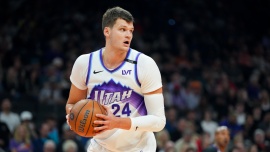
After sending the Jazz their 2027 first-round pick to dump Westbrook back in 2023 and handing the Dallas Mavericks their 2029 first-round pick at the 2025 deadline, the Lakers have more or less exhausted their tradable draft capital. Only a first-round swap in 2032 is available. The cap space they've spent the past 18 months hoarding has been allocated. Joining Kessler in Los Angeles are guards Quentin Grimes and Collin Sexton and big man Sandro Mamukelashvili.
The roster isn't done. They have two open roster spots and minimums to spend. They'll have to shed a bit of money to squeeze in all of those signings. Maybe there are minor, player-based trades available to them. But this is functionally the team. The Lakers have used up their flexibility.
What do these additions bring to the Lakers?
So what exactly do they have? Oodles of shot-creation, for one. The Lakers have always placed a higher premium on basic points-per-game players than most teams. If nothing else, the additions of Sexton and Grimes offer enough supplemental offense that the Lakers won't have to run Luka Dončić and Austin Reaves into the ground over the 82-game regular-season grind. Of course... similar logic arguably guided the decision to prioritize Kendrick Nunn and Talen Horton-Tucker over Alex Caruso after the 2020-21 season, and we saw what happened there. In fairness, no Caruso was known to be available to them this summer.
The Lakers have been a low 3-point volume shooting team basically since James arrived, and that has capped their offensive ceiling. JJ Redick, entering his third season as coach, finally has a roster that can let it fly. The ability to play five-out with Mamukelashvili at backup center is going to be torturous to guard. It is also going to create some track meets because Mamukelashvili emphatically cannot protect the rim as the lone big man in any lineup. His offense is still a plus at power forward, but that shooting goes from a superpower to a mere strength.
Kessler is inarguably a better fit at center than Mark Williams (whose trade to the Lakers in February 2025 was rescinded) would have been. This all-in center move nets the Lakers a meaningfully better player than their first attempt at such a trade would have. Of course, the Williams trade, for all of its warts, would have gotten the Lakers a center with a year-and-a-half of cheap team-control baked into his rookie deal, whereas Kessler is coming at market value. That deal would have preserved their 2033 first-round pick for future trades. This one obviously did not. Would you rather have had Williams alongside James 17 months ago, or Kessler without him now?
The team's preference for Kessler is entirely understandable on a number of levels. His schematic versatility is a question, but he is an absolute mountain of a rim protector. The closest he's ever come to playing on a competitive team was in his rookie year, when the Jazz won 37 games. Kessler allowed just 0.94 points per shot at the rim that season, good for the 87th percentile in the NBA. The numbers have slipped slightly since then, but the Jazz have more or less spent his whole career openly tanking. We don't really know how good he can be on a real team, and that applies to his offense far more than his defense.
Kessler opened his career with Mike Conley as his starting point guard. Conley got traded at the 2023 deadline. No Utah player averaged more than 6.3 assists in the two-and-a-half years that followed. Isaiah Collier was probably the best playmaker he had after Conley left, and Kessler missed most of his growth from last season due to the torn labrum that kept him out for all but five games. Now he's playing with Dončić and Reaves. We're about to find out just what sort of lob threat he can actually be with that 7-foot-4 wingspan. He can pass a bit. He's a monster of an offensive rebounder. There's a lot to his game still left to be discovered. There have even been flashes of 3-point upside, though he's never made free throws consistently enough to genuinely buy into that long-range hype.
He is getting paid at the absolute top of the non-star center market. Literally. He has the 10th-highest average annual salary at the position now, and the nine players above him have all made at least one All-Star team. The two single-time selections, Alperen Sengun and Chet Holmgren, are both under the age of 25 and headed for several more. Reaves was headed for an All-Star selection last season, but still hasn't made one. He, too, is making top-of-the-market money now on a full, 25% max contract.
That's where the concerns start to arise. The Lakers are now relying on Kessler and Reaves to be the second- and third-best players on a contender behind Dončić. Maybe they could be on the right contender. But we're in the depth, defense and versatility era of the NBA right now. And securing this version of their team cost the Lakers virtually all of their optionality. Again: this is the team.
The Lakers' fatal flaws
How many top-100 NBA players are on this roster right now? How many championship-caliber starters do the Lakers currently employ? Grimes has spent most of his career coming off the bench for teams with lighter ambitions than these Lakers. Sexton has more starting experience, but has mostly played for tanking teams. Mamukelashvili has never played 22 minutes per game. There is a lot of projection going on here, a lot of players needing to take on more than they've ever comfortably handled.
How on Earth are the Lakers getting a big wing now? You probably need multiple to genuinely compete for a title. The New York Knicks had OG Anunoby, Mikal Bridges and Josh Hart. The Oklahoma City Thunder and Boston Celtics had multi-positional defenders everywhere. Even the defensively deficient by championship standards 2023 Denver Nuggets had Aaron Gordon, Kentavious Caldwell-Pope and Bruce Brown to cover their bases. Among the core Lakers, there is not even a 2023 Gordon-level defender, much less, say, a 2024 Jrue Holiday, 2025 Caruso or 2026 Anunoby.
These are the hardest players in the NBA to acquire, the league's scarcest commodity. There's a reason the Knicks gave up five first-round picks for Bridges. They are utterly essential, and the Lakers no longer have the means to acquire one the traditional way. They're going to have to develop one. The two in-house options are not offensively viable. Jarred Vanderbilt crosses the "2023 Bruce Brown-level defender" line, but barely plays because he is a complete and utter non-shooting threat. Adou Thiero shot 28.4% from deep in college, and as Lakers fans will eagerly tell you, shooters have had a nasty habit of getting worse in Los Angeles, not better. Rui Hachimura was a notable recent exception. He'll have to be the beginning of a trend. Cameron Carr was the No. 24 overall pick. The odds at that point in the first round are always low.

Even if the Lakers could get one, there are so many weak perimeter links here to be hunted on switches. The Thunder attacked Reaves relentlessly in the second round, and they're hardly the first team to do so. Dončić isn't as bad as his lowlights defensively, but the Lakers don't want him hunted purely to minimize his overall burden given his offensive workload. Sexton has the tools to be a better defender than he's ever been. History says he's a target. So is Mamukelashvili. This is probably why the Lakers specifically targeted Kessler. If your perimeter players are getting burned constantly, you need the best possible last line of defense at the rim. But they're asking Kessler to be a Victor Wembanyama-level rim protector to make this defense viable, and that is unrealistic. They'll get torched whenever he rests.
Even if Kessler was the right target, it's worth wondering here if the Lakers went about acquiring him correctly. Say they had thrown a full four-year max offer sheet at Kessler. The Jazz might have matched. It would have been an overpay if they hadn't. They could only have afforded two of their other free agents in that world, not all three. But they'd still have picks and tradable salary available to go hunting for a big wing.

The Lakers probably felt they couldn't risk Utah matching. "Luka's first and foremost desire is an A-list center," ESPN reported before free agency. They'd made Dončić wait 18 months for his big man. Not getting one risked added pressure from your franchise player. But filling one hole practically ensured the existence of another. How do they plug the big wing hole? Were the Grimes and Sexton additions made with the idea of building a shot-creation infrastructure outside of the stars so that Reaves could one day be traded for more defense?
Even that isn't exactly an answer here. Dončić and Reaves, by all accounts, have grown close, and perhaps more importantly, removing Reaves from the equation makes Dončić the only All-Star-level talent on the floor. That just isn't going to cut it in a Western Conference this strong. The San Antonio Spurs and Thunder are too good. Are the Lakers even better than the Minnesota Timberwolves or whatever becomes of the Nuggets?
I'll take this a step further: where does this team rank even among the ones Dončić has played for? It's certainly worse than the 2024 Mavericks squad that made the Finals, right? Perhaps Dereck Lively II and Daniel Gafford weren't quite as good as Kessler, but the Mavericks could keep both of them fresh by rotating them in and out of games frequently, and having 48 minutes of reliable center play beats the 30 or so Kessler gives you. Kyrie Irving is certainly more accomplished than Reaves. The Lakers don't have wing equivalents to Derrick Jones Jr. or PJ Washington.

Is it even better than the Lakers of this March? With James, Hachimura, Marcus Smart and Luke Kennard in place, Los Angeles went 15-2. Kessler addresses the single biggest hole for that group at center, but the Lakers were surviving defensively with Redick's creativity and the collective basketball IQ of their veteran group. We'll probably never be able to answer this purely because of the injuries to Dončić and Reaves that ended last year's championship pursuit, but it's a real question.
Neither of those two teams we covered won a championship or came particularly close. If a championship is Dončić's goal, the roster the Lakers built, given the lack of remaining flexibility, seems to have a "worse than the Thunder or the Spurs" ceiling. James seemed to have come to that conclusion, at least, when he opted for free agency. So what does that mean for Dončić moving forward?
The looming threat of a 2028 homecoming
We started this story talking about LeBron James' 2026 free agency, but perhaps more pertinent to Pelinka's long-term dilemma is the decision he made in 2014. James, four years after leaving the Cleveland Cavaliers for the Miami Heat, elected to return home to Ohio and attempt to end his city's five-decade championship drought. He was ultimately successful in that endeavor.
There was genuine sentiment attached to that decision, but it was quietly a necessary basketball move for him. Dwyane Wade was past his prime and injury-prone at that point. The Heat had minimal flexibility to tweak their roster with James, Wade and Chris Bosh making max money. Their big moves that offseason were adding Josh McRoberts and a pretty much washed Danny Granger. James looked at Kyrie Irving and a younger, flexible team in Cleveland and concluded that the Cavaliers gave him a better chance at continuing to win championships. He was right. And he was willing to make peace with Cavaliers owner Dan Gilbert, who published a scathing letter about James the night he initially left for Miami, in order to give himself that chance.
Dončić can become a free agent in 2028. There are similarities here between the move James made in 2014 and the one that may be available to Dončić 14 years later. The only guaranteed salary on Dallas' books for the 2028-29 campaign right now belongs to Washington, Gafford, No. 9 overall pick Morez Johnson, and Cooper Flagg, the young star serving as our 2014 Irving equivalent. The Mavericks will have worn down most of their outstanding pick obligations by 2028, giving them flexibility to continue improving the roster. Notably, they control the Lakers' 2029 pick, which would suddenly become a prized asset if Dončić left.
Most of the braintrust that controversially traded Dončić -- most notably general manager Nico Harrison and coach Jason Kidd -- is gone. Governor Patrick Dumont remains. If James can forgive Gilbert, it's not hard to imagine Dončić making peace with Dumont. The trade was obviously a disaster, but a potentially explainable one in hindsight. A new owner was misled by Harrison, a basketball executive he didn't hire and should have known not to trust. Only Dončić knows how mendable those fences are.
Flagg might be a better player than any non-Dončić Laker as soon as next season. By 2029, there's a non-trivial chance he's an MVP candidate. Dončić has never played with anyone as good as Flagg has a chance to be. That upside means everything in the Western Conference that's coming.
The Spurs just made the NBA Finals with Wembanyama in his age-22 season. Dylan Harper is a rookie and he was San Antonio's second-best player in the Finals. Stephon Castle got genuine All-NBA consideration. Really wrestle with the implications of that trio all being on the same team. We're looking at a possible dynasty led by a talent, Wembanyama, with "greatest of all time" potential. If they're already this good, what will they be in three years?
Kessler and Reaves are very good players, but imagine Dončić going head-to-head with the fully-realized version of Wembanyama two or three years from now. Kessler and Reaves as his support against Harper and Castle has real "bringing a butter knife to a gun fight" potential. The Spurs are younger than the Lakers. They are deeper than the Lakers. They are more flexible than the Lakers. And they are, comfortably, more talented than the Lakers. Most of this applies to the Thunder as well.
James, 41 and trying to win now, wasn't thinking that far down the line with his own free agency. He still seems to have come to the same short-term conclusion. The Lakers are not good enough, and now they no longer have the means to get good enough without pulling several rabbits out of their hat. And if they aren't good enough two years from now, Dončić could eye a return to a perfectly viable suitor that could be.
The Lakers are losing James in part because of the plan Dončić's presence convinced them to pursue. But if that plan fails -- and there's a pretty good chance that it does -- it may one day wind up costing them Dončić as well.