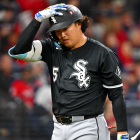


The Houston Astros announced Wednesday that they have not renewed the contract of manager Joe Espada, expanding the leadership void atop the AL West winners and opening up questions about where owner Jim Crane sees this team going.
"We are thankful for Joe's hard work, his passion for the game, and for his commitment to the Houston Astros. He represented the Astros and the Houston community in the most positive way. We wish he and his family the best moving forward," said Astros owner Jim Crane in a statement.
For the last decade or so, the Astros have been reliable contenders and, for most of those years, a modern baseball dynasty. Since they emerged from their deep rebuild with a postseason berth in 2015, the Astros have hoisted the World Series trophy twice -- albeit with some scandal and controversy appended to one of those trophies -- won more than 100 games in a season on four occasions, and at one point made it at least as far as the ALCS for seven straight years.
Now, though, these bedrock contenders are at a crossroads after seeing many members of that championship core depart over the years, and it may be that their window has finally closed. This can be wondered aloud not only because they were swept in the Wild Card Series by the Chicago White Sox, but also because the Astros in 2026, playoff berth notwithstanding, were a bad team. They finished the season with an 81-81 record despite having played, based on opponents' average winning percentage, the weakest schedule in all of MLB. That made them the only non-winning team in MLB history ever to make the playoffs in a full season. Additionally, the Astros had a -32 run differential during the regular season, which means they had a "deserved" record of 78-84. Again, a bad team.
Now, they enter an uncertain offseason. The ongoing CBA negotiations hang over everything. General manager Dana Brown was let go in August and Crane named himself the temporary head of baseball operations. Espada is now out too. And beyond that, pervasive roster weaknesses mean it may not be advisable for the Astros to try to contend again in 2027.
All of that sets the stage for the three questions that will, in many ways, define the Astros moving forward. Let's explore those now.
1. Who will be the new manager and head of baseball ops?
This is the most central question of all. On the manager front, the leading "free agents" right now are, in no particular order, former Red Sox manager Alex Cora (the Astros' former bench coach under AJ Hinch), future Hall of Famer Albert Pujols, former Orioles manager Brandon Hyde, former Twins manager Rocco Baldelli, and former Cubs manager David Ross. Maybe current Astros bench coach Omar Lopez, a longtime presence in the organization, gets his shot.
More important -- and much less clear -- is who will become the new general manager and/or president of baseball operations. Idly guessing specific names is a fool's errand when it comes to this kind of vacancy, so we won't do that. The Astros have some capable internal candidates who have been around since the Jeff Luhnow years, and that may be the path of least resistance. Otherwise, select assistant GMs or, in the case of a president of baseball operations search, GMs in other successful organizations will be under consideration.
Is the job an attractive one? On one level, it's one of 30 such jobs in the world, and pretty much every front office employee with their hands in baseball ops aspires to such a role. So yes, it is. More specifically, though, the Astros are not in a good place right now. They're caught in a downward spiral on the field (they've gotten worse every year since winning it all in 2022), and the organization has fallen far behind in terms of player acquisition and development.
Related to all that is the meddling presence of Crane and Astros-legend-turned-right-hand-advisor Jeff Bagwell. Let's explore that latter point more closely while wondering whether leading top-exec candidates might be turned off by the power dynamic in Houston.
2. Will the new lead decision-maker have autonomy?
Assuming the Astros don't opt to just rearrange their current front office structure -- which probably shouldn't be assumed, truthfully -- the new head of baseball ops needs the freedom to repair and reshape the organization. The problem is there's little reason to think that will be the case. Crane, when it comes to making actual baseball decisions, seems not to know all that he does not know, is far too hands-on, and has given too much power and influence to Bagwell, who's trenchantly anti-analytics at a time when the Astros need much more of that very thing.
Crane, you'll recall, butted heads with James Click, Brown's predecessor, and fired him a week after the Astros won the World Series. Brown hardly distinguished himself, but how much was he truly allowed to implement his own vision for rebuilding the Astros' young talent base? That young talent base remains in a fairly wretched state. If Crane wants the top talent the Astros need in the big chair, then he can't do things like, oh, helm the talks that led to José Abreu's disaster contract or the Rafael Montero extension.
The Astros need a new lead exec in baseball ops, but first, they need an owner who accepts he doesn't know as much as he thinks he knows.
3. Is a rebuild ahead?
Yes, it's tempting to go for it again in the sad-sack AL West, but the Astros, as repeatedly noted, are not good and, despite the MVP-grade presence of Yordan Alvarez, are almost certainly not going to be good anytime soon. This should lead to a rebuild that sees them pivot to the long-term and begin reconstructing the base of young, controllable talent.
What would this mean? It might mean that whoever's in charge of the Astros -- putatively or in actuality -- opts to trade away select players with at least one year of control or contract remaining, like Josh Hader (assuming he's willing to waive his no-trade clause), Jeremy Peña, Isaac Paredes, Christian Walker, and, yes, maybe even Alvarez and Hunter Brown. No, the Astros don't necessarily need to go scorched earth and trade all of those core contributors, but most of them should be dealt in the name of setting the club up for future success.
Will Crane allow such an approach? And if he does, will he allow his actual baseball people to make those crucial baseball decisions? That's to be determined.