Way-Too-Early Busts for 2026: Why Nick Kurtz and other big names carry more risk than their draft cost
Chris Towers examines the hidden red flags that could turn big names into costly Fantasy disappointments.

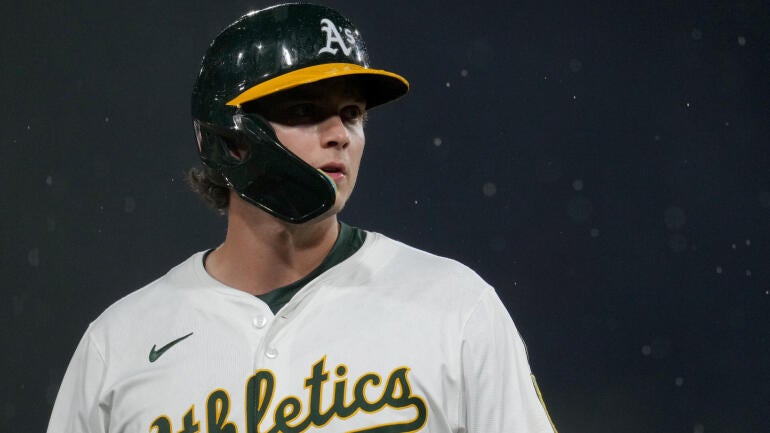
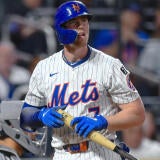
Nick Kurtz is an awesome player.
I know, stop the presses, right?
But I do feel the need to state that as clearly as possible before I do something like consider where to call him a "bust" for 2026, because people tend to misinterpret that tag. Good players can be busts. Great players can be busts. Last season, you could reasonably argue Gunnar Henderson was a bust as a first-round pick, despite having what would, for most other players, be a pretty good season. To a lesser extent, Vladimir Guerrero was a pretty big disappointment, finishing as the No. 47 player after being drafted with an ADP of 12.9 a year ago. They weren't bad; they just weren't worth what you paid to draft them.
And that's what I think we're heading for with Kurtz. He had a historically great rookie season, finishing with a .290/.383/.619 line that made him just the sixth player in MLB history with an OPS north of 1.000 in at least 450 plate appearances as a rookie. Here are the other five who did it before him, along with that they managed the following season:
- Judge: 1.049 OPS as a rookie; .919 OPS his next season
- Pujols: 1.013 OPS as a rookie; .955 OPS his next season
- Braun: 1.004 OPS as a rookie; .888 OPS his next season
- Williams: 1.045 OPS as a rookie; 1.036 OPS his next season
- Bernie Carbo: 1.004 OPS as a rookie; .677 OPS his next season
With the exception of Ted Williams – maybe the best hitter of all time – every single one of them saw their OPS fall from one season to the next. Three of the other four saw their OPS drop by at least 110 points, and if you exclude the biggest Year-Two outliers (Williams and Carbo), they dropped from an average of 1.022 as rookies to .920.
A .920 OPS isn't a bad thing. It would have been the seventh-best mark in baseball last season, and if Kurtz has a .920 OPS next season, you'll probably be pretty happy with him even as a borderline first-round pick.
But that isn't the floor. It probably isn't even the likeliest outcome. For as good as Kurtz was as a rookie, he outperformed his underlying metrics significantly. His .371 xwOBA was very good, for example, but it was just the 18th-best mark among all qualifying hitters. Again, that wouldn't be a bad outcome, but given Kurtz's lack of stolen bases and potentially poor batting average – his xBA was .248 – it would probably make him a pretty big disappointment for Fantasy.
What if he only goes .255 with 40 homers in 2026? Is that enough to justify a "bust" tag? Well, it probably wouldn't be worth an early second-round pick, but I think you'd have a hard time justifying the "bust" label there. And I think that's probably the likeliest outcome for Kurtz, who genuinely does have elite power and players in a terrific home park.
So, I'm not quite ready to slap that label on Kurtz right now. I do think he carries significant batting average risk, but the power figures to be good enough that he's going to be a big-time contributor even if he's a drag in batting average. But if it's more like 30 homers than 40 … yeah, there's some risk here that he moves from "he wasn't worth that pick" and into "he was an outright bad pick" territory.
Who am I slapping that tag on for 2026? That's what we're here to talk about today, but I do want to note one more thing before we do: This exercise has never been harder to do. A decade ago, it was fairly easy to find players who were being wildly misvalued in Fantasy. We had access to plenty of advanced stats back then, of course, but they weren't as widely adopted, and there was a lot less consensus about who was truly good or not. The Fantasy Baseball world has gotten a lot sharper in how it values players, to the point where it's genuinely hard to find players who are just obviously bad picks.
Doing an exercise like this requires going out on a limb. It requires disagreeing with a lot of smart people. That's always risky, but you have to differentiate yourself from the pack to win in Fantasy Baseball these days. Here are nine players I'm going out on a limb on:
Way-Too-Early 2026 Busts
We'll start with a couple of players whose status as bust candidates will very much depend on how the rest of this offseason goes:
Mason Miller, RP, Padres*
This one is simple: If Miller is the Padres closer in 2026, he should be the top closer drafted in every Fantasy league. He's a proven dominant ninth-inning option, arguably the best strikeout artist in the game, and a candidate for 40-plus saves on a team where Robert Suarez had 76 over the past two seasons.
And if he's pitching in the Padres rotation, I'll probably want nothing to do with him. That's not to say he shouldn't be drafted if the Padres experiment with him pitching in the rotation; it's to say that I won't be the one drafting him if that happens. He might be an effective starter, but I have no reason to believe he'll ever be able to hold up to a starter's role. As I noted a few weeks ago, you have to go back to his final season in college in 2021 for a season where Miller made more than 13 starts in a season. In 2022, he broke down with a shoulder injury; in 2023, it was an elbow strain that felled him. There would be plenty of upside if Miller pitched in the rotation, but you can't bet on the best-case scenario for a guy who currently costs a top-50 pick in early drafts. He'll be worth that as a closer, but I can't ask him to justify that cost in a starting experiment.
Eugenio Suarez, 3B, Free Agent*
Despite putting up consecutive massive seasons – including 49 homers in 2025! – Suarez heads into free agency as a pretty big question mark. For MLB teams, that's because he's 34 and has pretty massive swing-and-miss numbers that have led to wild variance in his production. But given how good he's been over the past couple of years, I think it makes sense for Fantasy players to buy in for 2026, at least – unless he signs in Seattle.
Then all bets are off. And this is one situation where the early drafter's aversion to picking players who are unsettled in free agency actually makes sense. Because Suarez might go from a potential top-five third baseman in the rankings to someone I probably won't rank as a top-12 option if he returns to Seattle. I've cited this a few times, but let's look once again at Suarez's numbers in the three parks he has called him most in his career:
- Great American Ballpark (1,835 PA): .260/.347/.504, 27.9% K rate
- T-Mobile Park (804 PA): .211/.311/.406, 31.2% K rate
- Chase Field (615 PA): .278/.343/.585, 25.5% K rate
It's not a gigantic sample size, but 800-plus PA isn't nothing, especially when it's been spread out over two stints with the team where he struggled in the same way in both. Suarez is a high-variance player as it is, and the risk of him putting up an intolerable batting average is high enough to make him a risky top-100 pick in the best of circumstances. If he returns to Seattle, he's a risky pick in the top 200.
Roki Sasaki, SP, Dodgers
Sasaki's price so far is reasonable. He's sitting at a 181.6 ADP, and it's hard for there to be too much risk at that price, especially in a 12-team league. Here's my problem with him: I'm just not sure he's good. He's talented, but I think he's a long way away from figuring out what to do with that talent. Even in his much hyped run as a high-leverage reliever in the postseason, Sasaki wasn't exactly blowing people away – even while allowing just one run over 10.2 innings, he had just six strikeouts to five walks. That's despite a jump in fastball velocity that may not be sustainable when he's asked to pitch in longer outings.
The problems remain what they were when he was struggling as a starter: Even when he throws hard, his fastball just doesn't have the shape or movement profile to be a good pitch. At best, you're hoping he can sit in the high-90s and have the pitch be decent enough to allow his genuinely very good splitter to put hitters away. The problem is, he wasn't putting guys away consistently in that relief run, so why should we expect him to suddenly start doing so when he's being asked to pitch five innings at a time?
And, to be clear, it's only going to be five innings at a time, in all likelihood, and will be every sixth day, limiting his ceiling even if he is good, which is a huge question mark. Sasaki is probably better served in 2026 by getting a chance to continue to work in relief, but that's probably not the best thing for either him or the Dodgers' long-term prospects. And, even if he did get to work as a high-leverage reliever, there are some red flags lurking behind the sub-1.00 ERA he posted in that postseason run.
Like I said, the talent is here. But I think the likeliest outcome in 2026 is that Sasaki just isn't particularly helpful for your Fantasy team, no matter what role he's filling.
Oneil Cruz, OF, Pirates
How badly do you need stolen bases? Do you need them so badly that you're willing to spend a top-90 pick on a guy who might just be a platoon bat who somehow managed to hit just .200 despite being shielded from the toughest lefties on the schedule? That's the case with Cruz, whose 38 steals (in just 135 games) were basically his only positive contribution for Fantasy in 2026 – his 20 homers are about the minimum you're hoping for from every lineup spot in a 12-team Roto league, while his 62 runs and 61 RBI don't even meet that low bar. Despite the 38 steals, he ranked as just the No. 45 outfielder in 2025, so of course, he's being drafted as the No. 19 outfielder in early drafts. I think Cruz is likely to hit better than .200 next season, but even if he hits to his .220 expected average from Statcast, that's still not worth the price you're paying here. Cruz's raw power just hasn't translated into difference-making production, and with his plate discipline moving in the wrong direction, I just don't think it makes much sense to bet on a breakout from his age-27 season.
James Wood, OF, Nationals
I keep waiting for some sign that Wood was playing through some kind of injury in the second half, like we got from Elly De La Cruz recently. Wood looked like he might be breaking into the first-round range of the rankings in the first half of the season – he had 23 homers, 12 steals, and a .958 OPS through his first 87 games of the season, looking for all the world like the superstar everyone expected from his time as a prospect. But he slumped entering the first half and never really pulled out of it, hitting just .210/.219/.369 with just eight homers, three steals, and a massive 39.4% strikeout rate over his final 70 games. A 39% strikeout rate is absolutely unworkable, and that, combined with the big drop in sprint speed and lack of steals in the second half, is what has me hoping there was some kind of physical issue holding him back in the second half.
Wood hits the ball about as hard as anyone in baseball, but if he's not going to steal many bases and he's going to strike out more than a third of the time, he's just not going to be good enough to justify a top-30 pick. There's massive upside here, but the second-half slide shows how low the floor can be here, too. Given his age, betting on a step forward is justifiable, but there's a ton of room for things to go really wrong here.
Blake Snell, SP, Dodgers
I don't know how many times Snell has to let Fantasy players down before they stop drafting him like a guy who can carry their rotation. He's a tremendously talented pitcher, one who is absolutely capable of carrying your rotation, of course, and he'll do so for weeks and even months at a time every season. And every time he comes up with one of those stretches, it seems like there's a wave of collective amnesia around what his final numbers inevitably look like.
In 2025, he had an ADP of 52.9 as the No. 10 SP off the board, coming off a season where he finished as the No. 39 SP. He finished as the No. 59 SP in 2025 while throwing just 61 innings, and he's dropped all the way to … SP16, with an ADP of 58.91. Snell was good when he was on the mound, of course, finishing with a 2.35 ERA, 10.6 K/9, and a 2.69 FIP. And then he went out in the playoffs and put up a 3.18 ERA with 10.9 K/9 in 34 innings in the playoffs, another reminder of how good he is. How good he can be.
But we're 10 seasons into his career, and he has reached 130 innings exactly twice in those 10 seasons. He has finished as a top-five SP in Fantasy in both of those seasons, so you can see the case for drafting him if you're chasing that upside. But here's the other side of the coin: Per FanGraphs' Player Rater Tool, Snell hasn't even finished as a top-30 SP in any of his other eight seasons. Not once. He has a sky-high ceiling, but at some point, we have to stop assuming the best-case scenario is going to happen every year, when it happens so rarely.
Jacob Wilson, SS, Athletics
The year everyone is finally realizing that the elite batting average just isn't worth the hit you take everywhere else with Luis Arraez, we've got a new Arraez ascending the ranks. Now, you might think that's not fair to Wilson, whose 13 homers in his first MLB season are three more than Arraez has ever hit in a season. There's more juice here with Wilson, you'll say, especially since he'll turn just 24 shortly after Opening Day.
But here's the thing: It's hard to find evidence of this juice once you look beyond the surface-level numbers. Wilson's average exit velocity was just 84.6 mph in 2025; Arraez's was 86.1 mph. Wilson's hard-hit rate and barrel rate were both better than Arraez's, but that really isn't saying much when Wilson was still in the second and sixth percentiles in those respective metrics; his .300 expected wOBA on contact was similarly better than Arraez's in 2025, though it was notably worse than every previous Arraez season.
Wilson's 13 homers came with a 10.5% HR/FB rate that was within spitting distance of the MLB average of 11.9%, despite his dreadful quality of contact metrics, and it's not like he's an Isaac Paredes-level pulled-air savant; his 14% pulled-air rate was below MLB average. His home park in Sacramento will help, but Wilson's lack of punch leaves him with an Arraez-esque lack of counting stats, and he doesn't steal many bases, so you're left hoping for low double-digit homers and a .300-plus batting average to carry the profile. Maybe it can. But .280 with five homers is well within the realm of possibility, and while that can still be useful, it's not worth a mid-round pick. Just ask anyone who spent a mid-round pick on Arraez last season.
Cam Schlittler, SP, Yankees
I like Schlittler. He's got a terrific fastball that serves as the foundation for everything he does, and when he's locked in – as he was during the playoffs, especially – the results can be astounding. But his 2.96 ERA was backed up by a much uglier 4.11 xERA, as he struggled with walks (10.2%) and flyballs, a dangerous combo when you call Yankee Stadium your home. The rest of the arsenal at present also trails behind the four-seamer, with none of his other pitchers rating out as much more than average by run value, and only his cutter joining the four-seamer above the 25% whiff rate mark.
If the fastball remains one of the best in baseball, that might not matter, but that's where another concern comes in. Schlittler has been one of the biggest gainers in fastball velocity in organized baseball, going from a 95 mph average velocity in 2024 at Triple-A to 96.6 mph in 2025 at Triple-A, all the way to 98 mph in the majors. Is that sustainable? Is that amount of velocity gain a red flag for injury? I tend to think yes, especially over such a short period of time, and given how much Schlittler relied on that fastball, any losses here could prove disastrous. It just feels like there are too many ways for this to go wrong.
Gavin Williams, SP, Guardians
This is one I reserve the right to change my mind about. For nearly the entire season, Williams looked like he was way in over his head, and the underlying numbers back it up: Just compare that sparkling 3.06 ERA to the 4.28 xERA, 4.39 FIP, or 4.35 SIERA for confirmation. That's enough to slap the "bust" tag on him, right?
Well, there are two things to consider. The first is his price: An early ADP of 145.1 just doesn't seem that onerous. Is it more than I'd want to pay? Possibly, but given the surface-level numbers and the hype that has surrounded Williams at times in his career, I'm surprised he doesn't cost significantly more than that. As I said in the intro, we just generally don't get these kinds of things wrong anymore like we used to 10 or 15 years ago. Williams might have been drafted as a top-20 SP back then; now he's coming off the board as a low-end SP4 in 12-team leagues. That's probably fine.
And the second part is that Williams closed the season much stronger than he started it. From June 1 through Aug. 18, Williams had a 2.57 ERA, a 4.41 FIP, and a 10.9% K-BB rate and basically looked like someone I wanted nothing to do with in 2026. And then something clicked, and he had a 1.74 ERA with a 21.8% K-BB rate over his final five starts. He upped the strikeout rate, got his walk rate to manageable levels, and looked like the ace people have been hoping he could become. Was that a sign of Williams "figuring it out?" He's so talented that I can't write that possibility off.
But the likelier explanation is that he's an inherently volatile pitcher who just locked in for a month in a way that won't prove sustainable. He has the talent to build on it, and his price is reasonable enough that if you want to make that bet, I won't argue with you too much. But the risk of a 4.00-plus ERA is too much for me to make it.