Fantasy Baseball: H2H points mock draft highlights the players who gain or lose value in the format
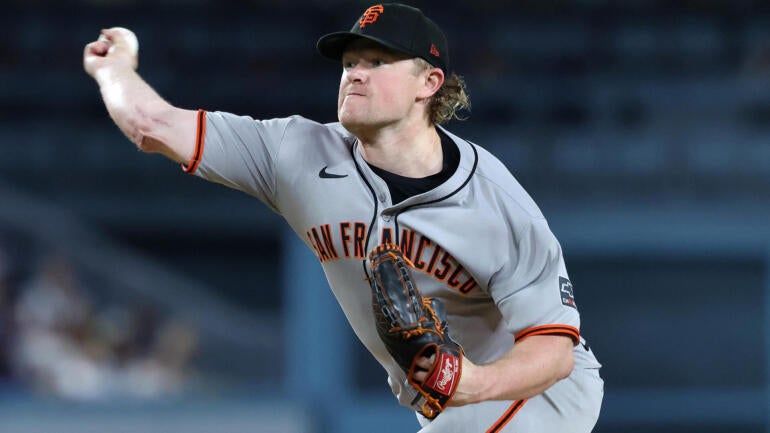
Innings eaters like Logan Webb get a healthy boost in Head-to-Head points

Not everyone is well-versed in points leagues, you know. The content creator class in particular tends to be Rotisserie-focused, and so sometimes when I gather up these writers and podcasters for a Head-to-Head points mock, it can take on a Rotisserie tinge.
That's not what happened in this one, though. Innings eaters were elevated. Swing-at-anything types were faded. It was a proper points league draft. If anything, they may have gone a little too far in making it so.
Who are "they?" Sure, let's get the introductions out of the way.
1) Bryson Ostepchuk, The Run Down Report (@rundownbryson)
2) Chris Towers, CBS Sports (@CTowersCBS)
3) Anthony Kates, SportsEthos (@akfantasybb)
4) Zac Morain, Driveline Baseball (@makeitmorain)
5) Scott White, CBS Sports (@CBSScottWhite)
6) Steve Giangaspro, Tablesetters podcast (@SGroundballTS)
7) Phil Ponebshek, Patton & Company
8) Jeremy Heist, Fantistics Fantasy (@heistjm)
9) B_Don, Razzball (@RazzBDon)
10) Nick Fox, NBC Sports (@CT_FOX)
11) Jake Holland, The Cutoff Man podcast (@jakebaseball17)
12) Matt Scardigno, points league enthusiast
A few examples of what I'm referring to:
- Logan Webb was the fourth starting pitcher drafted at 30th overall, and he's a great point league pitcher as a big accumulator of innings (worth three points apiece). His biggest shortcomings (high WHIP and low strikeout rate, with 2025 being an exception) also don't hurt as much as in 5x5 play. Still, making him the fourth starting pitcher picked -- ahead of Cristopher Sanchez and Chris Sale, to name a couple -- is taking it too far. There are some clear limits to Webb's upside, even in this format.
- Yoshinobu Yamamoto, meanwhile, was only the ninth starting pitcher drafted at 44th overall, which is nearly two rounds later than he's typically drafted in Rotisserie leagues. And there's a certain logic to it. His ability to pile up strikeouts isn't as valuable here, with them being worth only half a point each, while operating in a six-man rotation costs him valuable innings, not to mention denying him an opportunity for two-start weeks. I'd still draft him higher than ninth (and in fact, I'm the one who stopped him from sinking further), but downgrading him slightly is proper in this format.
- Pete Crow-Armstrong, who broke through as a 30/30 man last year and is generally a Round 3 pick in Rotisserie, lasted until Round 5 in this one. His poor plate discipline, which is of no direct consequence in traditional 5x5 play, can be detrimental in this format, where walks are worth a point each and strikeouts deduct half a point. Letting him slip to 58th overall is verging on taking things too far. He did, after all, average the same number of points per game last year (3.14) as Freddie Freeman, who went a round earlier and is generally regarded as a points league standout, but that was in a career year for Crow-Armstrong and a down year for Freeman. I'd consider Crow-Armstrong's downgrade to be a proper one.
- Luke Keaschall, an up-and-comer at second base, may have some questions concerning his power production, but he's shown himself to be a disciplined hitter. His plus walk and strikeout rates, along with his abundance of stolen bases (worth two points apiece in standard CBS leagues), gave him the second-most Head-to-Head points per game at second base last season (3.44, behind only Ketel Marte). Clearly, there's great potential for him in this format, but it was too small of a sample (just 207 plate appearances) for me to put him on equal footing with confirmed points league standouts like Josh Naylor and Christian Yelich, not to mention a full round ahead of second base mainstay Jose Altuve. As such, targeting Keaschall at 69th overall is, to me, taking his potential points league prowess too far.
- Zachary Neto's power/speed contributions have made him a borderline third-rounder in Rotisserie, but much like Crow-Armstrong, they're undermined in this format by a poor strikeout-to-walk ratio. There's a difference between going at Pick 58, though, like Crow-Armstrong did, and Pick 80, a couple spots after Brandon Nimmo, of all people. This, to me, is downgrading Neto too far.
Every draft needs a wild card, and in this draft, that wild card was Bryson Ostepchuk, who raised an eyebrow with picks like Jackson Merrill at 25, Michael Busch at 48, Merrill Kelly at 96, Kris Bubic at 97 and Daniel Palencia at 145 (with Devin Williams still available). Though you could argue the Kelly pick was playing to the format -- he actually placed 17th in it last year, mostly on the basis of innings accumulation -- the others weren't so much. Jackson Merrill in particular could suffer from his lack of walks, even with a full bounce-back to his 2024 production.
On the whole, I think this is my favorite team I've drafted so far. The key moment was opting for Junior Caminero over Nick Kurtz in Round 2, not wanting to test the scarcity at third base and recognizing that I would likely get a stud first baseman in Round 3 or 4 (which I did, Pete Alonso). I didn't invest heavily in pitching, apart from Yamamoto, but I think I loaded up on enough high-upside arms that it won't be an issue.
You can be the judge, though.