

If you think it's patently absurd that a football player can sign an NFL contract -- or even participate in legitimate preseason games -- and then come back to college, take heart in the fact that at least you're not alone. In a world where you constantly have to check whether things that were once obvious still hold up, more or less, nobody in college football actually likes that this is happening.
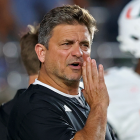
Oregon coach Dan Lanning came out strong on the issue. He's far from the only coach to do so, but his sentiment pretty much encapsulates where the vast majority of people arrive on the issue:
"You're a professional now, once you declare for the Draft," Lanning told reporters. "So to let any of those players come back, fair or unfair to them, it's unfair to the sport, and I think it's unfair to the players that are on current teams for those guys to be coming back."
Even Lane Kiffin went on The Pat McAfee Show and said, "I don't think professionals should come back to college sports and college football."
But then he kept talking, and his elaboration is the heart of the issue.
So why is this happening at all, and why now?
"But in this instance, these are not players who have gone on to play seasons professionally or randomly filed an injunction," Kiffin continued. "This is part of a specific class that was ruled wrong by the NCAA that was supposed to be five-for-five."
In fact, CBS Sports reported Kiffin and the Tigers were actively encouraging players to sue the NCAA. Kiffin, like the lawyers whose talking point he shares, is pointing to the five-for-five rule, a recent NCAA rule that says a player has five years to play five seasons.
Players in the high school class of 2022 were essentially caught between two eligibility situations: They weren't covered by a COVID-19 season extra year of eligibility, and weren't grandfathered into the NCAA's current rule change. (There's a school of thought that happened intentionally, but more on that later.)
Regarding Kiffin's latest profile in courage, it features him attempting to take tight end Dae'Quan Wright after the Eagles released him, as well as New Orleans Saints defensive tackle Zxavian Harris and Arizona Cardinals safety Wydett Williams.
Kiffin was not alone in his pursuit of the players, who were initially granted a court order to return to college football. They were among the group that sued for eligibility because they weren't grandfathered into the NCAA's five-for-five rule. Kiffin is arguing that it's a one-time deal, but all of these are popping up as one-time deals over and over again.
This is the cycle of college sports anarchy: loophole attempted, lawsuits follow, coach defends his actions on competitive grounds, leagues sometimes try to put a stop to things, more lawsuits follow and onto the next.
Why literally now, on the eve of the season? Well, the formal NFL cutdown day is Sunday. There is some functional insanity if you think too hard about the following situation: Let's say a player gets cut Sunday, and they show up Monday and have the required five-day acclimation period. Then they're good to go for Week 1 of college football the next day.
It may seem far-fetched, but not really when you consider the college football world we all live in now. There's also a subplot regarding the message this sends to a locker room: You can compete all fall camp for playing time, but on the eve of the season, the school can just go grab a professional they're familiar with from the NFL and down the depth chart you slide. But Kiffin and any coach who tries to take a pro bounceback apparently aren't terribly concerned by that.
The SEC certainly tried to stand behind its rule barring interconference transfers (Wright, Harris and Williams were with Kiffin at Ole Miss) when it was a football-only issue. But then, across campus in Baton Rouge, men's basketball coach Will Wade got some good news in the way of a court allowing St. John's RJ Luis an injunction to play for him this year. Luis signed a two-way contract with the Utah Jazz this summer.
So the SEC found itself in a pickle -- and got outflanked
That goes a long way to explaining why the league's Monday statement on the subject was fairly mealy-mouthed. Even if the vast majority of its schools (potentially 15 of 16 if you read the tea leaves) are operating on one set of parameters (you know, college athletes are college athletes), at least one is overtly refusing to do so. So the league punted, asking Congress to help it solve the mess without passing a formal rule.
"College athletes, not professional athletes, have been at the heart of the Southeastern Conference," the league wrote in a statement Monday night. "Individuals who choose to leave college athletics, sign professional playing contracts, and compete professionally should not then be permitted to return to college competition. Allowing that to occur will blur the line between college and professional sports, create significant competitive equity concerns and reduce opportunities for high school and current college athletes. College sports are for college athletes. The current confusion around national eligibility standards emphasizes the need to advance the Protect College Sports Act."
On Tuesday, the ground shifted out from under the conference where "it just means more." The Big Ten unanimously passed a rule that says, in broad strokes, anybody who signed a pro contract is ineligible, as are underclassmen who declared for the draft formally and did not withdraw.
In other words, the Big Ten quickly codified its stance on the integrity of college athletics, while the SEC paid it lip service.
Hours later, the SEC passed its own rule and upped the ante to include basketball (thereby covering the Luis issue). It's funny how a competitor moving first magically spurred the SEC's presidents to step in and act like there are actual adults in the room. Expect the ACC and Big 12 to follow suit soon as well for a full slate of Power Four leagues passing similar rules.
Regarding that school of thought about the NCAA's failure to grandfather
The organization will no doubt continue lobbying Congress for legislative help to enforce rules on a national scale, including eligibility measures. The effort is dormant until Congress gets back from a break next month, but when they do, lobbyists and stakeholders can point to this mess (in part created by the NCAA by not grandfathering 2022 players in) and say, along with the SEC and others, Hey, help us out with rules, we're underwater here.
If you're wondering where the insanity stops, it doesn't. There will undoubtedly be lawsuits against these conference rules, too, if the time-honored tradition of billable hours remaining undefeated holds.
It's a competitive enterprise, so loophole hunting will persist even after legislation passes. But every time you think something is beyond the pale, remember that this is college football, which is to say nothing really is.