
The Pelicans have started bringing Zion Williamson off the bench, and that's probably a glimpse at his future
Zion Williamson's best long-term bet would probably be a lower-minutes role

By
Sam Quinn
•
5 min read
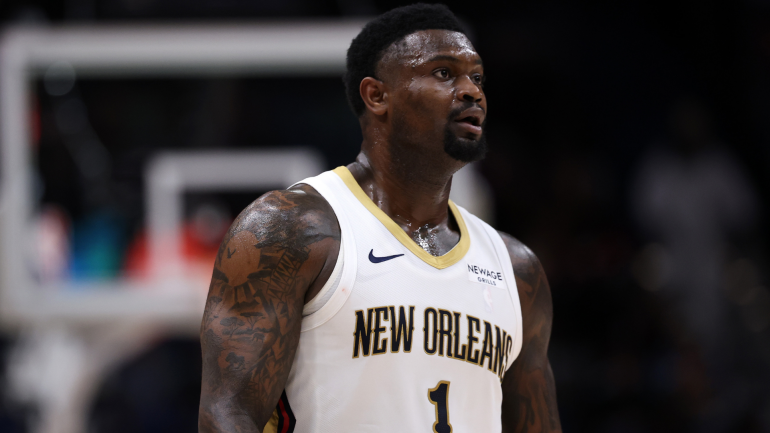
Zion Williamson is nearing the end of his time with the New Orleans Pelicans. It may come through a trade. It may come through his non-guaranteed contract, which only guarantees through games played triggers the Pelicans can choose to bypass just by sitting him. But one way or another, it just no longer makes sense for Williamson to stay in New Orleans.
The Pelicans can't justify a $40 million salary for someone who's rarely available, especially when his place in that team's future has seemingly been supplanted by a recent draft pick (Derik Queen). When presented the option between taking less money with the Pelicans and taking less money with another team, well, most players are going to choose the other team. If you're not going to make a max salary anymore, you might as well take that pay cut for a winner, or for a team you trust to take better care of your health than the Pelicans have.
That makes the rest of this season, or at least the period leading up to the trade deadline, a bit awkward. Williamson is a high-maintenance player. He needs the ball to thrive. The Pelicans would rather keep the ball in the hands of their younger players. Lineups need to be built to suit his needs. The Pelicans weren't great at doing that even at the best of times. This could have gotten ugly. Instead, something mutually beneficial seems to be happening.
On Dec. 14 against the Bulls, the Pelicans brought Williamson off the bench for the first time in his career. He scored 18 points across almost 27 minutes in a win. On Thursday, the Pelicans again started without Williamson. He wasn't nearly as effective, but the Pelicans won the game in overtime against the contending Rockets. Williamson has come off of the bench twice for New Orleans and the Pelicans have won both games. He's started 10 games and they've lost nine of them.
The stated purpose of using Williamson, who has returned after missing more than two weeks with a hip injury, as a reserve is to make better use of the minutes he can play under his current minutes limit. "If you bring him off the bench, it lays out cleaner to finish in the fourth quarter in a more manageable way. You're not rushing to bring him back in or take him out. It gets clunky in the fourth if he's starting right out of the gate," Pelicans coach James Borrego said, before adding that the hope is for Williamson to eventually get back to his "normal rotation."
However, so far at least, this new arrangement is working out well for everyone. New Orleans, without control over its first-round pick, has no incentive to lose games, so this newfound winning is an obvious benefit. It also makes it easier for them to separate Williamson's minutes from Queen's, as the two overlap quite a bit. Williamson was better in the Bulls game. Queen, who was a +18 while Williamson was a -17, was better against Houston. But perhaps most importantly, it shows that Williamson is flexible about his role, something that should appeal to potential future employers.
"If you're about team and you're about winning, you're willing to make moves like that. If guys are willing to sacrifice, that's a positive for our culture and our team," Borrego said. The next team Williamson plays for is not going to be built specifically to suit him. Doing so given his medical history would be irresponsible. That's going to mean that some degree of sacrifice is probably required. There's a big difference between joining a team as a No. 1 overall pick perceived as a franchise player and doing so as a buy-low free-agent signing or trade addition.
So if Williamson's next stop is any sort of "prove it" destination, proving ahead of time that he's comfortable in a smaller role obviously gives him a bit of a head start. There's a pretty rich history of high-profile players thriving in smaller bench roles when it becomes clear that their bodies can't handle the strain of a starter's workload. Bill Walton won Sixth Man of the Year and a championship averaging only 19 minutes or so per game for the 1985-86 Boston Celtics. Blake Griffin was a very effective role player for the Nets after his body broke down in Detroit. Though he was never quite as high profile, Shaun Livingston was at one time a potential future star who had to reinvent himself in a smaller role for the Warriors and wound up becoming a key part of a dynasty.
These are possible models for Williamson, but there are just as many in the NBA today if you're willing to broaden your search a bit. The league has frankly never been kinder to players who can be extremely productive in mostly short stints. Think about how critical T.J. McConnell was for the Pacers during their run to the Finals last year. How many minutes do you think he averaged in doing so? He must've played at least half of the game, right? No? Maybe 20 minutes then? Wrong again. McConnell averaged 17.5 minutes in the 2025 postseason. But he owned every one of them, generating huge value in brief stints. Steven Adams is doing the same thing for Houston. Jose Alvarado has made a career out of this. When a reserve has a single, star-level trait, whether it's McConnell's mid-range shot-making or Adams' offensive rebounding, they can tilt entire stretches of games even if they're flawed in other ways, especially if those stretches are coming against weaker bench lineups.
That's probably Williamson's best bet at maximizing his own future. It just doesn't seem realistic to ask him to play 30 minutes every night anymore, but if he can get to a winning team that wants him to play 20, and completely own those minutes by getting to the rim at will against weaker bench lineups, there's still a chance for him to be a hugely impactful supporting piece that can scale up in playing time and usage when circumstances demand it. That is frankly probably the sort of role he's going to be paid for in his next job. And the early impression he's giving for now that is that he'd be on board with that. And when he gets to pick the team he's doing it for, then all the better.
We'll see how long this experiment in New Orleans lasts. Perhaps as he gets healthier, Williamson pushes for his starting job back--though with Queen and Saddiq Bey playing as well as they are, it's unclear who the Pelicans could even bench. Or maybe he gets hurt again, or the team's newfound success proves to be a mirage. For now, though, this is working for everyone. The Pelicans are slowly turning the page on the Williamson era, and Williamson himself is making use of its ending to set himself up for what's probably coming next.