


CLEVELAND — Kenley Jansen sat in the dugout, patiently waiting to talk. The fighter jets screamed over Progressive Field this Saturday afternoon, preparing for Cleveland's National Air Show and, every few minutes, drowning out conversations below.
Even a man rarely short on words had no choice but to wait for the noise above to pass. But Jansen had something to say. A lot, actually. About his season. His career. And the number that had become increasingly difficult to ignore: 500 saves. So the 38-year-old waited for the howl of the turbofan engines to trail into the distance.
The Tigers closer -- who spent 12 years with the Dodgers before suiting up for the Braves, Red Sox, Angels and Detroit over the past five seasons -- now sits at 497, close enough now that, like fighter jets in the distance, he can feel the roar coming. The no-doubt Hall of Famer is approaching a milestone that anoints him a deity among closers.
"It feels like a dream, man," Jansen said.
Because 500 saves represent more than dominance. But also longevity. The kind of excellence that maneuvered around trends, migrated through eras. His greatness persisted when people doubted. His acumen carried him when his body rebelled against the constant torque.
He knows something about saving. For nearly two decades, he's made a living walking willingly, even eagerly, into baseball's most combustible moments. The pressure of the previous eight innings. The stakes of the game, of the season. His franchise's hopes. Jansen wore the weight like a fitted cap pulled low, its bill casting a shadow over his eyes. Unflinching. Certain. A closer inherits magnitude, and Jansen mastered the art of slowing his pulse, embracing the urgency, commanding precision from his cutter, trusting the mettle of his spirit. On 497 occasions, he preserved victories by imposing himself on moments designed to overwhelm.
All-time MLB saves leaders
- Mariano Rivera: 652
- Trevor Hoffman: 601
- Kenley Jansen: 497
- Lee Smith: 478
- Craig Kimbrel: 441
The Tigers' season will end this weekend, and Jansen would need to record a save in every game against the Pirates -- an unlikely feat for the righty who has 21 saves this season -- to hit the milestone this year.
But this conversation wasn't just about the times he succeeded. The great ones tend to remember their defeats more. And Jansen couldn't help but ache over the loss he was powerless to prevent. Even with all his stuff, all his nerve, all his heart.
He built his reputation on rescues. But sitting in that dugout on the Saturday before Labor Day, the blue sky still decorated with contrails, he grappled with the limits of his power as he contemplated his journey and his place in baseball history. With a broken heart and welling eyes, Jansen talked about the one he couldn't save.
His mother.
Some things even a deified closer can't conquer. So, on this warm afternoon in the home of the Guardians, Jansen was simultaneously a 6-foot-6, 265-pound mountain of a closer and his mother's boy, his voice carrying the tremble of a son still grieving.
"She didn't miss not one game before she passed," Jansen said. "The only time that she missed games watching me was when she was in a coma."
He paused.
"That's everything to me right there."
Her death in March of 2025 is still raw. Diabetes, heart complications and kidney failure had taken their toll before eventually claiming Bernadette. Alongside his father, Isidor, she had been there from the beginning. From the 6-year-old playing ball in Curaçao to the man pitching in the big leagues, she watched every game she could.
And so grief has done what grief so often does. It rearranges what matters. Made the enormous feel small and the ordinary feel sacred.
Five hundred saves is the kind of feat history won't forget. Jansen knows that. But even something so monumental shrinks beside mortality. The numbers that will define him now share space with the people who made the journey matter.
His wife, Gianni. Their four children, two boys and two girls. And his father. Especially his father.
Losing his mother made Jansen more conscious of what remains. More grateful for the phone calls, the faces in the stands, the people waiting after the final out. He's more aware of how a 17-year MLB career measured in saves is really measured in time. And time for Jansen, who turns 39 next week, feels different.
There are plenty of tread on those tires now. A closer's body keeps its own analytics. Saver metrics. Nearly two decades of ninth innings. Thousands of cutters. Jansen has 20 postseason saves to go along with the 497 in the regular season, and he has a World Series ring from the Dodgers' triumph in 2020. Seasons stacked atop each other. Countless surges of cortisol coursing through his system. The psychological toll of baseball's loneliest gig.
The accumulation makes him cherish the origins and remain connected to the kid from Curaçao who wanted nothing more than to play baseball. Because pain is the price of love. Because losing something often refocuses. It's why his gut still features the hunger he had as a young man in Los Angeles.
"I love this game," he said. "I didn't play this for money. I played this for love until today. I'm still doing it for the love."
His favorite team growing up was the Braves because of Andruw Jones. He was already a star when Jansen was growing up, a fellow Curaçaoan proving the distance between their island and the major leagues could be traversed.
Jansen and his friends rode bikes around the neighborhood and played ball wherever they could. The game followed them everywhere. Any broomstick they found could become a bat, which Jansen used to mimic Fred McGriff's helicopter finish.
"I was a left-handed hitter, too," Jansen said with a smile.
There it was.
For a moment, 500 disappeared. So did the Hall of Fame conversation. The mileage on his arm. Life on his fourth team in five seasons. It faded. The kid came out. The one who hurled and launched tennis balls with his friends during games that extended into the night. Back when bedtime was merely an inconvenient interruption.
That kid had no idea what baseball would ask of him. That he would leave his home and sign with the Dodgers as a catcher. That the organization would eventually ask him to surrender the position and climb onto a mound. That on the back fields he would discover a cutter that would befuddle hitters for the better part of two decades.
That kid couldn't have known about ninth innings. About October pressure. The blown saves and the improbable ones. The exhilaration of protecting something and the agony of one mistake that haunts.
That kid didn't dream about 500. Just about playing. That part survived it all. The world-class hitters. The deafening stadiums. The nine figures of earnings. The injuries. The wins and losses, on the field and off. He's three saves from joining a most exclusive club, with Hoffman and Rivera, but that old feeling still tugs at him.
The wonder. The imagination. The spirit. Processing 500 means reflecting, rediscovering those sentiments tucked away in sacred spaces of his psyche.
His village extended well beyond home.
His mother was always the anchor. His father was there, too. But eventually, both had to let go. Their son had to leave Curaçao, his path entrusted to others who would help him become what he could not yet see.
Jansen raised his hands and began to count, touching his left thumb to his right pinky, then moving from finger to finger.
Logan White. Danny Darwin. Chuck Crim. Charlie Hough.
Then he got to De Jon Watson.
Jansen smiled.
"De Jon, man, I can't thank him enough for being tough on me," Jansen said. "For some reason, man, no, he saw it, man. He's the one that saw it, man. He put me on the mound."
That was 2009.
Jansen had signed with the Dodgers as a catcher in 2004, but the bat never developed the way his arm did. In 2008, he hit .227 across 79 games in Single-A.
"I always wanted to be a catcher," Jansen said. "I always wanted to hit. I hit my first year rookie ball but then I just lost it."
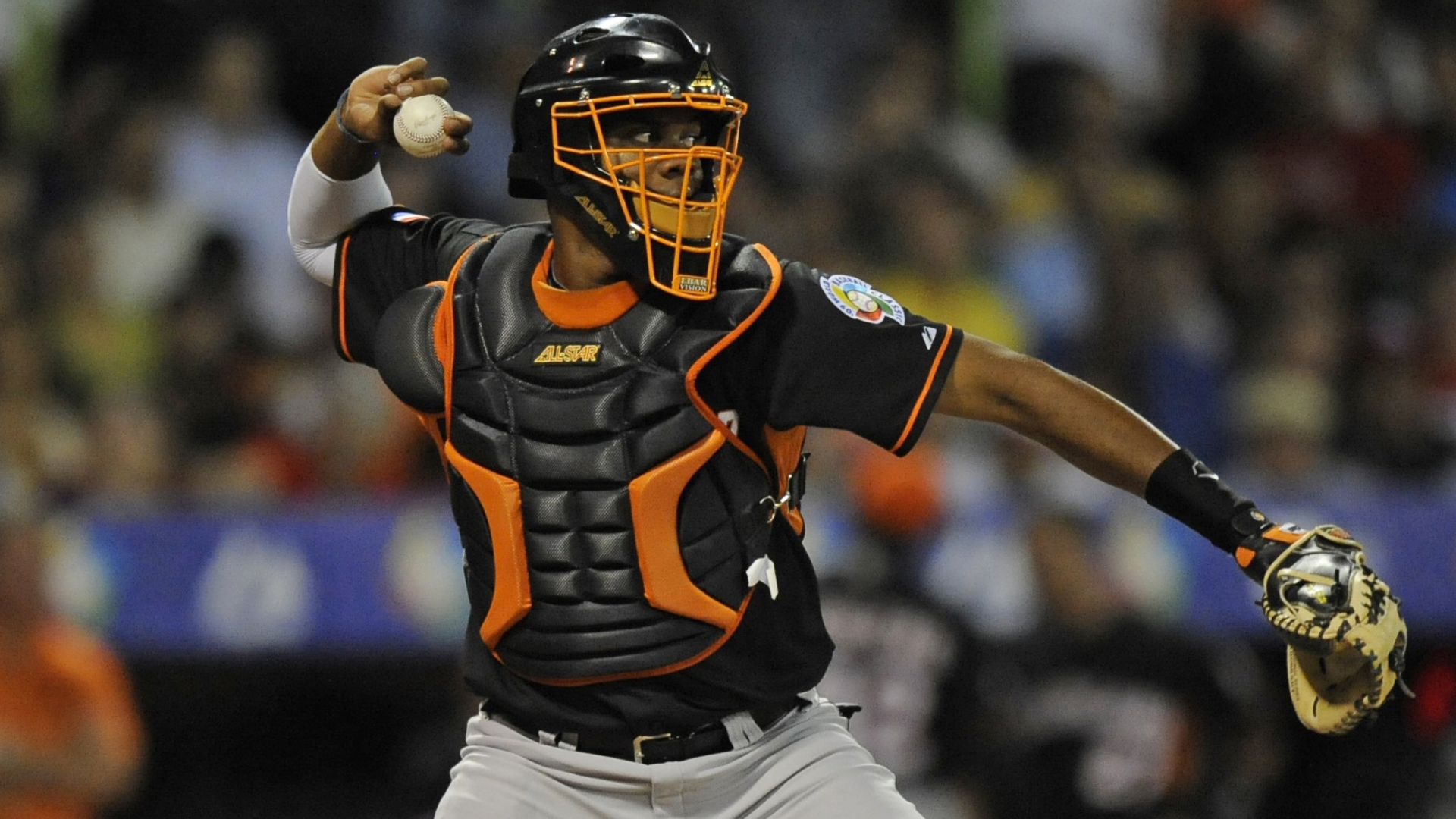
For Jansen, saving would come to mean more than protecting leads. Before he could save games, someone had to save his career.
Watson, then the Dodgers' vice president of player development, saw what Jansen could not.
The bat was light. The arm was anything but.
Jansen could throw out runners from his knees, relying on an arm powerful enough to compensate for a 6-foot-6 frame that didn't always allow him to move like the smaller catchers around him.
Watson wondered what that arm might look like from 60 feet, six inches.
"The bat was a little short from an offensive standpoint," Watson said. "And then I don't want to kill him about his game-calling, but managing a staff wasn't his strong suit. The arm was obviously the carrying tool. I really believed in my heart that he had a chance."
Jansen, who had made it all the way to Triple-A as a hitter, was suddenly back in High-A as a pitcher. Still just 21, he pushed back.
Watson was adamant.
"You have to trust me on this."
Watson believed Jansen could reach the big leagues sooner rather than later.
Finally, Jansen trusted him.
Knowing Jansen's career seemingly rested in his hands, Watson paired him with Charlie Hough, then the pitching coach at High-A Inland Empire. Hough had spent 25 seasons pitching in the majors before becoming one of the more respected pitching minds in the game.
Jansen hadn't even been under Hough's guidance for a full week when Watson's phone buzzed.
It was Hough.
"You gotta get here quickly."
Watson made the trip back to the Inland Empire. Then he saw why.
Jansen sat between 96 and 99 mph.
On July 31, 2009, Jansen made his professional debut on the mound. Less than a year later, on July 24, 2010, he made his major league debut against the Mets.
A day later, he recorded his first save.
Promise kept.
Now look at him, 16-plus years after that first save. He's close enough to feel it. Far enough away for the chase to still carry some angst.
There's Mariano Rivera. Trevor Hoffman.
Those two sit on a Rushmore of their own.
But 500?
Something about the five and the two zeros that follow makes the accomplishment feel whole. Complete. It carries history. Weight. A finality that 450 or 475 doesn't.
In truth, Jansen might be the last of a dying breed. The game has changed. Bullpens are managed differently. Relievers are asked for max effort in shorter bursts, while save opportunities are spread across more arms. Reaching 500 requires not only dominance, but surviving long enough to accumulate them.
"In this era of max effort, when you look around the closers around the league, just to be able to stand the test of time is really hard," said Tigers manager A.J. Hinch. "Kenley's going to be somebody that has to pitch for close to 20 years to get to those totals.
"We do use our bullpen differently than the plug-and-play bullpens of old. That may hurt some guys with some career accomplishments, but I wouldn't count anybody out being able to do it."
Maybe Red Sox closer Aroldis Chapman, 38, could be next. Chapman, currently at 402 careeer saves, has found a third act to his career, still dominating with a fastball that has reached 102 mph.
"The way that baseball is going right now, these accomplishments are going to be harder and harder to get," Chapman said. "But I'm happy for the both of us and the careers we've built so far."
Happy, though, doesn't quite describe Jansen's season. The milestone will likely have to wait.
His team won't make the postseason. Jansen made it 10 years in a row, nine with the Dodgers and one with the Braves, before missing out the last four seasons.
His own season has been a mixed bag, too. Jansen has a 3.27 ERA and just 21 saves, his fewest in a full season since becoming a full-time closer.
"It's almost like I feel like it's ruined," Jansen said on possibly reaching 500 in a lost season. "This year kind of ruined it a little bit because my feelings are always about the team. My feelings are always about winning as a team."
Even with a lockout looming and an uncertain 2027 season on the horizon, Jansen is certain 500 will come. The Tigers have a $12 million team option on Jansen's contract. If they decline it, he'll become a free agent this winter. He does not want to retire.
When Jansen allowed himself to imagine that moment of his 500th save, his mind drifted back to his mother.
He became a son again.
She missed 450. She will miss 500.
By then, the roar of the fighter jets had faded, leaving only Jansen's voice.
He thought about her then. He will think about her again once he reaches his goal.
Because joy and grief in Jansen's world are now neighbors.
His eyes began to well once more.
"Damn," he said. "It's making me emotional."