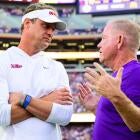
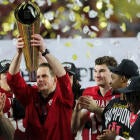
SMU Director of Recruiting Operations Bryan Filker knows logistics and intelligence.
He oversees business expenses, coordinates with vendors, prepares for recruiting visits and ensures the Mustangs' operation runs seamlessly. It's not that different from his previous job in the Air Force.
Filker worked in intelligence, briefing pilots to ensure they had all the necessary information before a mission in enemy territory.
"I went from doing life-or-death briefings … to coming here and your life and death is winning and losing on Saturday," Filker said. "It's a little theatric in a sense, but there are so many more parallels than I would have imagined."
Filker isn't the only former military member to draw parallels between his previous career and college football.
As college football front offices expand into multimillion-dollar operations, former military members are finding opportunities to apply the skills they developed while serving. But for veterans looking to enter the industry, there is no established pathway.
Ahead of Veterans Day, CBS Sports spoke to four former service members about their roles in college football front offices and how their time in the military shaped their next step.
Even if it wasn't always easy for them to get there.
"I reached out at that time probably 60-something colleges," said Old Dominion general manager Hunter Sims, who served in the Navy. "From HBCUs all the way to Division I, P-4 schools. I was reaching out to everyone. Keep pushing, and somebody is going to answer you.
"Take a leap of faith."
A new mission in football
When North Texas assistant general manager Jarae Thurmond thinks about the end of his playing career at Georgia Southern, he says with a bit of a grin: "Some would say I got kicked off the team, some would say I quit."
Either way, he wasn't -- in his words -- a model citizen.
He lived in Atlanta after college, working security and playing semi-pro football. Eventually some of his close friends and family members sat him down: "You need to go to the military and get your life together."
Thurmond, who had done Navy ROTC in high school, was in boot camp two months later.
Thurmond scored well (93 out of 100) on the ASVAB (Armed Services Vocational Aptitude Battery) test. That gave him many job options in the Navy, from serving as a linguist to working with nuclear weapons.
On the advice of one of his co-workers in his security job, he asked to be a gunner's mate. He thought shooting guns all day sounded awesome. The Navy told him that was for people who scored in the 40s to the 60s. Thurmond, still a tad stubborn, did it anyway.
Thurmond served a combined 12 years in Virginia, Hawaii and San Diego.
By the time he finished his service -- he was honorably discharged due to medical issues -- he earned Sailor and Instructor of the Year. He taught sailors about ships, subs and how to load Tomahawk missiles.
Thurmond shot five missiles in his career. Three in training. Two were tactical.
Holding up his finger, Thurmond says: "Two missiles that I shot with this finger, $2.1 million – each."
He basically spent his entire North Texas roster every time he pressed that button.
Thurmond never could shake football. When his brother died during Thurmond's time in the service, the way his brother impacted kids as a youth football coach resonated with him: "It awoke a fire in me."
That connection took on a different meaning. He was a youth football coach. Thurmond saw the impact his brother had on kids. "It awoke a fire in me."
Thurmond continued to play semi-pro football while he served. When he arrived in San Diego, he volunteered as a high school coach. He used to tell everyone and anyone, when he left the military, that he'd work in college football. People would call him crazy. He was just Sailor of the Year.
Thurmond used to think: "That's not a life fulfilled for me."
He reached out to the athletic director of his alma mater, Georgia Southern, on Nov. 4, 2020. Jared Banko -- now the AD at Iowa State -- responded the next day. He invited Thurmond to sit in his office and learn. Thurmond took leave, flew home to Georgia, drove his dad's truck, changed into his suit in the parking lot and sat with Banko.
Banko said to keep in touch. Thurmond didn't bother him for two months. Then Banko called again: "What are you doing? You said you wanted this."
Thurmond did.
He turned down six-figure offers to exit the military and pursue football.
Knowing Thurmond's time in the Navy was coming to an end, Banko introduced Thurmond to Georgia Southern head coach Clay Helton, who offered Thurmond a role that hadn't yet been defined. Thurmond thought he'd coach. Helton saw something else. He eventually created a role for Thurmond as Director of Player and Recruiting Relations.
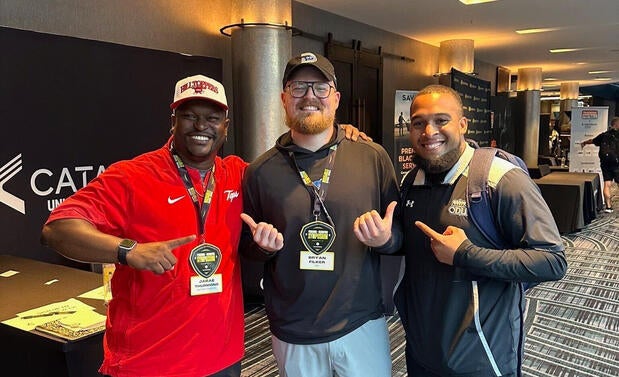
To Thurmond, football is a natural extension of his time in the Navy.
He once spent 256 days aboard a 505-foot ship with 303 people. Football creates the same bonds.
As for how the military translates to a front office, the discipline it instilled in a young Thurmond informs the way he approaches his day-to-day role as a recruiter, scout and organizer.
"When you're building a front office or you're building a team," Thurmond said. "You want individuals who can show that they have structure, show that they can work under high-stress environments, show that they can pivot at the blink of an eye when something changes. All those qualities and traits were learned through the military."
Intelligence work meets recruiting
Filker took the ASVAB test three times.
With no real direction after high school, Filker took the test. He did poorly.
"Heart wasn't in it," Filker said.
Filker bounced from job to job and took five years to earn an associate's degree. He took the test again a few years later and did much better. He was offered a job in the military police. Filker showed up to the place he'd ship out from but refused a urine test because he knew he'd be auto-disqualified.
"I got cold feet," Filker said.
A year or two later, as he worked in complex rehab -- in-home medical devices like customized wheelchairs -- he often talked with elderly folks who told him about all their regrets. It made him think:
"I need to get my a** in gear."
He took the test again. It went much better. He was offered a spot in Air Force intelligence.
So long, Ohio. Hello, Alaska.
In Anchorage, he did pre-mission briefings for F-22 pilots. Threats, analysis, tactics. He specialized in Russia, China, North Korea and Iran. His job was to understand what the enemy would try and to prepare his pilots for every contingency.
His time in Alaska pushed Filker out of his comfort zone and eventually gave him the direction he'd been searching for. It gave him the motivation to pursue what he always wanted -- working in football.
It's what he dreamed of growing up in Ohio. His entire fall revolved around the Cleveland Browns. He just didn't know how to get there. Thousands of miles away from the mainland United States and amid COVID-19 lockdowns, Filker looked for a way in.
He signed up for classes at The Scouting Academy. He'd write up reports on Baker Mayfield and Donovan Peoples-Jones to practice the craft. He applied for internships and direct-messaged hundreds of college football front-office staffers to connect. Maybe five responded. Filker remembers attending a personnel event in Las Vegas with 20-30 personnel staffers. He made digital business cards. He wore printed, colorful shirts to stand out.
"Once they found out I wasn't in the space, they looked right through me," Filker said. 'I remember how that felt.'"
A few people did respond.
One was current Arkansas general manager Gaizka Crowley. The other was current Kentucky assistant general manager Alex Brown.
After a few years in the Air Force, Filker decided to go all-in with football.
He used his military education benefits to give himself a chance. His family moved to Texas. They bought a house in Fort Worth. He figured he'd volunteer at TCU. He knew a staff member there. Then Gary Patterson got fired. Brown, then at SMU, saved the plan with an offer: You can volunteer here.
Fifty-five miles across the Metroplex daily to make $0 with two little kids at home?
Filker did it.
He worked overnights in security at the Great Wolf Lodge hotel. He took on holiday shifts at Target. He remembers sleeping four hours a night and jumping to 280 pounds.
"I was just putting all my focus on this," Filker said.
He earned his spot.
There's more balance in his life now. His kids are always around the team at SMU. He's the healthiest he's been in years. And as SMU's Director of Recruiting Operations, Filker is doing what he dreamed of as a kid.
Filker wishes the path was a little easier.
But he wants former military members to know it's possible to get into football. The skills and organization he learned in the Air Force translate into everyday life. He once briefed pilots. Now he does the same with coaches, trying to make every piece of information as digestible as possible.
"My whole job was how do I understand what the enemy is trying to do to us," Filker said. "The pilots were the experts. They knew what they could do from the jet. I tried to figure out what (the enemy) was going to do against us. It's no different than pre-opponent scouting. You're trying to figure out what the opposing team is trying to do. It was a direct one-for-one kind of trade-off in some instances."
Taking the long way
During recruiting weekends at Alabama, a high school-aged Sims would help out in the recruiting office. His brother, Blake, played quarterback for the Crimson Tide. Hunter would stay with him for the weekend but spend game days with Ashleigh Kimble, now a nearly 20-year veteran of Alabama football's recruiting operations.
He'd watch how Alabama structured its visits and help Kimble with tasks like preparing credentials for recruits and their families.
"It all intrigued me," Sims said.
Sims played college football. He finished his career at the University of the Cumberlands. But he knew even back in high school that a pro career, as his brother's would, wasn't in his future.
His time with Kimble helped him see a path in personnel. He just didn't know how to get there.
A random Sunday in a strip mall showed him the way. He was shopping next door to a Navy recruiter's office and walked in out of curiosity. Sims and the recruiter working that day -- nobody else was even around -- talked for a long time.
The recruiter knew Sims' brother. Everybody in town did. He told Sims something that stuck with him: "Go on your own journey."
He signed up the next day.
Sims now works in the same city he served in the Navy: Norfolk, Virginia. He was stationed on the USS George Washington, which was at the time docked in the yards for repair and upkeep. It wasn't an easy job. Sims was a retail services specialist. Usually, they run stores on a ship. But with the ship docked, Sims had a very different role.
CHANGED MY LIFE AND IM FOREVER THANKFUL FOR EVERYTHING I EXPERIENCED 🙏🙏🙏⚓️⚓️⚓️ pic.twitter.com/jxDgGdt9Ku
— HUNTER SIMS (@CoachHSims) November 11, 2025
He got staterooms ready for officers. Sims painted. He did electrical. He put in beds. The days were long. His ship, when docked, didn't have air conditioning or heat. There were cold winter days and humid nightmares in the summer.
Sims remembers being depressed for a time. He didn't understand why the job was important. He didn't see the full picture. Then his Chief, James Magee, changed his perspective. Magee changed the way he thought about preparing the ship for duty and what Sims' efforts could mean for his fellow service members.
Thinking back on his time as a football player, Sims never really considered himself a vocal leader. That changed in the Navy with Magee's help. He found his voice. He found the purpose in the details. He went from questioning the point to pushing his fellow retail specialists.
"He showed me I'm a leader," Sims said.
When thinking about his time in the service, Sims developed a mantra: "GSD. Get sh** done."
It's something he tells his staff members at Old Dominion all the time. It also helped lead him to his next step after the Navy. Sims knew where he eventually wanted to go -- football.
From 2021 to 2023, he worked full time in the Navy and volunteered as a high school coach at Meadowcreek High School in Georgia. When Sims had to leave the Navy in 2023 due to medical issues, he reached out to college football contacts.
Even with his connections and his brother's, Sims didn't have much luck. Eventually, his brother's old teammate Eric McDaniel, now at Tulane, offered him an opportunity at Troy.
A few years later, Sims is a general manager of Old Dominion.
The Monarchs don't have the resources of a Power Four program. Several of Sims' student workers handle responsibilities typically assigned to full-time staff members, including titles such as Director of Recruiting. He treats them like any other members of the operation, trusting them to do the work necessary for the program to function.
After all, it's GSD.
"I knew I had to step into the Navy to get to where I wanted to get to, and it set me up for life," Sims said. "I carry it with me every day."
Building a veteran pipeline
After graduating from the Naval Academy, Sean Magee figured military service would be his career.
A few years out from playing offensive line at the Naval Academy, Magee had been stationed in Japan, had been deployed during Operation Iraqi Freedom, and had driven a billion-dollar ship. In the late 2000s, he held a Chief Operating Officer role in Columbus, Ohio, where he led 80 Navy recruiting offices spanning Ohio, West Virginia and Kentucky.
GO NAVY!!! BEAT ARMY!!! @NavyFB Fedex Field 2003 pic.twitter.com/8i78kwFsMJ
— Sean Magee (@SeanMagee04) December 14, 2024
Magee's job was to recruit new service members and optimize the territory. During that time, Magee would often get calls from Navy head coach Ken Niumatalolo, his old position coach with the Midshipmen. They'd discuss recruiting tactics and ping ideas off each other to learn from the other's world.
Eventually, Niumatalolo asked Magee to meet with his staff and help out on a project.
When that day came to an end, Niumatalolo asked Magee a question: "Could you do this full time?"
"Sean, I think you can be an admiral," Niumatalolo said. "But you're a football guy. I think you'd be really incredible in this world."
Magee always wanted to work in sports. Before franchise mode was a thing in the Madden video games, he used to write down the stats from each game on paper to compile a season record for every team.
Niumatalolo pulled him back toward his original goal of working in sports. Magee was Navy's Director of Player Personnel from 2012 to 2017. He then worked at Michigan as associate AD for Football, as Chief of Staff for the Chicago Bears and then again as Michigan's general manager.
Now, Magee is the Vice President of the search firm ZRG Turnkey, one of the largest search firms in college athletics. He partners with schools to identify and hire the best head coach, general manager and athletic director candidates.
When Magee thinks about how his service in the Navy prepared him for a life in sports, he considers it a foundational element of his education. Both are high-pressure environments when people of all backgrounds are pushed together to work toward a common goal.
"There are no two more alike communities than the military and sports," Magee said.
When Filker, Sims and Thurmond think about their path into college athletics, none of them considered the path easy. They didn't grind as underclassman student assistants or as post-graduate GAs to break into the business. Their 20s and early-30s were spent in the military.
While there are some organizations that help service members transition into NFL coaching -- like Soldiers to Sidelines -- everyone CBS Sports spoke to for this story said there is no specific path to help veterans transition into personnel roles. There are some scattered group chats. Sims always tries to have a veteran or two volunteer with him at Old Dominion. But he gets bombarded with emails and can't help everyone.
"I think they could do a lot better getting more veterans transitioned into college coaching," Sims said. "At the end of the day, our structure and the way we do things is different from people who weren't in. A lot of that could be changed by allowing these people who served to get more volunteer roles to go into personnel or recruiting. I think as a whole in college football we need to do better."
Magee knows how difficult it is for veterans to make the transition.
He didn't jump into football until eight years out of school. At that point, life begins to get in the way of dreams.
Now that Magee is in a role where he speaks with decision-makers daily, he hopes to help develop pathways that could give veterans more opportunities to enter personnel roles. Magee thinks a scouting internship in NFL training camps would be a no-brainer for teams.
Breaking into college football and the NFL is largely a product of networking. Most connections are formed through a person's playing days or years spent working as a graduate assistant. Filker was an exception, aggressively pursuing hundreds of personnel staffers until someone answered.
Magee feels that a pathway could help schools and NFL teams tap into an untapped talent pool.
"I think decision makers in this league would look at it and go, 'Holy shit, they're really good," Magee said. "This is a whole new population you can have access to."
Magee visited the Naval Academy over the weekend.
Magee was in Maryland helping with the Terrapins' coaching search when his daughter's lacrosse tournament in nearby Baltimore gave him an opportunity to visit his alma mater.
While on campus, Magee always runs into alumni and almost feels like he knows them.
They have different experiences, but their perspectives, honed through service, are often the same.
It's why he believes veterans are such an asset in potential personnel roles. No, the jobs aren't exactly the same. But the skills developed over years of military service translate easily.
"The function of scouts and personnel and team building are such a process-oriented approach," Magee said. "There's just something that naturally lends itself to what military members have always done in their career -- process, detail and finding the path to achieve objectives."