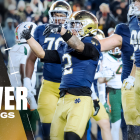
Nine weeks into LSU's 2026 season, it feels too much like the 2025 season, despite all the resources poured into the program to ensure that wouldn't be the case.
Saturday evening brought a familiar feeling in Baton Rouge as No. 5 Alabama pulled away from No. 14 LSU late for a 31-13 win. The Crimson Tide are now 7-1 in their last eight trips to Death Valley, and most of the recent wins have come by comfortable margins.
With that loss, LSU is 6-3 and clinging for dear life to its College Football Playoff hopes. Entering the season, many pundits and prognosticators considered the Tigers to be a virtual lock for the playoff. Some of them picked LSU to win the national championship.
When things went off the rails one year ago, LSU fired Brian Kelly and began its very public pursuit of Lane Kiffin, who ultimately chose the Tigers over another lucrative offer from Florida. Kiffin's contract comes out to around $91 million overall -- $13 million this year plus incentives. It also cost the Tigers a $54 million buyout to move on from Kelly. On top of investing big money into Kiffin, his coaching staff and go-away money to Kelly, LSU also dumped a fortune into its roster.
The 2025 LSU roster cost roughly $18-20 million, sources told CBS Sports' Chris Hummer. Double that number -- to somewhere slightly north of $40 million -- and you've got the price tag for the 2026 Tigers.
"LSU is almost in a tier of its own this year," an anonymous SEC front-office staffer told CBS Sports.
Despite a 100 percent increase in spending, LSU has just one more win through nine games than it did last season. That's probably not the kind of return on investment donors in Baton Rouge had in mind when they opened up their wallets to land Kiffin and the No 1 transfer class in the country, per the 247Sports Team Rankings.
This loss will put some pressure on Kiffin to win out and reach the playoff, and justifiably so, but that won't be easy with Texas and a road trip to Tennessee remaining.
Better numbers, similar results
To be clear, those millions haven't been completely wasted. LSU is vastly improved in a number of areas. The offense is much more dangerous, and the defense has made major gains, especially on the ground.
Without looking at the actual wins and losses, the difference between the 2025 and 2026 teams is night and day through the first nine games.
| 2025 Offense | 2026 Offense | 2025 Defense | 2026 Defense | |
|---|---|---|---|---|
Points/game | 23.6 | 37.1 | 19.0 | 17.7 |
Yards/game | 341.8 | 504.1 | 327.9 | 261.1 |
Pass yards/game | 240.8 | 324.9 | 201.9 | 176.4 |
Rush yards/game | 101.0 | 179.2 | 126.0 | 84.7 |
The simple fact is that LSU is a much more talented team this year, and it shows in the box score. Sam Leavitt is exponentially more dynamic than the combination of Garrett Nussmeier and Michael Van Buren Jr.
Jackson Harris has emerged as a legitimate threat for opposing defensive backs. Trey'Dez Green is a matchup nightmare. Princewill Umanmielen has been worth every cent at the EDGE position, as has fellow pass-rusher Jordan Ross. The lineup is loaded with NFL talent, and you can see it on the field every Saturday.
That doesn't explain LSU's underwhelming record, but what about the schedule? The Tigers have played some tough opponents, but this schedule isn't drastically more difficult than last year's.
LSU's 2025 slate ranked No. 12 in the country in terms of toughness, per ESPN FPI. The 2026 schedule ranks No. 23. Last year's losses through the first nine games came against No. 13 Ole Miss, No. 17 Vanderbilt, No. 3 Texas A&M and No. 4 Alabama. That wasn't exactly a cakewalk.
Besides, LSU has been right in every game its lost this season, but the little things have added up a 6-3 record.
Losing on the margins
In the modern world of college football -- where parity reigns supreme -- the margins between winning and losing are smaller than ever. Gone are the days of simply overpowering opponents with a depth chart full of starting-caliber talent.
When it came to the margins on Saturday, the Tigers were awful. They went 0-for-4 on fourth down and lost the turnover battle, 2-0.
The second quarter was probably the best encapsulation of those woes. LSU piled up 129 yards of offense and entered Alabama territory on every drive but came away with zero points. A missed field goal, a failed fourth-down attempt and a head-scratching interception from Leavitt allowed the Crimson Tide to take a 10-3 lead into halftime.
GIMME DAT! 😮💨
— Alabama Football (@AlabamaFTBL) November 7, 2026
📺: ABC pic.twitter.com/ZfQxgie6BO
Even in LSU's overtime loss to Kentucky, there were a few key moments that proved to be the difference.
With under two minutes to go in the fourth quarter and the Tigers facing a fourth-and-1 from their own 43-yard line, Kiffin chose to punt instead of going for it in an attempt to ice the game. Kentucky got the ball back and kicked a game-tying field goal anyway.
Then, in overtime, the Tigers got the ball first. They scored and elected to kick the PAT. When Kentucky scored on its ensuing possession, Will Stein went for a two-point conversion and the win.
How does LSU fix its shortcomings in high-leverage moments? Maybe they're just part of the ebbs and flows of a football season, and the Tigers' luck will turn down the stretch. Maybe Kiffin is approaching situations differently because of the lofty expectations in Baton Rouge.
Whatever the cause, Kiffin is getting paid handsomely to correct those issues, and he's running out of time to do so.