WNBA Free Agency 101: FAQs ahead of the busiest and most expensive free-agent period in league history
WNBA free agency will get started later this month after the new CBA was signed in March


It's almost time for another round of WNBA free agency, and this year's period will be unlike anything we've seen before. The biggest free agency class in league history will have less than two weeks to meet with teams and negotiate new deals, which will be the richest in league history. And there are two new teams joining the mix that still have to complete their expansion draft.
Ahead of what is sure to be a fascinating and league-altering few weeks, here's everything you need to know about 2026 WNBA free agency.
When does free agency start?
No official dates have been announced. However, earlier this year, the league gave teams a series of tentative dates for the different phases of free agency, which are as follows, per ESPN:
- Free agency designations: April 7-8
During this period, teams can make "Core Player" designations and hand out qualifying offers. There are no changes to the core player system this year, but starting in 2027, players who have seven or more years of experience will be ineligible to be cored.
- Free agency negotiations: April 9-11
During this period, teams will officially be able to negotiate with free agents from other teams. Those rules will always be skirted to some extent, but teams caught breaking them will be punished under the league's tampering rules. Most recently, the Seattle Storm were fined in 2022 for jumping the gun on legendary point guard Sue Bird's re-signing.
- Free agency signing period: April 12-18
Beginning on April 12, players will be allowed to officially sign new contracts.
Typically, the free agency process would begin in mid-January and take well over a month to complete. But due to the extended labor negotiations, which didn't conclude until mid-March, the league has been forced to condense free agency in order to get it done before training camps open on April 19.
How does WNBA free agency work?
WNBA free agency largely operates just like the NBA. There is a moratorium period where teams can speak to players but not officially sign anything -- which will be extremely short this year -- and free agents are grouped into different classifications that dictate how both they and teams can operate.
The two main groups are unrestricted free agents, who can speak to and sign with any team they want, and restricted free agents, who can speak to and sign with any team they want, but whose prior team has right-of-first-refusal.
The WNBA also has a reserved category, which is for players who hit free agency with fewer than three years of service. Often, these are veterans who entered the league later in their careers, but they can also be younger players who, for whatever reason, were not on a typical rookie-scale contract. The prior team has exclusive negotiating rights with said players, provided that they make a qualifying offer.
Furthermore, in rare instances, players' contracts can expire while they are suspended. When this happens, players are technically found to be "withholding service," and are listed as "suspended -- contract expired." In practice, these players are treated much like reserved players, though the prior team does not have to extend a qualifying offer.
What is the 'core designation'?
The "core designation" is most analogous to the NFL's franchise tag. The players were hoping to eliminate the core designation in this new collective bargaining agreement, but the league held steadfast on that front, and it remains in place -- albeit with a slight tweak that will make players with seven or more years of experience ineligible to be cored beginning in 2027.
If a team uses the core designation on a player, they gain exclusive negotiating rights with them, even if that player was set to be an unrestricted free agent. Teams must be shrewd with this machination, however, as there are limits on its use.
On an organizational level, each team is only allowed to designate one "core" player at a time. If said player then signs a contract with that team, they will be considered their lone designated core player for the entire length of that contract, or until they are traded or the contract is terminated. Speaking of trades, teams are allowed to trade for another team's core player even if they already have their own core player on the roster, though those situations arise rarely.
On a player level, the limit for how many seasons a player can play under a core designation was lowered to two in 2022. Thus, any player who has spent two or more seasons under a core player contract can no longer be cored. Here is a list of 2026 free agents ineligible to cored:
- DeWanna Bonner, Phoenix Mercury
- Tina Charles, Connecticut Sun
- Kahleah Copper, Phoenix Mercury
- Skylar Diggins, Seattle Storm
- Brittney Griner, Atlanta Dream
- Natasha Howard, Indiana Fever
- Brionna Jones, Atlanta Dream
- Jonquel Jones, New York Liberty
- Jewell Loyd, Las Vegas Aces
- Nneka Ogwumike, Seattle Storm
- Breanna Stewart, New York Liberty
- Jordin Canada, Atlanta Dream
When a team makes a core player designation, it comes with a core qualifying offer of a one-year, fully guaranteed supermax contract. Said player can decide to play out the season on that one-year deal, but it's important to note they are not required to do so. The team and the player can negotiate a deal at different terms or work together on a sign-and-trade. Notably, under the new CBA, teams cannot sign-and-trade anyone who makes more than the regular max. So if a team wants to trade someone they cored, they will have to negotiate a deal at or under the regular max.
What are the new player salaries?
Salaries are determined by a number of factors, with draft position and service time being particularly important. Thanks to the new CBA, which "establishes the first comprehensive revenue-sharing model in women's professional sports history," players will make more than ever this season.
The salary cap will be $7 million in 2026 -- up from $1.5 million in 2025 -- and is expected to grow to more than $11 million by 2032.
Full salary scales have not yet been announced, but players will earn significant pay raises in 2026 and will see their salaries climb even further over the course of the CBA. Here's a look at the minimum, average and supermax numbers in 2025 and 2026, and the projected numbers by the end of the deal in 2032.
| Year | Minimum salary | Average salary | Supermax salary |
|---|---|---|---|
2025 | $66,079 | $120,000 | $249,244 |
2026 | $270K -- $300K (based on years of service) | $583,000 | $1.4 million |
2032 | $340K -- $380K (based on years of service) | $1 million+ | $2.4 million |
Who is on the market this spring?
Who isn't might be a better question.
Every single veteran aside from Kalani Brown and Lexie Brown maneuvered to be a free agent this offseason in anticipation of a major pay raise from the new CBA. As a result, there are more than 100 free agents, including dozens of unrestricted free agents.
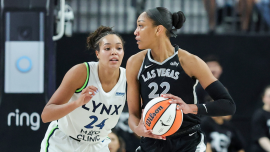
This year's free agent class includes some of the league's best players: A'ja Wilson, Napheesa Collier, Breanna Stewart, Alyssa Thomas, Jackie Young, Sabrina Ionescu, Jonquel Jones, Kelsey Mitchell, Nneka Ogwumike, Kelsey Mitchell and Allisha Gray, among others. Here's a look at the top-30 free agents:
For a full tracker covering every free agent, their classification and their status, go here.
The best of the best -- Wilson, Collier, Stewart -- are expected to stay put, but there should be plenty of movement over the next few weeks, especially with the new salary structures. The league will likely look significantly different by the time training camps open.