Because time machines are not, in fact, real, there was no perfect solution to the WNBA's Game 6 problem. The Atlanta Dream and Golden State Valkyries, tied 2-2 ahead of Game 5 on Monday night at the Chase Center, needed either a schedule change or a location change.
And yet, faced with a number of sub-par options, the league delayed the decision until the last possible second, announcing the Game 6 venue just hours before the tipoff of Game 5, and then made the worst choice of the bunch.
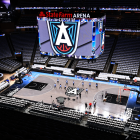
Game 6 will be played in State Farm Arena at 12:30 p.m. ET on Thursday, Oct. 29.
Yes, that's right. A game during which the champion of the landmark 30th WNBA season could be crowned will take place during lunch on a workday -- and that's for East Coast fans. Valkyries fans, who have shown their second-year expansion team unprecedented levels of support and devotion, will be watching over breakfast, if their jobs and lives and adult responsibilities will permit them to watch at all.
To add insult to injury, the game has to be early because there will be a regular-season Atlanta Hawks vs. Cleveland Cavaliers game in State Farm that evening -- the game was shifted from 7 p.m. to 8 p.m. to help the arena get turned over in time. But that means that, if a champion is crowned in Game 6, the title-winning celebration and media availability will have to be abruptly cut short in order to accommodate the switch to the men's court. There have even been discussions about moving the on-court celebration to a practice facility, according to ESPN.
It is simply a baffling decision made inexcusably late in the game, and while I have no doubt that everyone involved will make the most out of it and that the atmosphere at State Farm on Thursday will be as electric as possible given the circumstances, it is an embarrassing subplot to a season that began with the trailblazing new CBA and is ending with two of the best stories in the league -- Angel Reese's emergence with the Dream and the Valkyries' success as an expansion franchise on and off the court -- duking it out in a thrilling best-of-seven series.
But hey, nothing puts an exclamation mark on women's sports history like interrupting a championship-clinching, legacy-defining moment so that the men can play a regular-season game.
How did we even get here? Well, it's a long story that includes centuries of structural inequities and sexism in sports, but I'll try to keep it to the calendar year. The Dream play their home games at the Gateway Center, a 3,500-seat venue that is the smallest in the WNBA. They began moving marquee games to State Farm Arena, the 17,000-seat home of the Atlanta Hawks, in recent years. This season, thanks in part to the popularity of Reese, who was traded to Atlanta in April, the Dream played five regular-season games in State Farm Arena, and hosted the first two rounds of the playoffs there, too. Next year, State Farm will become the Dream's permanent home.
But when the Dream swept the Liberty to reach the Finals, things got more complicated, primarily because of the start of the NBA season and other scheduling challenges. But all parties came together and figured it out -- Game 3 was moved from Oct. 22 to Oct. 21 to avoid a Sombr concert, while Game 4 was moved up to 1 p.m. ET to accommodate the Hawks' home opener against the Houston Rockets on Saturday. Both games were sold out and electric. It was understandable that everyone involved wanted to try their best to get Game 6 into that arena as well, and I am extremely sympathetic to the logistical challenges involved with moving NBA and WNBA games, as well as to the financial commitment and risk involved with holding arena space available for games that likely won't even happen.
However, none of that excuses the eventual outcome or its timing.
The truth is that Dream ownership clearly underestimated the interest in its team off the court and the ceiling of the team on the court, while the WNBA failed to appropriately require contingencies or arrange alternatives themselves once this problem became apparent. And, while moving NBA games to help remedy the situation would have been a nightmare, NBA regular-season games have been moved for many reasons; the league just seemed unwilling to do so in this circumstance.
Given all that, the league should have just held Game 6 at Gateway Center at the previously scheduled 8 p.m. time slot and arranged watch parties for Dream fans across the city.
But by all accounts -- including the public comments of Valkyries owner Joe Lacob after Games 3 and 4 were moved -- the league and the two franchises involved would have found it a bit shameful and optically disadvantageous to hold the Finals in such a small arena. And that's fair; the arena is dark, cramped and very ill-suited for a game that involves this much media coverage and exposure. However, the optics of the move to a matinee game, and the possibility of having a WNBA championship celebration moved because of a far less important men's game, is far worse.
The players will roll with the punches, as they always do. In 2018, the Seattle Storm clinched their sweep of the Washington Mystics in the WNBA Finals at EagleBank Arena at George Mason University near Fairfax, Virginia, more than an hour outside of the city, because Capital One Arena was undergoing renovations. The following year, the Mystics won the WNBA Finals in a deciding Game 5 against the Connecticut Sun in their new home arena, a 4,200-seat arena where they still play to this day. Both were far from ideal circumstances, but I covered both in person and the atmospheres were extraordinary. I'm sure Game 6 will be the same.
The difference is, in this era, the league and owners have the resources available to do better for the players, the fans and women's sports as a whole. Once again, they chose not to.