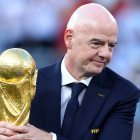
Contractually, at least four more years of Mauricio Pochettino are on the horizon for the United States men's national team after he and U.S. Soccer agreed to extend their deal through the 2030 World Cup. Now he'll get a chance to show what he can do leading the helm for the full cycle that includes Concacaf Nations League play and World Cup qualification.
The United States didn't have a standard World Cup preparation schedule this time around due to being a host nation, but for 2030 they'll be back to the Concacaf grind, which is among the many things that will look quite different for Pochettino than the first cycle. Not only will pressure on his decisions crank up due to playing more competitive games, but the consequences for experimenting will also be higher.
Some of that experimentation shouldn't be needed, as he won't need to learn the full pool of American soccer players that saw him call in 70 different players in the lead-up to the World Cup. But there is plenty of room for change in the senior squad, and areas where Pochettino's influence can make a major difference in the fate of the USMNT.
In 2026, the goal was to figure out the best XI and perform well at the World Cup. The USMNT had mixed results, scoring more goals than ever before in the World Cup but fell apart in the round of 16, leading some to want a different look at the manager, especially when Pochettino was linked to the AC Milan job before the tournament, before they hired Ruben Amorim. In cycle two, job links won't go away, but Pochettino will also need to show his own investment in American soccer.
Potentially managing the team for a four-year spell, his influence can have an impact on transfers that members of the national team make, areas where they improve, and he'll likely have a close relationship with U-23 manager Steve Cherundolo, especially with the Olympics looming. It's a much more expansive job than Pochettino had, even if he had the pressure of a World Cup on home soil, and it's part of why managers usually don't last more than one World Cup cycle at the helm of a team.
In the 2026 World Cup, only five countries had the same manager that led them in the 2022 tournament in Qatar. Those teams are Croatia, France, Japan, Argentina, and Switzerland. Of that quintet, only Argentina and Switzerland are sides who would truly consider their tournaments to be successful ones. It's just hard to lead a team for that many years while being successful during it.
However, a look at the rocky road that got to Pochettino is something that shows why U.S. Soccer would want to keep consistency for the next few years, even if the chance that Pochettino doesn't last until 2030 is certainly there.
There were options, but Pochettino is still the best one
Names like Roberto Martinez were tossed around while Pochettino's extension was being discussed, but he's also a manager who, while he had the high of finishing third in the 2018 World Cup with Belgium, he also underachieved with Belgium in 2022 and Portugal in 2026. When it comes to American options, BJ Callaghan is one of the most qualified names of the bunch right now.
A few years ago, considering his own experience as a player and a coach, Cherundolo would've been considered a frontrunner for the role, and considering the squad that could represent the United States in the Olympics in 2028 on home soil, it would be a natural progression if Pochettino were to depart for Cherundolo to make the move up himself.
Even taking out the Belgium game, an embarassing loss to end the USMNT's World Cup run, there are areas where Pochettino needs to improve. He hasn't won a trophy with the United States; he also failed to defeat Mexico, and his side still struggled against top sides in the world, with their best results coming against Paraguay and then Senegal in a friendly. For a two-year stint, it's enough to show potential, but in four years, they'll need to build on that, especially when they could also be involved in the next Copa America.
The World Cup should be enough to give Pochettino more time to show what he can do, but it's not a carte blanche pass to 2030. If it's not working, then there should be a succession plan in place, but that should be the case no matter who the coach is. Managers don't last very long in global soccer even during the best of times.
The concern of a departure is real
If you're a manager doing well in global soccer, you'll always be linked to other jobs, especially when you're a manager who has the stature in the game that Pochettino has. But international management is becoming more star-studded than ever with Thomas Tuchel, Carlo Ancelotti, and, now, Jurgen Klopp all overseeing national teams. Also, with "a philanthropic leadership gift" from federation donors, U.S. Soccer can offer Pochettino a competitive salary, making it harder for a club team to pull him away.
This summer was expected to be one where club soccer had a bigger draw than it did for Pochettino but when it came down to it, teams went in other directions so if U.S. Soccer could survive one period with numerous openings while staying in contact with the Argentine every step of the way, presumably they can do the same during another spell unless results go south and they want to move on anyway.
That said, all reporting indicated that the closest Pochettino came to leaving was talks with Milan, and while Milan is a big name, it's a side not currently in the Champions League, and without the kind of of top-tier budget Pochettino has grown used to working with the club game. If in a year or two a side like Real Madrid came calling, it might be a different story.
Time is on his side
What's important is what he does with the extended time, especially since there are holes in the potential 2030 roster. Tim Ream hasn't retired yet, but he'll be over 40 by the next World Cup, and figuring out who the center backs will be is critical. Noahkai Banks's international future is still undecided, and with Klopp taking over Germany, he could be even harder to recruit for the USMNT if Germany determines that Banks can play a part in their own setup. Neil Pierre is also scoring for fun with the Philadelphia Union and may warrant a call sooner rather than later. The September international break is one that will be longer than previous years, with the USMNT playing four games, and that's a time when Pochettino can get a look at a younger squad. A new distinction in Pochettino's role is that he'll now take on an advisory role with U.S. Soccer so it's not just about wins and losses on the field, but developing talent level.
He was already involved in some of the consultation around the new Arthur M. Blank National Training Center, but now with a longer buy-in, he'll be able to shape youth pathways and what the future of U.S. Soccer looks like. For a manager with ambition and a track record in player development like Pochettino, these are things that could've been appealing as to why he'd want to stay in charge of the USMNT after a World Cup on home soil. The memories of singing, "Country Roads" in Seattle and growing an affinity to Ella Langley's music will help keep Pochettino here, but so will the pool of talent at his disposal.
Cavan Sullivan, Julian Hall, Xavier Gozo, and Adri Mehmeti are all talented teenagers who, along with Pierre, could be in that September roster to give Pochettino a look at where he may need to get to work.
Silverware is a must
While the full USMNT schedule isn't known, as they could appear in the CONMEBOL Copa America as an invited team again, with Concacaf Nations League play looming, that's goal number one. Mexico took the title for the 2024-25 edition as the USMNT suffered their worst finish in the history of the competition, finishing fourth. Pochettino will want to bring silverware as soon as possible, which can be done by March of 2027 if all goes well.
Key dates
- September 21 - October 6: Friendly matches facing Peru, Chile, Mexico and Canada
- November 9 - November 17: Concacaf Nations League quarterfinals
- March 22, 2027- March 30, 2027: Concacaf Nations League finals
- June - July 2027: Concacaf Gold Cup
Then the build for the Gold Cup begins; Nations League play likely determines what kind of squad the USMNT brings to this competition, as it's the last official competition before the Olympics, so it could be a good time to bring a younger squad into the tournament as Pochettino and Cherundolo work together to build toward the Olympics. But if the USMNT doesn't win a Nations League title, pressure will already be building by this point as Pochettino will have been in charge for three years, managed in three tournaments and failed to win any of them.
Under Gregg Berhalter, the USMNT established themselves as Kings of Concacaf, and with Mexico's resurgence and Canada's rise, it's something that they'll need to regain. There's no way they can establish themselves as one of the best teams in the world without conquering their own region first, which is why the results will be critical for the Argentine this time around. If those don't come, it will be a call for a change at the helm even if Pochettino doesn't leave of his own volition, but that's what you sign up for when managing an ambitious country; only time will tell just how ambitious U.S. Soccer is. They've taken the step of determining who will lead the road to 2030, but if it doesn't go according to plan, then all parties will be tested.