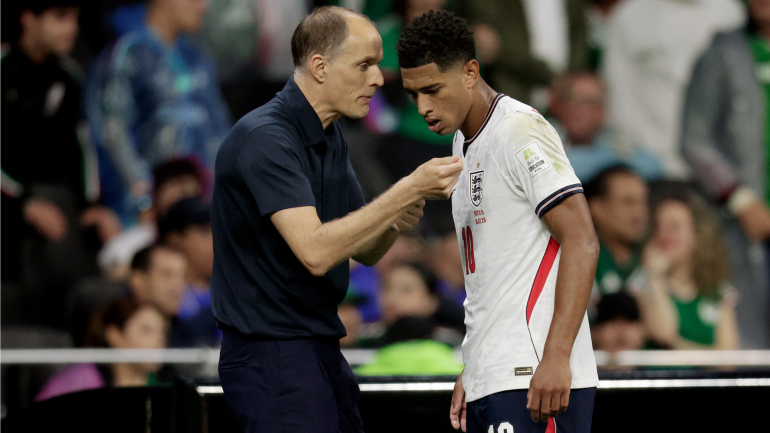
England's 2-1 win over Norway in extra time in the World Cup quarterfinals, however drab it may have been, was undoubtedly cause for celebration. The Three Lions were back in the tournament semifinals for the second time in the last three editions, one step closer to their first World Cup title in 60 years. Jude Bellingham was the headlining act after his brace, but after the game something else pulled the focus from their win -- a disagreement between him and England head coach Thomas Tuchel.
The pair used their post-match media responsibilities to offer very different views on England's performance, Tuchel critical of their outing while Bellingham saw it as an example of the team's perseverance. It was a departure from the sense of accomplishment teams usually exhibit after a notable win, even if England's players and staff were still overwhelmingly in a positive mood. It also offered a stark reminder that it was not the first time Bellingham and Tuchel have not seen eye-to-eye. Saturday's disagreement was tame compared to the comments the coach directed at the player months earlier.
The complicated relationship between England's coach and its newest World Cup star will now play a central role in the build-up to the team's semifinal against Argentina on Wednesday, potentially an unnecessary distraction as the Three Lions chase a historic accomplishment and face the reigning champions along the way.
Tuchel: Bellingham's behavior as 'repulsive'
Saturday's disagreement brought back memories of the time Tuchel singled out Bellingham's presence, going from saying he has a certain "edge" in an almost complimentary fashion before listing what he felt were downsides to Bellingham's tendencies.
"Jude has a certain something," Tuchel said in an interview with TalkSport in June of last year. "He brings an edge, which we welcome and which is needed if we want to achieve big things. The edge needs to be channelled towards the opponent, towards our goal and not to intimidate teammates or to be overaggressive towards teammates or referees. He has the fire. I don't want to dim this down. But the fire comes also with some attributes that can intimidate you. Maybe even as a teammate. And you see sometimes the explosion towards referees and the anger in his game. If he can channel this in the right way and we can help him in this, then for sure he has something that we need. He has a certain edge that is hard to find."
Tuchel then mixed in a dash of compliments before describing some of Bellingham's behaviors as "repulsive."
"[He's] nice kid, very open, very intelligent and very easy so far [to manage]," he said at the time. "I can see that [Bellingham's edge] can create mixed emotions. I see this with my parents, with my mum, that she sometimes cannot see the nice and well-educated and well-behaved guy that I see and the smile. If he smiles, he wins everyone, but sometimes you see the rage, the hunger and the fire and it comes out in a way that can be a bit repulsive. For example, for my mother when she sits in front of the TV. I see that. But in general, we are very happy to have him. He's a special boy."
Tuchel apologizes for his comments in a press conference in August, regretting his word choice.
"I used this word unintentionally," Tuchel, a native of Germany, said. "There was no message, no hidden agenda. I fully understand that it's my responsibility, that I created the headlines, and I'm sorry for the upset. I should have known better. I should have done better. If someone makes the effort to listen to the whole answer, he would clearly understand the appreciation that I have for the player.
"When I was aware of the headlines, I made contact straight away … Is it sorted? I hope so. It was in English so I don't think my mum was fully aware of it. She had the right to be annoyed at me."
Bellingham: 'Maybe he doesn't know what it's like'
England notched a win in the quarterfinals of the World Cup the hard way on Saturday, something both Tuchel and Bellingham agreed on. The pair, though, looked at the difficulties they jointly faced differently. Tuchel was critical of the team's performance, arguing they were far from their best and were lucky at times. Bellingham flatly disagreed.
"Maybe he doesn't know what it's like to play in those kinds of conditions against Erling Haaland, [Martin] Odegaard, [Antonio] Nusa, [Alexander] Sorloth," Bellingham said, listing several Norway players. "That's not an easy team to play against, so I think we've tried to create a positive environment. We should continue that going into the final four. I can't speak highly enough of the lads. You're not going to win every game pumping the ball and making 1,000 passes. Sometimes you have to win dirty, and we've done that again tonight."
Tuchel then defended his own comments and argued he was not actually in conflict with Bellingham's characterization of events.
"No one disputes that," the coach said. "I am impressed with the shift that they put in, the effort, the team spirit, the belief and to overcome adversity and to dig in and find ways to win is on the absolutely highest level. They cannot get enough praise for that, but I am also a football coach, and I think we can play better. In general, I think it was not a high-level game. I think we['ve] had better games in general. We had a lot of momentum swings for both teams, so full credit to the team. We found a way. We're in the last four, which is, of course, the most important, but the analyzing head of me and the football coach in me still thinks we can and have to play better football."