Barcelona prodigy Lamine Yamal to '60 Minutes' on choosing Spain over Morocco: 'I never really had a doubt'
Yamal was eligible to represent Morocco through his father, who was born in the country, but elected to play for Spain, the nation of his birth

•
5 min read
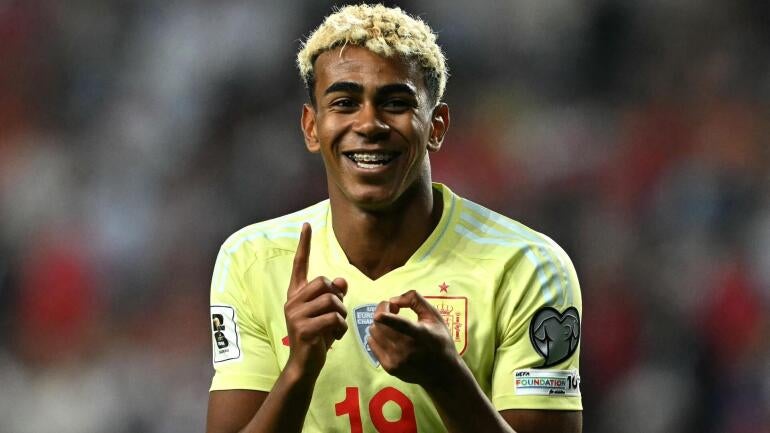
Lamine Yamal said his desire to compete to win a World Cup drove his decision to represent Spain over Morocco, admitting he "never really had a doubt" about playing for the country of his birth.
The Barcelona star was a youth international for Spain and made his debut for the senior team at the age of 16 in 2023, doing so in a Euro 2024 qualification match against Georgia. That appearance cap-tied him to Spain but before that, Yamal was eligible to represent Morocco, where his father was born. Yamal said he did contemplate playing for Morocco, especially after they became the first African team to reach the World Cup semifinals in 2022, but was essentially always intent on representing Spain.
"The truth is that it was something strange because it was something on my mind, 'Hey, I could play with Morocco,'" Yamal said in an interview with CBS' "60 Minutes."
"Morocco had just reached the semifinals of the World Cup, but in the moment, the truth is, I never really had a doubt, honestly.
"In the end, with all the love and respect I have for Morocco, I've always wanted to play in the Euros. I've always wanted to play here in Europe. I think European soccer is watched more. I think it's closer to the international level and in the end, playing for Barcelona, I wanted to be close to being able to win the Euros, which, thank God, I've already done, and to play in a World Cup with a chance of winning. I will always have affection for Morocco. It's my country, too, and the truth is that there would have been nothing strange or bad about playing for them. In the end, I did have this handicap that Spain was playing in the Euros and I grew up in Spain and I also feel that it's my country."
The answer was part of a wide-ranging interview 60 Minutes correspondent Jon Wertheim, one that touched on his joy for the sport and how his upbringing in the suburbs of Barcelona shaped him as a player and more.
Only the fourth soccer player to feature on 60 Minutes... Lamine Yamal 🌟 pic.twitter.com/HDua2Aga2i
— CBS Sports Golazo ⚽️ (@CBSSportsGolazo) November 25, 2025
'At my best when I can have fun'
Yamal said he has as much fun on the field as many have watching him, a sense of joy acting as a foundational aspect to his approach to the game.
"I'm at my best when I can play, when I can have fun with my teammates and I think it really shows when I'm happy on the field and I translate that into my game," he said.
That desire to have fun is also his prevailing feeling every time he steps onto the pitch.
"I believe that in the end, I've never been the type of player who goes to the field and says, 'Today, I want to score four goals and three assists,'" Yamal said. "Instead I think, 'Today, I want to have fun. I want to use what I learned yesterday. I want to do what I used to do at the park. I want people to have fun. I want to have fun with my teammates and obviously if I score lots of goals, that would be even better but I believe soccer goes beyond that."
Yamal also described his ability to deliver joy as his athletic superpower.
"I think that I would like to brighten people's day," he said. "For example, someone is sad, they can come to a game, watch me and feel better and go home happier than they were before."
'Soccer puts everyone on equal ground'
For Yamal, having a sense of joy on the pitch calls back to his upbringing in Rocafonda, a neighborhood in the Barcelona suburb of Mataro. He played his earliest matches on a concrete pitch that doubled as a promenade for local residents, and he still carries those experiences with him as he trades a neighborhood pitch for the most pristine pitches in Europe.
"There were like walls where people would sit and I think there was no better feeling than getting the people who were sitting there to stand up, to laugh at the opponents," Yamal said as he recalled playing in his neighborhood. "I think it's the best feeling in the world and something that reminds me of that a lot is when I'm playing on the field and when the fans get up and are surprised by a play I've made."
Yamal is now the most notable product of Rocafonda, a low-income neighborhood with a sizable immigrant population originally hailing from North Africa. His attachment to Rocafonda is a part of his public persona – he frequently celebrates goals by making the numbers "304" with his hands, a nod to the neighborhood's zip code of 08304. In a way, his upbringing alleviated the pressures of playing for Barcelona.
"In the end, it was a neighborhood where no one knew what was going to happen in their lives," Yamal said. "The truth is, no one knew whether they would become a soccer player, an architect, a painter or whether they'd find a job. You see your parents working. They can't be with you all the time and you feel not nervous but uncertain about what's going to happen to you."
Soccer, he said, is meaningful for those from neighborhoods like Rocafonda because certain differences matter less on the pitch.
"I believe that all kids who were born in a neighborhood or in a city that isn't very big or doesn't have many resources, I think that in the end, soccer is everything because it's one of the sports that puts everyone on equal ground," Yamal said. "Whether you come from a family with many resources or few resources, on the field, you're all the same. You can connect with each other and create friendships and create many feelings that, in the end, only depend on having a ball and a goal … so I think there's a feeling of love. It's the first love of my life and always, always will be. Ultimately, it's everything. My friends are in love with soccer, me, my mother, my father. Soccer is my whole life and it'll always be there with me."