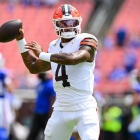


The Browns chose Deshaun Watson over Shedeur Sanders as their starting quarterback, a decision that answered the depth-chart question without ending the debate over who actually gives the team the best chance to win. First-year coach Todd Monken pointed to Watson's full body of work from the offseason, training camp, preseason games and joint practices as the reason, and he stressed that this was not intended to be a week-to-week decision. So that settles who gets the first opportunity, not whether Cleveland has found its answer at the position.
The much bigger question is whether Watson can be anything close to even an average NFL quarterback. The short answer, based on recent history, is no.
Watson's last elite season came in 2020, when he was 25 years old and still in Houston. Among 36 quarterbacks with at least 200 dropbacks that season, Watson ranked first in yards per attempt (8.9), second in passer rating (112.4), third in PFF passing grade (91.1) and third in positive-EPA rate (54.7%). His 0.24 EPA per dropback ranked fifth. In other words, this wasn't merely an above-average season -- Watson was playing like one of the five best quarterbacks in football. That player would solve Cleveland's quarterback problem immediately.
The problem is that version of Watson hasn't been seen in nearly six years.
Season | Games | Dropbacks | PFF pass grade | EPA/dropback | Positive EPA % | QB rating | YPA | Pressure-to-sack % |
2020 | 16 | 656 | 91.1 | 0.24 | 54.7% | 112.4 | 8.9 | 20.8% |
2022 | 6 | 204 | 51.0 | -0.14 | 41.7% | 79.1 | 6.5 | 27.4% |
2023 | 6 | 205 | 66.8 | -0.09 | 43.4% | 84.3 | 6.5 | 20.8% |
2024 | 7 | 270 | 63.4 | -0.25 | 37.8% | 79.0 | 5.3 | 28.0% |
* I know many of the metrics above have become commonplace in football discussions, but just in case, Positive EPA% basically answers the question, "How often did the offense end a pass play in a better scoring position than it started?"
The 2024 numbers are especially difficult to dismiss. Watson's -0.25 EPA per dropback was near the bottom of the league, his 37.8% positive-EPA rate was similarly poor, and he averaged only 5.3 yards per attempt. His 63.4 PFF passing grade was also well below the average of 72.6. Even before his last catastrophic injury, Watson wasn't playing like an average quarterback. He was playing like the least efficient quarterback in the league.
The layoff is long – the bigger problem is what came before it
Watson tore his right Achilles against Cincinnati on Oct. 20, 2024. He underwent surgery five days later, then re-ruptured the tendon during his recovery and required another surgery in January 2025. That setback wiped out his entire 2025 season.
If Watson starts Week 1 as expected, 693 days will have passed since his last regular-season appearance.
There are examples of quarterbacks returning after unusually long injury layoffs and having success. Some returned to essentially their previous levels, while others became functional starters again. But those comparisons become much more complicated with Watson.
QB | Last meaningful pre-injury season | First meaningful return season | EPA: before → after | QB rating: before → after | Result |
Andrew Luck | 2016 | 2018 | 0.15 → 0.18 | 96.4 → 98.7 | Missed 2017; returned with 39 TDs and won Comeback Player of the Year |
Alex Smith | 2018 | 2020 | 0.00 → -0.14 | 85.7 → 78.5 | Nearly two years away, returned as a functional starter and went 5-1 |
Teddy Bridgewater | 2015 | 2019* | 0.05 → 0.12 | 88.7 → 99.1 | Career-threatening knee injury; eventually went 5-0 replacing Drew Brees |
Ryan Tannehill | 2016 | 2018 | 0.06 → -0.13 | 93.5 → 92.7 | Poor first year back, then broke out in Tennessee in 2019 |
Jimmy Garoppolo | 2018 | 2019 | 0.06 → 0.16 | 90.0 → 102.0 | Returned from ACL tear and started all 16 for an NFC champion |
Dak Prescott | 2020 | 2021 | 0.14 → 0.17 | 99.6 → 104.2 | Returned from major ankle injury and threw 37 TDs |
Joe Burrow | 2020 | 2021 | 0.05 → 0.15 | 89.8 → 108.3 | Returned from ACL/MCL injury and went to the Super Bowl |
*Bridgewater technically appeared before 2019, but 2019 was his first meaningful post-injury starting sample.
At first glance, that table might offer Cleveland some hope. Andrew Luck missed an entire season and returned as one of the NFL's best quarterbacks. Alex Smith essentially missed two years and still won games. Teddy Bridgewater eventually became a serviceable starter again. Dak Prescott and Joe Burrow came back from major lower-body injuries and were better afterward.
But those comparisons break down quickly when we start talking about Watson.
Watson isn't trying to return to where he left off
Most successful comeback quarterbacks were trying to regain a level of play they had demonstrated shortly before getting hurt.
Luck had posted a 90.3 PFF passing grade in his final full season before the lost year. Prescott had an 80.4 grade before his ankle injury. Burrow was already trending toward becoming a high-end starter before tearing his ACL. Even Smith, whose efficiency declined after his return, had been a competent NFL starter before suffering his devastating leg injury.
Watson isn't trying to get back to October 2024. He needs a time machine to take him back four years before that, to 2020. That's a completely different – and unprecedented – challenge.
Cleveland isn't dealing with one isolated injury that interrupted a productive career. Watson didn't play at all in 2021 after requesting a trade from Houston, spending the season inactive amid numerous civil lawsuits alleging sexual misconduct. After Cleveland traded for him, he missed the first 11 games of 2022 while serving an NFL suspension for violating the personal conduct policy, and then appeared in only six games that season. He played six more in 2023 before season-ending surgery on his throwing shoulder, then seven in 2024 before tearing his right Achilles. That same Achilles ruptured again during rehab, requiring a second surgery and ultimately costing him the entire 2025 season.
Over the five seasons since his last elite year, Watson has played 19 regular-season games. And when he has played, he hasn't been particularly good.
That makes the names in the table above much less reassuring. Cleveland isn't simply hoping that a 30-year-old quarterback can physically return after nearly two years away. It's hoping he can return from another prolonged absence and rediscover a level of production he hasn't shown since before the Browns traded for him.
At this point, Watson doesn't have to become the 2020 version of himself for the comeback to be considered successful. Simply becoming an average NFL quarterback would represent a substantial improvement from what Cleveland saw in those 19 games.
To repeat one of my favorite phrases when it comes to roster-building: Hope ain't a plan.
The Browns' 2027 QB isn't on the roster
That brings the conversation to the bigger organizational question.
Cleveland's initial 53-man roster includes Watson, Sanders and sixth-round rookie Taylen Green, while Dillon Gabriel begins the season on injured reserve. To varying degrees, there are reasons to continue developing the three young passers. There are not yet compelling reasons to believe any one of them should prevent Cleveland from drafting a quarterback in the first round next April.
Sanders is the most plausible internal candidate. He started seven games as a rookie and showed enough this summer to make the competition with Watson legitimate. But his 2025 season -- 56.6% completions, seven touchdowns, 10 interceptions, a 68.1 passer rating and an 18.9 QBR -- didn't provide anything close to a definitive answer.
And there is something revealing about the result of this summer's competition. Sanders couldn't beat out a quarterback returning from nearly two full seasons away who had played poorly the last time he was healthy.
That doesn't mean Sanders can't eventually become the answer. He may play this season and change the conversation entirely. But Cleveland shouldn't operate under the assumption that he will.
Gabriel started six games as a rookie and went 1-5 while averaging 5.1 yards per attempt. Green is a worthwhile developmental swing because of his size, athleticism and arm talent, and his 66 rushing yards in the preseason finale helped earn him a roster spot. Neither profile should stop Cleveland from pursuing a premium quarterback prospect if the opportunity presents itself.
April still looks like the real decision point
The Browns also shouldn't assume the 2027 draft will offer an easy answer. Every summer, the next QB class gets talked up as "loaded," and then the season has a way of telling a different story. Arch Manning and Dante Moore will draw plenty of attention, and there are other intriguing names, but this group could end up looking a lot more like 2025 or 2026 than the truly deep 2024 class that saw six QBs off the board in the first 12 picks. That doesn't change Cleveland's problem. It just makes the evaluation more important, because if the Browns are drafting a quarterback next April, they may have to identify the right one in a class with fewer sure things than advertised.
For now, Watson winning the Week 1 job obviously doesn't reset his career; instead, it gives him one last chance to prove he can still function as an NFL starter. Sanders is next in line based on how snaps were divvied up during training camp and the preseason. Gabriel, last year's third-round pick, appears to have lost standing with coach Kevin Stefanski gone, while Green is the developmental swing -- an athletic sixth-round rookie who isn't yet close to competing for a starting job.
Put another way: when you have four quarterbacks, you really have none. And Cleveland's schedule may force the issue quickly. The Browns open with two road games -- at Jacksonville, then at Tampa Bay against Baker Mayfield, the quarterback Cleveland effectively replaced with Watson in 2022 -- before finally returning home in Week 3 against Carolina.
Watson has already acknowledged how strained his relationship with the Browns faithful has become, saying that after being booed in the preseason, he feels more support on the road and noting that some fans cheered when he tore his Achilles in 2024.
He begins the season with an already tenuous hold on the job, and history isn't on his side. Two bad road starts could be enough to make the Week 3 home opener less of a celebration that football is back than a referendum on whether Watson has played his last snap for the Browns.