The rise of the 'slower' elite WR: How a new archetype is taking over the NFL
How has the receiver position changed in the modern NFL?

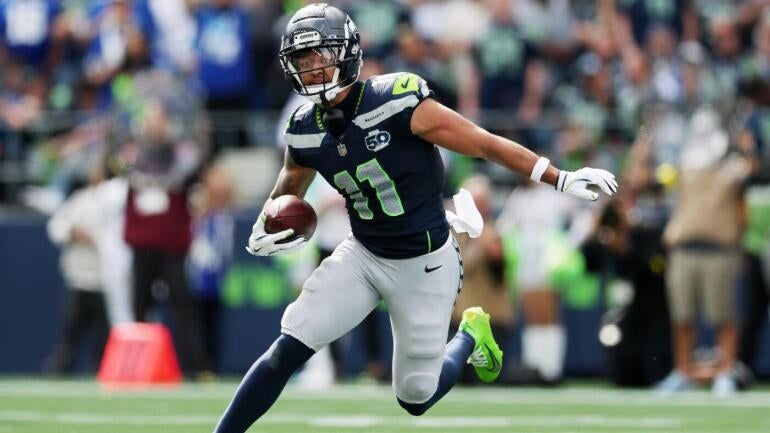
What do Jaxon Smith-Njigba, Puka Nacua, Drake London and Amon-Ra St. Brown have in common? Well, outside of being four of the top 10 receivers in yards per route run and total receiving yards this season, none of them are true burners at the position.
Nacua ran a 4.56-second 40-yard dash, St. Brown ran a 4.61, and Smith-Njigba and London notoriously didn't run 40s at all. Yet they find themselves at the top of nearly every receiving category this season, and Smith-Njigba is on pace to set records once thought to be untouchable by a wide receiver.
Of course, everyone wants the dominant athletic threat at wide receiver, but it feels like the body type and playing style of some of the elite receivers in the NFL are changing, just as the modern NFL offense changes.
Where the modern WR archetype began
If you want to mark when this change began, I think you can start with the rise of current Seahawks wideout Cooper Kupp and his role in the Rams' offense. Despite running a 4.62 40-yard dash at the NFL Scouting Combine and then a 4.61 at Eastern Washington's pro day, Kupp instantly became a star with the Rams due to his ability to create separation, toughness after the catch and an ability to block meshing perfectly with the Rams' offense.
As the branches of the McVay tree expanded, the priority for slot receivers grew — and, well, the receivers grew with it. The days of your 5-foot-9 jitterbug slot receiver are mostly gone, replaced by what's called a "power slot." For these guys, speed isn't the name of the game; their ability to block and dig safeties out on run plays became the priority.
When the Rams shredded teams in 11 personnel, Kupp was at the forefront, with McVay using Kupp's blocking ability to keep defenses in lighter personnel while he remained incredibly productive in the middle of the field.
Among the four guys I named at the top, London, Nacua and St. Brown are all incredibly impressive blockers -- using their size to overwhelm nickel corners -- and are asked to do a lot within their respective offensive schemes. Everyone is running a variation of the offense that McVay ran with Kupp, but where these passing games really begin to use these guys is in the middle of the field.
Nacua and St. Brown are among the top 10 receivers in targets down the seams and between the hashes, per NFL Pro, and it blends perfectly with their ability to block. The physicality to work in the middle of the field is a matchup problem for anyone in the spine of the defense. These guys are the kings of versatility, and they do it without elite speed.
Why agility beats straight-line speed
So what does that tell us about receivers and what's needed to play the position? I've long said that the 40-yard dash is a cool event at the combine, but for wide receivers, being able to move quickly when things change just as fast is more important. I'm talking about drills such as the 3-cone drill and 20-yard shuttle, where the athlete has to change direction while still maintaining top speed. Combine speed doesn't always translate to football speed -- running 40 yards in a straight line doesn't exactly mean you'll be great on a field where you're rarely running in a straight line.
While Smith-Njigba didn't run a 40-yard dash, his 3-cone and 20-yard shuttle are in the 96th and 97th percentile for all receivers who participated at the combine, respectively. Rams wideout Davante Adams was 74th percentile in the 3-cone when he entered the draft, and that ability to change direction at top speed means a lot more than just being fast in one direction. It's cliché, but getting open and creating separation ages like fine wine, even without top-end speed.
Adams' speed has definitely been sapped as he's gotten older, but his dominance in the red zone doesn't come from being fast. His ability to change direction and footwork in the red area helps him dominate in ways where being an overwhelming athlete might not always work.
Smith-Njigba is a perfect example of using your acceleration and change of direction to create separation, and he leads the NFL in yards per route run by a wide margin. His movement efficiency helps him at every level of the field, and Seattle uses his ability to create separation to drive its offense -- literally. (Smith-Njigba accounts for 45.6% of the Seahawks' receiving yards and 35% of the Seahawks' targets, most in the NFL.)
What this means for future NFL Draft prospects
With the success of these guys in the modern NFL, I'm curious what'll happen with future players in the NFL Draft. We saw the early success of Bucs rookie Emeka Egbuka, but there's another player very similar to the St. Browns of the world entering this year's draft in USC's Makai Lemon. Lemon isn't the biggest receiver, nor is he the fastest, but he just knows how to get open and is tough after the catch. That's the formula for success in the NFL at the receiver spot, and it feels like Lemon could go a lot higher than people believe because of that.
UConn's Skyler Bell and Alabama's Germie Bernard also fit in this category: guys who may not be burners but are just professional receivers who can win after the catch.
With the modernization of the NFL comes the modernization of body types at important positions, and the success of "slower" receivers may change how we view what's important at the position forever.