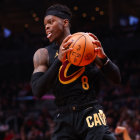


With the NBA world waiting on Giannis Antetokounmpo trade news to drop, the Washington Wizards slipped in a doozy of a Trae Young deal on Monday. The Wizards have agreed to sign the four-time All-Star point guard to a four-year contract just shy of his max at approximately $212 million, according to ESPN.
This is a shocking amount of money for a guy who, seven months ago, was basically salary dumped by the Hawks with nobody interested in giving up anything of value for him in a trade. Now he suddenly has a contract with an average annual value of $53 million?
Jalen Brunson -- you know, the guy who just won NBA Finals MVP -- is currently making an average of $39 million a year. What in the world is happening? Who were the Wizards bidding against?
The
"In recent weeks, the Wizards decision-makers became convinced that, with the NBA's new anti-tanking measures compelling more teams to compete, Young was going to command maximum-salary contract offers from other franchises," according to the Athletic's reporting.
This is hard to believe. But even if it's true and Young was going to have other max offers, to be so desperate to not lose a player that seven months ago nobody wanted that you're willing to pay him $14 million more per year than Jalen freaking Brunson borders on an act of lunacy.
Ever since the end of the Finals, people have been calling De'Aaron Fox's four-year, $229 million contract that is set to begin this season one of the worst values in the league, given the nuclear ascension of Dylan Harper. This Young deal is way worse on paper.
Frankly, that Fox deal isn't even that bad -- at least for the time being -- on a Spurs team that still has its three best players on rookie contracts. In a vacuum, this Young deal is a wild overpay. There is absolutely nothing to suggest he is worth this kind of money.
But let's dive deeper on the first enormous NBA contract of the summer and try to make sense of things.
Did Brunson inflate small-guard market?
For a minute, small, defensively challenged guards were the most rapidly depreciating player archetype in the league. Again, nobody wanted Young. The Bucks are paying Damian Lillard $113 million to play for someone else. Before Brunson made Becky Hammon and Draymond Green eat their words, the idea that a player like Young could be worth a contract like this would've been laughable.
It still is, because Young isn't anywhere near the caliber of player that Brunson is. But generally speaking, you do have to wonder how much Brunson has reinvigorated the value of these so-called one-way players that look and vaguely profile like him -- particularly in the context of teams that have designed or are trying to design long and versatile defenses, like the one the champion Knicks constructed, that are capable of covering for such players.
The Athletic reports that the Wizards front office thinks that the rest of the roster can cover for Young's defensive shortcomings. They're making a big bet that will be the case.
How much of this is about the new lottery odds?
A lot of it. When the NBA approved its "3-2-1" lottery reform proposal at the end of May as part of its anti-tanking movement, it not only shifted the best odds (8.1%) for the No. 1 overall pick to the teams that finish between the fourth-worst record and the 10th-worst record, but it also decreased the odds for the teams with the three worst records from 14% to 5.4%.

In other words, there is no incentive to be bottom-of-the-barrel terrible anymore, and there is maximum incentive to be a middle-of-the-pack non-playoff team. If any player ever profiled as a perfectly suited engine for the latter sort of team, it's Trae Young.
So now the Wizards can lean on a guy who, for all his flaws, is one of just 16 players in NBA history to average 20 points and 10 assists in a season to make their offense functional while the young guys develop. Along with Anthony Davis, it should protect the Wizards from a bottom-three record without too much risk of rising above the second play-in game, where their No. 1 pick odds would be 5.4% (the same as if they had a bottom-three record).
Does this change how we feel about the contract?
Not so much, because again, it's just hard to imagine there were going to be all these teams out there ready to pay Young a max deal. Maybe the Bulls or Nets. But even if that were the case, the Wizards could've matched any offer or even gone a bit higher if they were seriously that intent on keeping Young.
Or, you let him go. You didn't give up that much to trade for him in the first place, so there isn't much of a sunk-cost factor. In today's NBA financial landscape, you have to draw a line on these sorts of deals, and $14 million more than Brunson on an annual basis seems like pretty far past the line.
The Wizards almost certainly overpaid here, and for the time being, this is about as close to an un-tradeable contract as you're going to find. So for better or worse, you're stuck with it.
That said, there is now great incentive to be a functional NBA team that spends the next few years mired in non-playoff or play-in mediocrity, and Young does serve that purpose. Until proven otherwise, he is a good-stats/bad-team guy. It just so happens that he found one of the teams -- possibly the only team -- that is suddenly incentivized to be his particular level of bad. Good work if you can get it.