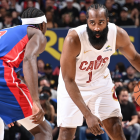


Coming into Cleveland's Game 7 showdown against Detroit on Sunday, the social media masses were ready to pounce on another James Harden big-stage stinker. His previous Game 7 stat lines were making the rounds. The nine points against Boston in 2023. The seven points against Denver last year.
And if you look at the box score from Sunday night -- nine points on 2-of-10 shooting, including 0 of 6 from 3 -- he provided the haters with more than enough ammo for what would have been a merciless personal attack had the Cavaliers not won the game, and series, to advance to their first non-LeBron James conference finals in franchise history.
Problem is, the haters would be overlooking the most important number on his Game 7 ledger: +31. As in, the Cavaliers outscored the Pistons by 31 points on Sunday with Harden on the floor. That is not a product of the lineups he shared the court with. It is a product of the impact he had on the game in every area except scoring, and that has held true this entire postseason.
Across 14 games and 524 minutes in these playoffs, the Cavs have outscored their opponents by 62 points with Harden on the floor. By contrast, they have been outscored by 40 points in the 158 minutes he's been on the bench. That is not an accident.
Yes, Harden has struggled with turnovers for much of the postseason. Yes, his 38% shooting clip, including 29% from 3, in the Detroit series looked rough. But he took care of the ball when it mattered most (only three combined turnovers in two Game 7s, and one on Sunday), and he has had huge scoring stretches when the Cavs desperately needed them.
He had 25 points in Game 5 of a 2-2 series vs. Toronto. He had 30 in Game 5 of a 2-2 series vs. Detroit. Everyone remembers the 39 points that Donovan Mitchell put up in the second half of Cleveland's comeback Game 4 win over the Pistons, but it was Harden scoring 15 of his 24 in the first half that kept them alive long enough for Mitchell to come around.
Absolutely nobody will be talking about Cleveland's Game 3 win, but we're not here without it. They lose that game to go down 3-0 and this series was a wash. Harden didn't let that happen; instead, he scored seven points inside the final 90 seconds, all self-created, capped by this game-sealing and very possibly season-saving 3 over Tobias Harris.
I know, the contortionist leg kick-out and theatrical crash to the court is annoying. It's part of what makes Harden so hard to root for. Or, better put, so easy to pick on when he comes up short in big moments. But give credit where it's due. Not just to Harden, but to the Cavs' front office for making the trade that brought him to Cleveland at the deadline.
Swapping a 26-year-old Darius Garland for a 36-year-old Harden was risky to say the least, but the Cavs bet on not only Harden being a better player than Garland, even at this juncture of his career -- if only because he is bigger, which paid actual defensive dividends against the Pistons that, again, nobody will talk about -- but a more durable player, too.
Garland could not be counted on to stay on the court. Say what you want about Harden, but the dude is, and always has been, a workhorse. He played in 27 of the Cavs' final 30 regular-season games, during which they went 20-7 to secure a top-four seed. His aforementioned 524 playoff minutes are the most on the team.
Harden isn't the scorer he used to be and, as mentioned, his shooting efficiency against Detroit was a major statistical stain. But he remains a pretty much guaranteed creator of quality-shot offense with his still virtually unstoppable ability to get downhill and, as ever, world-class passing.
Mitchell was averaging fewer than three assists per game in the playoffs entering Game 7 on Sunday. Harden is the one doing the playmaking. Cleveland's twin-tower bigs Evan Mobley and Jarrett Allen have broken out, and who's the one feeding the beasts? Harden. Of his team-high 87 playoff assists, 38 have gone to Mobley and Allen, and only Shai Gilgeous-Alexander has more secondary assists than Harden in these playoffs.
That's arguably an even more important number than the direct assists, because it's indicative of Harden still being a big enough threat to command two defenders off ball screens. That opens everything up, as you suddenly have one of the best short-roll passers in history spoon-feeding one of his bigs in the middle of the court for a 4-on-3 power play.
Now, the defense has to push up on the big with the ball, which in the clip below is Mobley, at which point the other big is left unoccupied underneath for an easy bucket.
This is how Mobley has racked up 10 big-to-big assists to Allen in these playoffs: Harden is setting the whole thing up, and the Cavs went back to this well plenty in their pivotal Game 5 win.
And again ...
You probably remember the dagger 3 that Mitchell hit in overtime of that game. Less memorable was how it was set up. I'll give you a hint: it started with Harden drawing two defenders and hitting his big man with the short-roll dime, and from there, in the ensuing chaos of a disadvantaged defense trying to scramble its way into some semblance of a fighting chance, one of the most electric scorers in postseason history wound up forgotten about on the weak side.
You cannot overstate the impact of Mitchell being able to attack against defenses already compromised by Harden, rather than having to initiate against set defenses almost entirely focused on him, all while usually being guarded by the other team's best defender.
Consider this quote from Cleveland coach Kenny Atkinson: "The tactical adjustment we made was avoiding Thompson. ... If he's near the ball, throw it to someone else. I've never experienced that in the NBA, where even if you have a great player with the ball and [Thompson is] on him, pass it to someone else."
The quote was meant to compliment Thompson, who is an absolute beast of a defender. But it was also a massive Harden compliment, because you know who Thompson was guarding a lot in this series? Harden. That's the kind of respect he still garners, and these things alone, simply being threatening enough to draw either two defenders or have the other team's single best defender assigned to you, are like cheat codes for your teammates.
Without Harden, Mitchell would be the one being guarded by Thompson, and thus, the guy who, in Atkinson's words, would be "passing it to someone else." Now Mitchell gets to be the someone else. Or if not him, well, someone else.
Take Dean Wade, for instance. He had just two buckets in Game 7. Both were set up by Harden. On the first one, the eyes of four defenders are focused on Harden on one side of the court as Wade spots up for a 3 on the other. On the second, Thompson is attached to Harden and is not going to leave him. Harden sets a screen, and when Max Strus rolls free behind the action crowd, Tobias Harris is forced to stop him, which leaves the baseline cut wide open.
Dean Wade vs. Detroit Pistons 5/17/2026
— NBA Shooting Audit (@NBAShotAudit) May 18, 2026
5 PTS | 2-2 FG | W 125-94 pic.twitter.com/gSnVeAqZJz
That second play won't show up anywhere in Harden's Game 7 box score, which is why you shouldn't be focusing on those nine points on 10 shots. He played well. Again, he's not the scorer he used to be, and it won't be the last time in these playoffs that he has an inefficient shooting night. But the creation is always there. This Game 7 short roll to Allen look familiar?
How about this one to Mobley?
If playing against Harden, between his skills and foul-baiting, is a nightmare, then playing with him, especially as a big man, is a dream. Mobley and Allen combined for 44 points in Game 7, and so much of the rhythm in which they have been operating of late is due to Harden's still elite floor game.
And I'll say again, Harden's defense has actually been quite helpful. If nothing else, he's big and strong, so much so that Atkinson was able to put him on bigger guys. In the clip below, Harden is covering Paul Reed, which in turn freed up Allen to cover Thompson, who can't shoot, which allows Allen to basically ignore him and serve as a roaming paint protector. And then you get this:
Basketball is a domino effect. One guy does one thing that forces a reaction, which leads to the next play, and the next reaction, and for the Cavs, it's Harden starting most of these sequences. That is how you shoot 38% in a series and still come out as a major positive.
This is everything the Cavs could've hoped for when they traded for Harden. They had Mitchell. They didn't need Harden to score 30 efficient points every night. He can still do that from time to time, but he was brought in to take the playmaking burden off Mitchell's shoulders, to get into the paint and be a consistent source of downhill force, to elevate Mobley and Mitchell, and ultimately, to get the Cavs over, at least, the second-round hump. On all counts, mission accomplished.