

One year ago, nearly one dozen of UCLA's largest athletic donors approached a Los Angeles Times reporter to say they had lost faith in their athletic director. What almost nobody outside the school noticed was that they had already stopped writing checks.
UCLA raised $18.5 million in donor contributions in fiscal 2022. Then $15.6 million. Then $13.9 million. Then $13.5 million. Donations worsened for three straight years, even though a move from the Pac-12 to the Big Ten in 2024 was supposed to fill the Bruins' treasure chest.
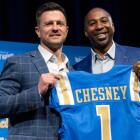
By the time UCLA chancellor Julio Frenk fired athletic director Martin Jarmond on Monday, five days before Bob Chesney's first game as head coach of the football program, UCLA ranked 14th out of 16 public Big Ten schools in donations. The league median was $34.1 million in 2025, according to the Knight-Newhouse College Athletics Database. Washington, which joined the conference a year after UCLA and plays in the same time zone, raised $52.9 million.
Frenk's letter to UCLA supporters late Monday did not mention donors, but it did outline a major deficit within the athletics department.
"UCLA Athletics currently carries a significant financial deficit, and its current path is not sustainable," he wrote in a letter to UCLA supporters. He said the future goal is a model that "supports itself through the revenue it generates."
The problem is that UCLA's athletics department doesn't support itself, according to financial records filed with the NCAA over the years.
The money train stalled
Donations are the clearest measure of whether the people closest to a program believe in it. UCLA's donor base was declining before the move to the Big Ten and has continued since it arrived in the richest conference in college sports.
Fiscal year | Donor contributions |
|---|---|
2022 | $18.5 million |
2023 | $15.6 million |
2024 | $13.9 million |
2025 | $13.5 million |
Source: Knight-Newhouse College Athletics Database, from NCAA financial reports
Set against the Big Ten conference, which UCLA joined in 2024, fiscal 2025 looks like this:
Big Ten school | Donor contributions |
|---|---|
$69.0 million | |
$64.6 million | |
Washington | $52.9 million |
$50.7 million | |
$50.4 million | |
$33.2 million | |
UCLA | $13.5 million |
$11.3 million | |
$8.1 million |
Source: Knight-Newhouse College Athletics Database
The complaints the donors aired publicly a year ago were specific. UCLA was slow to embrace the NIL market, and Jarmond kept football coach Chip Kelly in charge for too long. Perhaps the impetus for the donors' decision to go public with their grievances was the department's accidental leak in 2023 of a spreadsheet containing donors' giving histories, addresses and phone numbers, including Hall of Famer Troy Aikman, in an email. The athletics department never apologized for the gaffe.
"What's happening now feels like watching a train wreck in slow motion," one booster told the Los Angeles Times in October 2025. "What we're seeing isn't just a rough patch. It's institutional apathy. And if the administration doesn't care, why should fans and recruits?"
Corporate money also went south, according to the Knight-Newhouse database. Sponsorship, advertising and licensing revenue fell from $18.3 million in fiscal 2023 to $10.6 million in fiscal 2025 — a 42% drop in two years, and down from $23.8 million in 2019.
"Now is the moment to build a model for Athletics that protects the breadth of our program, creates new opportunities for student-athletes and coaches, and supports itself through the revenue it generates," Frenk said in a letter to supporters Monday. "I believe UCLA should help lead the transformation of intercollegiate athletics: our future must be shaped by purpose -- not by pressure."
UCLA's growing deficit
UCLA's athletic department has lost money every year since 2019, for a cumulative $241.1 million.
Fiscal year | Revenue | Expenses | Net | Campus subsidy |
|---|---|---|---|---|
2019 | $108.4M | $127.3M | –$18.9M | $2.6M |
2020 | $97.7M | $119.4M | –$21.7M | $2.6M |
2021 | $47.7M | $110.1M | –$62.5M | $2.6M |
2022 | $103.1M | $131.1M | –$28.0M | $2.6M |
2023 | $105.4M | $142.0M | –$36.5M | $2.1M |
2024 | $119.0M | $170.9M | –$51.9M | $31.6M |
2025 | $151.8M | $173.4M | –$21.6M | $31.1M |
Source: Knight-Newhouse College Athletics Database.
From 2019 through 2023, UCLA's athletic department accepted between $2.1 million and $2.6 million a year in institutional support and student fees — about 2% of revenue. In 2022, UC told its regents athletics was "nearly self-funded." In fiscal 2024, that number increased fifteen times to $31.6 million.
Because that money counts as revenue on the NCAA report, the published deficit is already net of the rescue. The 2025 figure of $21.6 million in net losses, which was reported as progress, exists only because the university provided $31.1 million to subsidize the department. Strip the subsidy out, and UCLA's athletic department generated $120.7 million against $173.4 million in costs.
The Big Ten Catch-22
UCLA left the Pac-12 for money, and the money came, but everything else in the ledger seemingly fell.
Line | FY2023 (Pac-12) | FY2025 (Big Ten) | Change |
|---|---|---|---|
Media and NCAA revenue | $41.2M | $77.3M | +88% |
Ticket sales | $20.2M | $18.3M | –9% |
Donor contributions | $15.6M | $13.5M | –14% |
Sponsorship and licensing | $18.3M | $10.6M | –42% |
Game expenses and travel | $24.2M | $33.1M | +36% |
Non-coaching staff pay | $23.6M | $31.8M | +35% |
Coaches pay | $30.9M | $33.0M | +7% |
Source: Knight-Newhouse College Athletics Database
Conference revenue rose 88% when UCLA joined the Big Ten, but every dollar UCLA raised through ticket sales, donations and sponsorships decreased. Travel costs and game expenses rose by a third as the program left its time zone to play Big Ten opponents in the Midwest. Meanwhile, the administrative payroll grew five times as fast as the coaches' pay.
By comparison, Oregon, which joined the Big Ten a year later, finished fiscal 2025 with a $2.7 million surplus.
Big Ten mainstay Michigan made $75.9 million in total ticket sales. UCLA made $18.3 million in the second-largest media market in America.
Not all issues were newly created at UCLA, but the noise in Westwood has increased in recent years. Jarmond inherited many of the issues the school faced over the last several decades. The Rose Bowl also keeps essentially all the premium seating, concession and parking revenue under a lease running through 2044. Pasadena and the Rose Bowl Operating Company sued UCLA in October 2025, alleging the school was maneuvering to move home games to SoFi Stadium, a breach of the lease between UCLA and the Rose Bowl through 2044. The city claims damages exceeding $1 billion, and a judge rejected UCLA's bid to force arbitration in February.
The parties are now scheduled to appear in court for a case management conference on Wednesday, two days after Jarmond's firing.
UCLA gained control of its logo in mid-August, and then, one week before Jarmond was fired, CalMatters sued UCLA under the uiCalifornia Public Records Act for records of players who received $20.5 million in NIL payments during the 2025-26 academic year.
What happens next
UCLA's next NCAA financial filing is due Jan. 15, and it will be the first to include the expense line for revenue sharing with players: $20.5 million in direct payments to as many as 229 athletes under the House settlement. The school is also set to pay its second of three $10 million payments owed to Cal for leaving the Pac-12. Additionally, there's money tied to Chesney's new contract, severance for DeShaun Foster's staff, and eventually Jarmond's roughly $5.9 million buyout.
Obviously, none of those new expenses are included in the current total of $241.1 million in total deficits reported to the NCAA over the last seven years, according to Knight-Newhouse's database.
There is hope, however. Twelve days before Frenk fired Jarmond, the chancellor reclaimed the rights to UCLA's logo, ending a unique 66-year arrangement under which a student organization held the commercial rights to the university's marks. Frenk also placed Tim Harris, a UCLA alum and former president of business operations for the Los Angeles Lakers, in charge of the athletics department on an interim basis. He will work for free with a mandate to "grow revenue through partnerships, licensing and other ventures," Frenk said.
Jarmond's tenure ended with nine NCAA championships in six years, including the women's basketball national title in April, and a seismic move from the Pac-12 to the Big Ten.
He also never managed to balance a budget.