

Nothing gold can stay in Indiana.
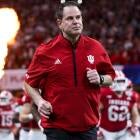
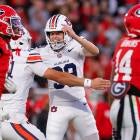
Nick Marsh, the most decorated receiver the Hoosiers have ever pulled out of the transfer portal, showed up to the first spring practice in March wearing gold cleats. Third-year head coach Curt Cignetti, 10 weeks removed from a 16-0 national championship, saw them before the first snap of the spring.
"I didn't love those gold shoes he came out in today," Cignetti told reporters that afternoon, March 27. "He learned what getting your ass ripped is all about. I don't know if that happened to him very often at Michigan State."
It wasn't necessarily the dry, no-nonsense head coach who had to take Marsh aside and show him the Hoosiers' ropes.
"If you see something that someone might think they might be a little above the program or something like that, you need to be brought back down to the standard," said left tackle Carter Smith, a consensus All-American last season. "Everybody is held to the same expectations. Nobody's above the program.
"... It's not just up to Coach Cignetti, but it's also up to the leaders to be able to call that out."
Replacing production, not expectations
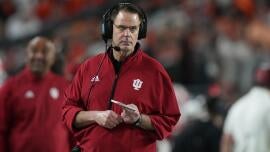
Basking in glory is not how Indiana won the national title and rose from the losingest program in college football history to the first 16-0 national champion, an out-of-nowhere accomplishment no Hollywood script could properly replicate. The question this August is whether that program still exists after the bulk of the roster that built it exited stage left, leaving the spotlight for Cignetti's rebuilding project, using parts that have never been in the building.
Indiana lost eight players to the NFL Draft, a program record, and, most notably, the Heisman Trophy winner and the No. 1 overall pick, Fernando Mendoza, who threw for 3,535 yards and an FBS-best 41 touchdowns. It lost 134 catches, 1,767 yards and 28 touchdowns in Elijah Sarratt and Omar Cooper Jr. It lost its center, its tailback, its All-America cornerback and the heartbeat of a defense that finished second nationally in scoring at 11.7 points per game.
Still, the Hoosiers return 10 starters -- a notable number, but not one that matches the benchmark set by the last eight national champions, each of whom returned at least 11 starters.
Cignetti's answer to the dramatic production loss was the same one he utilized when he took the job before the 2024 season: buy production. Indiana signed 17 transfers in a class rated fifth nationally. He replaced big production numbers with comparable production from elsewhere, the simplest approach in a sport that has turned to Moneyball more than development since the advent of the transfer portal and NIL payments.
"First thing, when a name comes up, I Google it, right?" Cignetti said. "And ESPN's got, like, the guy's picture and his career stats, season stats. I'm going to see how productive and consistent he's been. And then it goes to the tape."
Simple, right? Cignetti searches for production and consistency, targets players, and recruits them from the portal. If it were that easy, why can't other programs replicate Indiana's overnight success? It's a question many athletic directors across the country ponder, which led to a record churn on the coaching carousel this offseason, and several hires that follow Cignetti's blueprint: snag the fast-rising coach from a Group of Six school and have his top talent follow him to the new campus.
That worked for Cignetti in his first two years, but now he's counting on players he's never coached, even though their previous productivity at other schools seems to fit his prefabricated puzzle board.
"If a guy walks in my office, he might have a lot of talent and be a really good player, and that transcript doesn't look real good. And I get a vibe that this guy's a little selfish, can't see past his nose, I'm not taking it," Cignetti said. "I mean, he better be the best wide receiver in the history of football. And then I'm still going to think about it."
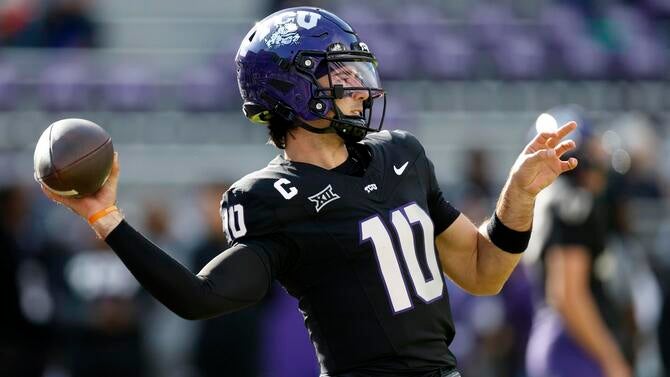
On paper, Indiana seems to have reloaded more than rebuilt the roster. Josh Hoover threw for 3,472 yards and 29 touchdowns at TCU last season and 9,629 yards with 71 touchdowns across 31 career starts. Turbo Richard ran for 749 yards and nine scores in 11 starts at Boston College and caught 30 passes out of the backfield. Marsh caught 59 balls for 662 yards at Michigan State. Shazz Preston caught 43 for 723 at Tulane. Joe Brunner started 12 games at left guard for Wisconsin. A.J. Harris was third-team All-Big Ten at Penn State. Preston Zachman has 130 career tackles and seven interceptions. Carson Williams was an FCS Freshman All-American at Montana State with nine pass breakups.
Eight of the 17 transfers play defense. The two Kansas State defensive ends, Tobi Osunsanmi and Chiddi Obiazor, are the closest thing in the group to a projection, and Cignetti still has extreme expectations for them.
"I'd like to see them be monsters. That's what I'd like to see," he said. "I think they both have talent. They flashed, and I'm looking forward to seeing them in fall camp and seeing how they improve."
The quarterback math is the reason for confidence. After all, Cignetti has done this before with a player he's never coached. When he signed Mendoza out of Cal a year ago, he was buying a player who had thrown for 3,004 yards and 16 touchdowns. What he got back was a national title, Heisman Trophy and the first pick in the draft.
Hoover arrives with a better résumé than that. He also arrived with 13 interceptions last season and 42 turnovers across his 31 starts at TCU.
Asked what he needs from Hoover, Cignetti gave the shortest answer of his appearance at Big Ten media days.
"Good quarterback play."
Pressed on what that means, he did not hesitate on the order, the underlying concerns everyone has about Hoover, or whether he can step in and pick up where Mendoza left off.
"Protect the football, complete the passes you should complete, be good in critical situations, play well under pressure, be smart, play smart, play with courage, play with toughness," Cignetti said. "All things he's capable of doing he's done in the past."
Can culture survive turnover?
The blueprint is no secret, but it had to change out of necessity. Familiarity can only last so long with rosters constantly spinning in the portal. Thirteen James Madison players followed Cignetti to Indiana in 2024, laying the foundation for familiarity and built-in high expectations, even if everyone outside the football building in Bloomington didn't expect much from a program known as a perennial loser. The gang from James Madison had won together in the Sun Belt, they knew the two manuals Cignetti calls the program's Bibles, and they arrived already speaking the language. Five of them -- Aiden Fisher, D'Angelo Ponds, Elijah Sarratt, Kaelon Black and Tyrique Tucker -- were still on the field when Indiana beat Miami 27-21 for the national title in January.
"In 2024, when he brought in all these James Madison guys, those were a lot of players who were in a conference and knew how to win and meshed really well with the Indiana players who were there that are itching for wins," Smith said. "So keeping that relationship alive while we recruit more guys, high school or transfer portal, is key -- making sure that everybody has the same body of work expected of them."
Hoover, Marsh, Richard, Brunner and Harris haven't been in the building longer than seven months. There is no JMU wave to absorb them. There is only the group that has grown and won over the last two years, and one JMU leftover: Tucker at defensive tackle.
"Being the last one kinda does feel like a badge of honor," Tucker said. "But it's one of those things I feel like I have to obtain. Everyone who has been from there has done things and been successful -- and being a part of that group is elite."
The JMU crew instilled a new culture in Indiana, but it's not up to one holdover to carry the torch.
"Those 20-plus guys that stayed from Indiana, that have been with us for two years, they're the JMU guys now," Cignetti said. "And the ones showing the new guys how to do it."
The early evidence is anecdotal, and preseason camp is typically more about survival than developing an identity before game-week preparations begin in late August, but there are moments that shine a light on the new imprint.
"He's made a lot of friends this offseason," Smith said of Hoover. "That's the biggest part, you know, being a really good locker room guy and understanding what everybody wants from their quarterback. And he loves to just hang out with the guys. We'll go golfing. He loves to fish."
The rings are the enemy now.
Life as the hunted
Isaiah Jones, the linebacker replacing a two-time All-American in Fisher, put 78 tackles, 15.5 tackles for loss and seven sacks on tape last fall while starting seven games. He has been assigned the green dot as the defense's quarterback. Off the field, he's making sure a championship trophy doesn't become an anchor.
"Last year was a great year. Great teammates, great friends, brothers for life. Brought home a lot of hardware, nice rings," Jones said. "But none of that does anything to win a game this year. We don't just roll our rings or trophies out on the field against North Texas Game 1. That doesn't win us a game.
"Every time you take a field, or you go into the weight room, or you're in a film room, you either get better or get worse. If you're getting worse, Michigan or Ohio State or USC or North Texas might be getting better."
Cignetti calls it attacking complacency.
"It starts with me, really," said Cignetti, now 27-2 in two seasons at Indiana. "I got to make sure I'm on my game, I'm organized, I'm structured, I'm working smart and that everyone is doing their job."
Those who don't follow his lead don't survive. Over the last two seasons, complacency hasn't seeped into the locker room because of Cignetti's laser-sharpened focus and the inherent motivation tied to a program that had never won big before. That's different today. The Hoosiers are now the hunted.
"When you have a lot of good people, the whole becomes greater than the sum of its parts. But one bad apple also, you've heard that one before, right? So we don't have bad apples," Cignetti said. "Coach Cignetti takes care of the bad apples. When they start getting a little soft on one side, right, they get looked at real close. And then when they've rotted some more, a little while later, they're out of here."
It's still wild to think Indiana has reset the pieces on the sport's chessboard. Now, everyone is adjusting as the Hoosiers try to maintain their recent stronghold in a sport that is not kind to newcomers leaping the rungs.
Cignetti doesn't dodge expectations, and he certainly isn't afraid to buck naysayers who tried to bury Indiana before he ever coached a game two years ago. He's always blunt. Asked at media days whether Indiana is the Big Ten's new Goliath, Cignetti repeated the facts and handed it back to the crew of scribes in the audience.
"We're the national champs of 2025 and 27-2 the last two years. Longest home winning streak in college football. Longest winning streak in college football," he said. "I don't know. You guys write those stories."
Indiana has seemingly transferred college football into a parallel existence. In that fog of war, everyone is confused, grasping for answers, and, in the case of Purdue's new athletics director, blundering for attention in this new reality.
Incoming Purdue athletics director Tommy McClelland, in an attempt to rally the troops at Indiana's in-state rival, stepped into no man's land.
"Every recruit and every student-athlete will hear this message repeatedly: We are here to win championships. If you don't want to win championships, go to Indiana," he said.
The words landed with a soft, wet thud. He knew it immediately. "I made an offhand, unscripted comment about an in-state rival that didn't land well. I knew it the second it left my mouth," McClelland said the next day on The Pat McAfee Show. "We're going to build programs here that are better at winning championships than I am at one-liners."
Cignetti, the most quotable coach in America, was asked about it Monday at preseason camp. He is 2-0 against Purdue by a combined 122-3 score. Did he have a response?
"No, not really," he said.
He swatted the gnat and turned his head to another questioner. His players, and for that matter, most of the sport, understand Cignetti's cadence by now.
"Some people might think he's brash or he's arrogant and makes some of these comments," Jones said. "As a player, from a player's perspective, you see a guy that has full belief in his players. He's going to go out there and make these comments and stick his neck out because he has belief in his players. As a player, when you see that and you see a coach that has full confidence in you, you want to go play your heart out for that guy. You don't want to play soft. You don't want to play timid."
Cignetti just turned 65. He calls himself a geriatric. Any other coach may have hit their career's zenith working under Nick Saban at Alabama in 2010, when he opted to take a step back and work his way through the system on an unorthodox journey as head coach at Division II Indiana University of Pennsylvania before later landing in the FBS at James Madison. Those experiences informed Cignetti, who has been in the business long enough to know how fast champions can fall.
"I know how temporary this is," he said. "You can be a hero one week, and all of a sudden lose a game and, you know, people hate you."
He knows what the title bought -- "donations have gone up throughout every department at the university," he said, and the largest alumni base in America has come "out of the woodwork who for so long had really no hope or interest because we were so bad" -- and he knows the terms attached to it.
"If we don't hold up our end of the bargain," he said, "I'll be hung in effigy next fall."
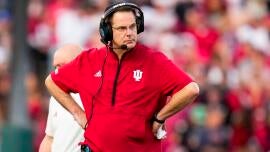
Despite all the criticism Indiana receives for its scheduling philosophy and for opting to avoid non-conference power opponents, the hurdles this fall remain larger. Ohio State comes to Memorial Stadium on Oct. 17, and then Michigan a week later. USC and Washington, thought to be playoff sleepers, hit the schedule in November. Purdue and whatever is left of McClelland's one-liners end the season Nov. 28.
Until then, it's Week 1 and North Texas, and 17 new men trying to coagulate into -- and maybe mimic -- a version of Indiana that beat everybody last year. It might seem new, but everyone else believes Indiana, the defending champion, is the team to beat.
"I don't look at it like that," Cignetti said. "We wake up tomorrow, we're going to do the things that we have to do to improve as much as possible to put the best day together and then do the same thing the following day. And then it all takes care of itself, because I'm a firm believer. You stack days, meetings, and do the proper preparation on a consistent basis, you can accomplish anything. Anything."