Scott Frost ended Saturday night in Orlando on his couch, answering a flood of text messages.
They all wanted to congratulate him after UCF upset No. 2 BYU 39-31 in double overtime, the program's first victory ever over a top-five team. Tony Dungy. Joe Brady. Country singer Casey Donahew. Todd Ricketts, co-owner of the Chicago Cubs. And Nebraska legend Tom Osborne, the coach who won a national championship in 1997 with Frost at quarterback.
"It was a good nightcap to sit down on my couch and see all the people that reached out," Frost told CBS Sports.
Saturday marked Frost's first win over a ranked opponent since Jan. 1, 2018, when the undefeated Knights beat Auburn in the Peach Bowl and declared themselves national champions just hours before he left for his alma mater to become the next head coach at Nebraska.
A lot has changed since that ill-fated decision eight years ago. Frost has learned a lot, too.
Now he's back doing what he loves, at a school he adores, and where he believes he can win, just as he did during his first stint leading UCF.
Frost isn't interested in revisiting his time at Nebraska, but it still hangs over the storyline, especially when redemption comes up. He went 0-19 against ranked opponents before Saturday's wild win, including a 0-14 run at Nebraska. It wasn't always like that for Frost, who turned UCF into a powerhouse before leaving for Nebraska.
"Again, you're kind of bordering on getting me to talk about something I don't wanna talk about, but there's a lot of good coaches. There's a lot that goes into winning," Frost said. "There has to be alignment at the university, you have to get support from campus, you have to have a good AD, you have to have the right players, you have to have the right assistants. You have to be at the right place at the right time.
"And there's been a lot of coaches that have done average jobs and won a lot because they're in the right place at the right time. And there's been a lot of coaches that have done everything they possibly can do and haven't won and lost their jobs. That's this business. I'm seeing a lot of good coaches that are on the hot seat and getting fired. When you take a job like this, that's what life's like. And one thing I've learned is it's not all about the head coach."
The shadow of Lincoln
Frost went 16-31 in five seasons coaching his alma mater, and faced criticism at nearly every turn. Nebraska prides itself on its past -- five national championships, including three in four years in the 1990s, and 43 conference titles -- and a large local media contingent covers the football team daily as if the heydays haven't ended.
Researching why it didn't work out for Frost at Nebraska could easily turn into a senior thesis. The bottom line is his offense, which shredded American Athletic Conference defenses, never quite found the personnel in the Midwest to run it successfully in the Big Ten.
His successor, Matt Rhule, is 0-10 against ranked teams at Nebraska.
The divorce is still messy. In December 2025, Frost sued the University of Nebraska Board of Regents, claiming the school owes him $5 million -- $2.5 million each for 2025 and 2026 -- and stuck him with a $1.7 million tax bill by reporting buyout money he never received on his 2022 W-2. Nebraska contends his UCF salary, which started at $3.9 million, wipes out the debt under the contract's offset clause. In July, a judge dismissed Frost's request for a declaratory judgment but allowed his breach-of-contract claim to proceed.

Every coach expects to be fired at some point in their career. It's the nature of the business. Only a select few go out on their own terms. On Sunday, Baylor fired its head coach, Dave Aranda. The Knights host the Bears on Friday.
"It's rough," Frost said. "I'm friends with James Franklin, and he's at another place doing well. Dave will land on his feet. He's a really good football coach. ... You can do all you can do, and sometimes it's not enough."
Saturday, it was enough to beat the hottest team in the country.
The insurance policy
UCF (4-3) spent October navigating a difficult schedule without its starting quarterback. The Knights led nationally ranked Houston 17-0 on the road and lost 27-17. They were tied with Oklahoma State at halftime and lost again. Starting quarterback Alonza Barnett III, who led James Madison to the College Football Playoff last season, hasn't played since hurting his hamstring at Pittsburgh in Week 2.
FIU transfer Keyone Jenkins came to life Saturday against BYU, throwing the game-winning touchdown and two-point conversion passes, finishing with 265 yards and four touchdowns, the program's best performance in four years.
"It's pretty simple. It was the players," Frost said. "... We hadn't gotten those plays in a couple other games this year. We got a bunch of them [Saturday] night, and that's why I was so happy for the players because they were faced with those challenges in that situation again and they stepped up."
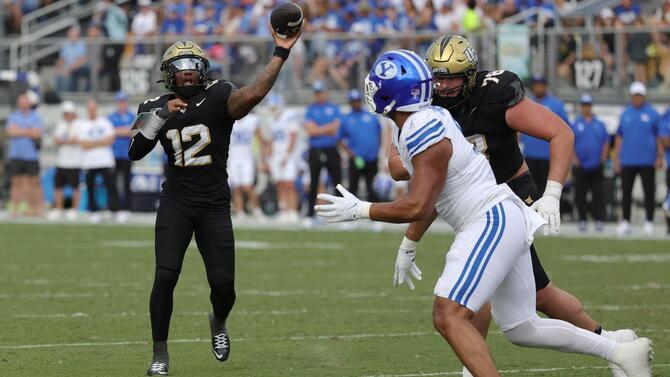
Jenkins didn't get much preseason preparation. He was signed as insurance, but his experience starting 33 games over three seasons at FIU has paid off.
"And we didn't honestly give him that many reps in fall camp. I'm being completely honest," Frost said. "I think he thought before (five years to play five seasons) passed (by the NCAA) this year, he could redshirt and go play again another year."
Jenkins is having the best season of his career, throwing 11 touchdowns against three interceptions while completing 67.9% of his throws.
The quarterback stepped up in a major way facing the Cougars, scoring four touchdowns in the double-overtime win. Victory wasn't easy, though, and the wild finish was made even harder to follow by a series of confusing, bizarre officiating calls:
- A personal foul on BYU after a blocked kick at the end of regulation, which ended the period with a 10-second run-off even though UCF's attempt came on third down.
- A roughing-the-kicker penalty against BYU's Kendal Wall in double overtime, turning what would have been a UCF field goal into a first-and-goal opportunity.
"There was about six things that we have to go to the rule book to check," UCF athletic director Terry Mohajir said Sunday, still working through the sequence with the Big 12 office.

Ghosts of 2017
The game was enough to stress anyone out with 11 ties or lead changes. In the closing moments, Frost's mind drifted back to his undefeated UCF Knights of 2017. On a fourth down, he thought of Tre Neal, whose interception sealed the AAC title in double overtime against Memphis. On a kickoff, he thought of Mike Hughes, whose touchdown return beat South Florida that season.
"The whole game just kind of had a feel like a couple of the biggest games in UCF history that I was lucky enough to be a part of," Frost said.
The parallels were everywhere for Frost.
Jenkins hit Josh Derry for a 25-yard touchdown on UCF's first overtime snap, a play Frost said he called on the first overtime play of a high-scoring Oregon-Arizona State game during his time as the Ducks' offensive coordinator.
After BYU quarterback Bear Bachmeier ended the game with three straight incomplete passes, UCF's Bounce House came unglued, and the student section poured onto the field. Mohajir found Frost on the field and hugged him. Frost, he said, asked whether the win really had to be that hard. Fitting, perhaps, that it was that hard after struggling so often in his career to win one-score games.
In the locker room, Frost talked about the bad habit of doing just enough in life to get by.
"You can go to class and do just enough to get a 2.5 grade point average, or you can try to be great," Frost said. "And as a father and a husband, you can do just enough, or you can sacrifice and give everything you got for your wife and your family. Football's the same way. If you do everything coaches ask you, that's just enough. I asked them to find a little more and find a way when they're in this situation to give a little more and make the plays -- and we did."
No time for a hangover
Now Frost wants that new feeling to stick around. Only six days separate the BYU win from a home game against Baylor.
"Really, the last and largest hurdle that this school needs to clear to me is now that we're in the big leagues, is to become relevant and consistently win at this level," Frost said. "That's the hardest hurdle because the teams you're chasing are established; they have resources."
"Upholding the standard," Jenkins said after beating BYU. "We've seen what we could do. Now it's about going out there and doing it every day, for real, and just proving it to ourselves that we are who we are."
Teams across college football have learned that success in this era can be short-lived. Seven teams this season have beaten a top-10 opponent, only to lose the next week. BYU, which upset then-No. 2 Notre Dame, became the seventh victim Saturday.
"Let me use that at my team meeting," Frost said Sunday after being told about the fleeting success.
"It's not just us. College football is happening. There is parity all over the place," BYU coach Kalani Sitake said after the game. "There's great parity in this conference, so you're just not going to show up and beat teams anymore because they're well coached, they have great athletes, and they have great cultures. I know Scott Frost really well, and I'm telling you he's a great coach. He feels comfortable here at UCF. They keep supporting that guy; they'll do so many good things."

Starting over every winter
Frost's first rebuild at UCF took two seasons, recruiting classes and patience. He inherited a 0-12 team, won six games in his first season and then sprinted to 13-0 in Year 2. His second stint at UCF starts over every winter with the transfer portal.
"That's why I say that once you have your team built, it goes back to just coaching," Frost said.
The process at UCF has also changed. Frost has the final say on personnel, and his assistants still recruit and evaluate, but a general manager and personnel staff handle the rest, using roster analytics to identify prospective players that Mohajir said UCF alumni helped design.
"In this day and age, I don't care how much roster money you have. If you don't evaluate and develop, you're just not going to win, period," Mohajir said. "You have to be careful spending the money."
The Knights also walk away from players who would swallow a position group's budget. "You got to have depth because in this day and age the other thing that you're seeing is a lot of injuries," Mohajir said.
It's not hard to find. Playoff contenders Ohio State and UCLA have turned to backup quarterbacks because of injuries. Oregon started the season as a preseason favorite to win the national title, then lost quarterback Dante Moore to a concussion, leading to a parade of changes (and losses).
For Ohio State, its top backup a year ago, Lincoln Kienholz, transferred to Louisville, where he ranks in the top 15 nationally in passer rating. Michigan went all-in financially on quarterback Bryce Underwood, but he was benched because of struggles. His backup a season ago was Davis Warren, who now has 11 touchdowns and only two interceptions at Stanford.
Building depth is a challenge in the era of constant player movement -- and of huge NIL contracts that strain resources and limit options.
"Now we have a sport where there's teams spending $45 million and other teams spending $15 (million)," Frost said. "And if that's not a competitive advantage, I don't know what is."
That's why identifying talent, and not overspending for it, is key. Jenkins is what UCF's approach looks like on the field when injuries strike. The Knights signed the FIU transfer for his experience, not his upside.
"Snaps matter, and that's part of our analytics. We're looking at players," Mohajir said.
UCF's roster budget is in the middle of the Big 12 pack at under $20 million, according to a preseason report from CBS Sports' Chris Hummer and John Talty. That number doesn't come close to the conference's big spenders like Texas Tech, which is close to $40 million this season, but it's competitive with most other programs.
The belief is that number could rise.

Digging for gold
UCF is still the new kid on the block chasing the older, bigger schools. The university didn't open until 1968, and it wasn't known as the University of Central Florida until 1978. Today it's home to 70,674 students, the second-highest total among public universities, and has more than 401,000 alumni. Its alumni base is among the fastest-growing in the country, increasing by roughly 65,000 every four years.
"I think we still need to find more ways to have more resources in the athletic department," Frost said. "We need to be more competitive with what we're spending on teams. I don't think that happens unless you have success and people come to the table and want to help more. You gotta try to build on what you've done."
Frost believes if UCF can "double down on investing in this program," the Knights "could be elite" in college football.
"We've climbed so far, so fast — and a lot of credit to the people that have gotten us here — but I want to put the foot on the pedal and build it."
In 2021, newly hired head coach Gus Malzahn described the UCF program as a "gold mine," citing its location and the major fundraising potential of a rapidly growing, young alumni base entering the corporate world. Frost shares that general optimism, but he's more pragmatic.
"It could be. You just don't know if you have to dig 10 feet or 40 feet to find the gold," he said. "We gotta keep swinging the pick and try to find it."