
Notre Dame, USC breakup is a shame -- but understandable through a College Football Playoff lens
We're losing yet another traditional rivalry in the name of the almighty expanded College Football Playoff

By
Tom Fornelli
•
4 min read
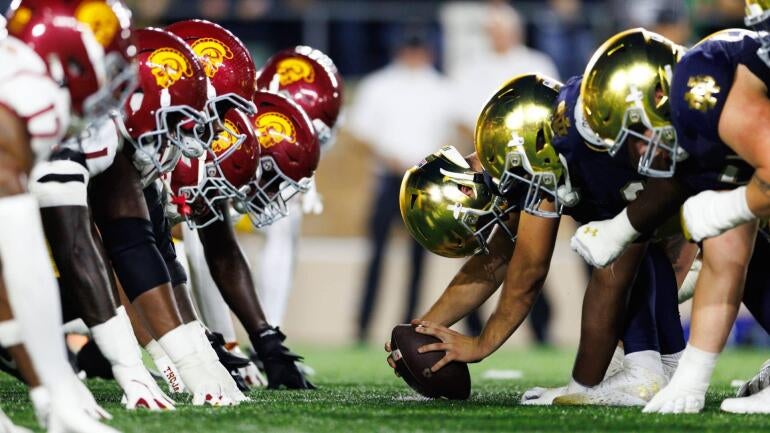
Notre Dame and USC are breaking up, and like most public uncouplings, this one is getting messy. Notre Dame wants everyone to know it did everything in its power to keep the relationship intact, but USC refused to change. USC says the same thing. Neither side believes it is at fault -- the other one is to blame.
The result is yet another cherished rivalry falling victim to the structural chaos engulfing college football. As I wrote after the first round of the College Football Playoff, when college football media went through an existential crisis over the inclusion of not one but two Group of Five teams, most of the sport's current "problems" are simply the aftershocks of conference realignment in pursuit of CFP dollars.
Everyone is at fault here.
USC has no one to blame but itself. It chased money by leaving the Pac-12 for the Big Ten, where television revenue was abundant and waiting to be claimed. The Trojans joined a league that plays the same number of conference games as the Pac-12 did, but now those games include Ohio State, Michigan, Penn State and, oh yeah, it still has to deal with Oregon. Those dollars came with a cost: a higher likelihood of losses. Suddenly, that annual nonconference game against Notre Dame didn't look nearly as appealing.
There are plenty of opportunities to enhance a résumé within Big Ten play. An additional game against Notre Dame feels far more like a chance to damage it. USC understands this, which is why it has motivation to step away from the rivalry.
Notre Dame can feel slighted if it wants, but that reaction often comes when privilege collides with inconvenience. Notre Dame put itself in this position by remaining independent -- a choice it has every right to make. Its brand is strong enough to survive turbulent waters without conference protection. And if the primary goal across the sport is access to playoff revenue, there is little incentive for Notre Dame to join a league. The CFP has bent over backward to accommodate the Irish, most recently through a memorandum of understanding that effectively guarantees Notre Dame a playoff berth as long as it finishes in the top 12 of the CFP Rankings.
Of course, Notre Dame also recognizes the benefits of conference affiliation, which is why it maintains its relationship with the ACC. But independence comes with consequences. When you decide you want to fend for yourself, nobody is required to help you.
Which is why that while I lament the loss of another rivalry and continue to cast an angry, skeptical eye at the people running the sport, I can't help but understand USC's side of this dispute.
Frankly, I don't understand why any program that considers itself a playoff contender would willingly schedule Notre Dame from this point on. It's a situation that carries more risk than reward. Right now, the Power Four conferences are all moving to nine-game conference schedules -- well, OK, the ACC is only requiring it for some of its schools, but nonsensical decisions are just part of their overall brand -- while three of the four (ACC, Big 12 and SEC) are requiring their teams to schedule at least one P4 nonconference game. We can argue about the depth of conferences and who has the tougher schedules all we want, but the truth is nobody in the Power Four will have an "easy" schedule with those requirements. Adding Notre Dame at this point only makes things more difficult.
The only requirement facing Notre Dame is that it plays 12 games and finishes in the top 12. It doesn't matter if it plays four Power Four opponents or 12. Which, to Notre Dame's credit, it has never been shy about playing Power Four teams. It needs to. Those television contracts wouldn't be as fruitful if they only played the service academies.
But for USC, Texas, Alabama or Ohio State, the calculus is different. Beating Notre Dame would significantly enhance a résumé, but only if everything else goes right. A loss to the Irish could be fatal. Meanwhile, if Notre Dame loses to one of those programs, it often remains firmly in the at-large conversation. This season was a clear example: Notre Dame stayed in the mix largely because its two losses were close defeats against Texas A&M and Miami. For much of the year, it even appeared that the CFP might include Notre Dame over the Miami team that had beaten it.
If you're the athletic director or coach at a Power Four school who watched that dog-and-pony show from the selection committee all year, why the hell would you want to schedule the Irish knowing what you know now?
So, yes, the end of the rivalry between USC and Notre Dame sucks. It also makes all the sense in the world when you look at it from the cracked perspective of where college football currently resides.