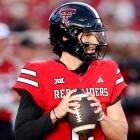


The NCAA has seen the backlash against the Brendan Sorsby eligibility ruling and is using it as an opportunity to push for passage of the Protect College Sports Act. On Friday, the NCAA sent a memo to all D-I conference commissioners claiming that the bill would override Sorsby's legal victory, Yahoo Sports reported.
The bill, introduced by Sen. Ted Cruz, R-Texas, and Sen. Maria Cantwell, D-Washington, aims to address a wide range of issues currently plaguing college athletics. One of the most notable aspects of the bill is that it would, in theory, allow the NCAA to enforce its own rules without constant litigation.
In a memo sent to the commissioners, the NCAA said the Protect College Sports Act would "resolve" the Sorsby saga if it passes and takes effect before the Texas Tech quarterback's legal battle reaches its conclusion.

The NCAA also pushed for that particular provision to remain in the bill with a markup looming next week.
"To answer many questions we received recently: yes, the bill would resolve the issue raised in the Sorsby case," the memo read. "There, Brendan Sorsby — Texas Tech's QB who admitted to placing thousands of sports bets, including wagers on his own team — successfully sued the NCAA in state court to overturn his NCAA-mandated ineligibility. If the Protect College Sports Act becomes law before the case is fully resolved, it would override Sorsby's legal challenge and allow the NCAA to maintain its eligibility restriction."
In a memo to DI conference commissioners sent today, the NCAA confirms that the Protect College Sports Act would not only prevent the Brendan Sorsby situation but, if the Act becomes law before the case resolves, it stands to "override Sorsby’s legal challenge." pic.twitter.com/6yhxc0kaBe
— Ross Dellenger (@RossDellenger) June 12, 2026
The NCAA argues that the Protect College Sports Act would allow the organization to enforce its own gambling-related eligibility rules -- even if disputes involving contract or personal injury claims fall into more of a gray area.
"We believe the bill gives the NCAA clear authority to restrict a student-athlete's eligibility based on improper gambling activity," the NCAA said. "Sorsby challenged his ineligibility under state contract law, arguing that the NCAA broke a promise or agreement. While the bill generally does not override state-level contract or personal injury claims, it does override any state law claim that directly conflicts with what the bill allows. Because the bill expressly permits the NCAA to enforce gambling-related eligibility issues, a state court cannot simultaneously order the NCAA to reverse that enforcement."
This claim by the NCAA also calls into question the eligibility of other players who have received injunctions -- such as Ole Miss quarterback Trinidad Chambliss -- while their legal cases are pending. Unlike Sorsby, however, Chambliss' argument was based on an illness he suffered earlier in his college career and was not related to gambling violations.
How we got here
On Monday, a Lubbock, Texas, judge shocked college football when he granted Sorsby an injunction against the NCAA that will allow him to play in the 2026 season despite admitting to gambling, including bets placed on his own team while at Indiana. Sorsby was ordered to sit out the first two games of the season against Abilene Christian and Oregon State, but he would be eligible to return after that.
In the wake of that decision, there has been a noisy outcry from the rest of the country. The athletic directors at Nebraska and Georgia have threatened to boycott games against Texas Tech in the future; the Big Ten has discussed a moratorium on scheduling Texas Tech in all sports; and the Big 12 held a conference call with all its athletic directors on Tuesday.
Meanwhile, Texas Tech athletic director Kirby Hocutt defended Sorsby and the program's handling of the situation while acknowledging his peers' frustration. If the Big 12 sanctions the Red Raiders, the school is preparing to take legal action.
Amid the flurry of reactions to the week's events, the NCAA has put the Sorsby case front and center in its advocacy for the Protect College Sports Act. Even if the NCAA gains more supporters behind the bill, there's no guarantee it will pass at all, much less before Sorsby's legal battle reaches a resolution.